Madison Square Park, NYC
5/28/2011
I was in NYC for a friend’s wedding. Big plans for the city: food, subway rides, Central Park, the Upper East Side, and chalk.
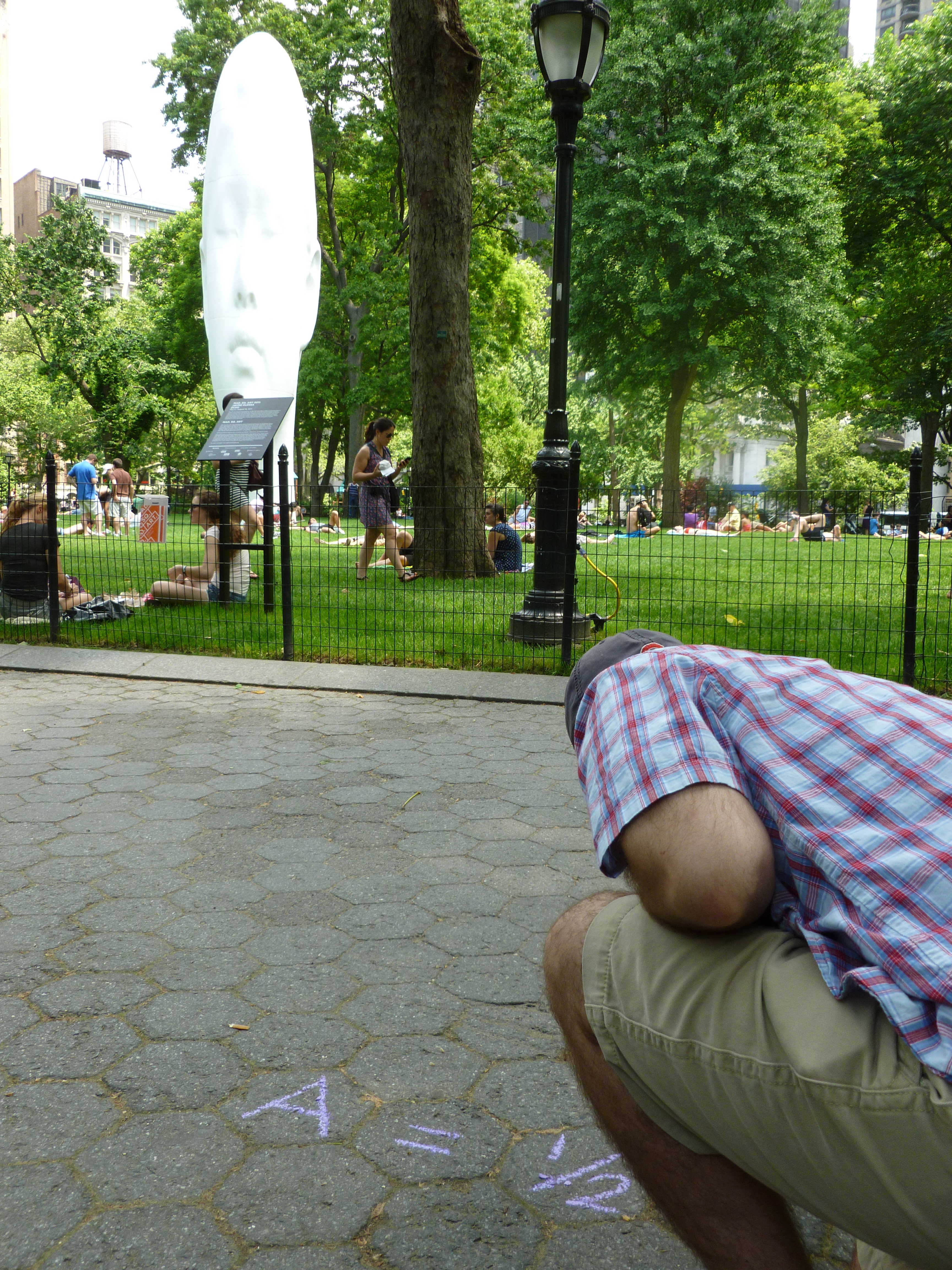
On Saturday morning, I hopped a train to midtown and headed into Madison Square Park. The park had a large sculpture from Jaume Plensa. It stopped me in my tracks.
Then, I looked down.
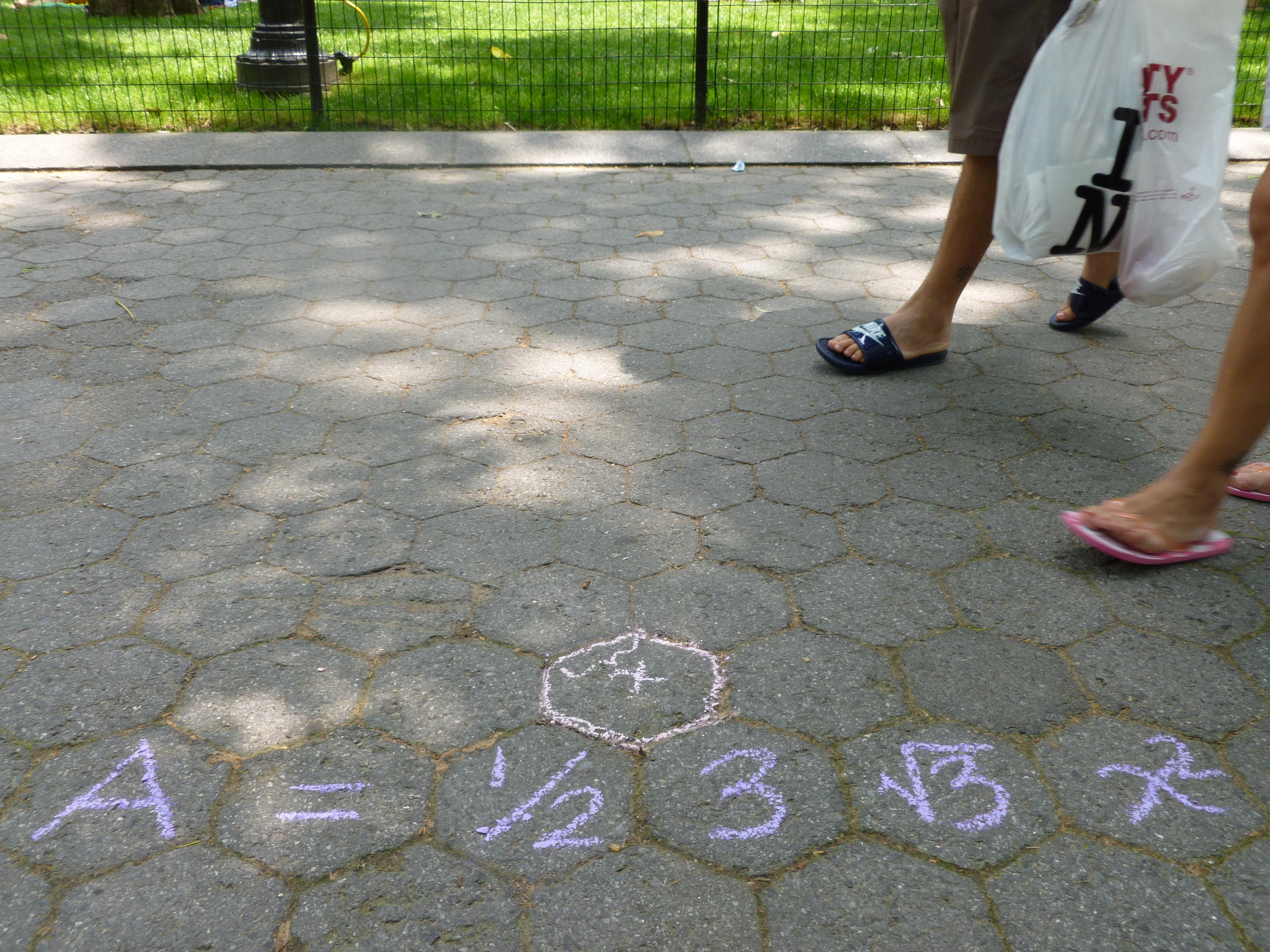
I am always on the lookout for pavement that is divided nicely into squares. In the park, and all over Manhattan, the pavement is made of great hexagonal stones. Hexagons are a great choice as it is possible to tessellate a surface with hexagons alone.
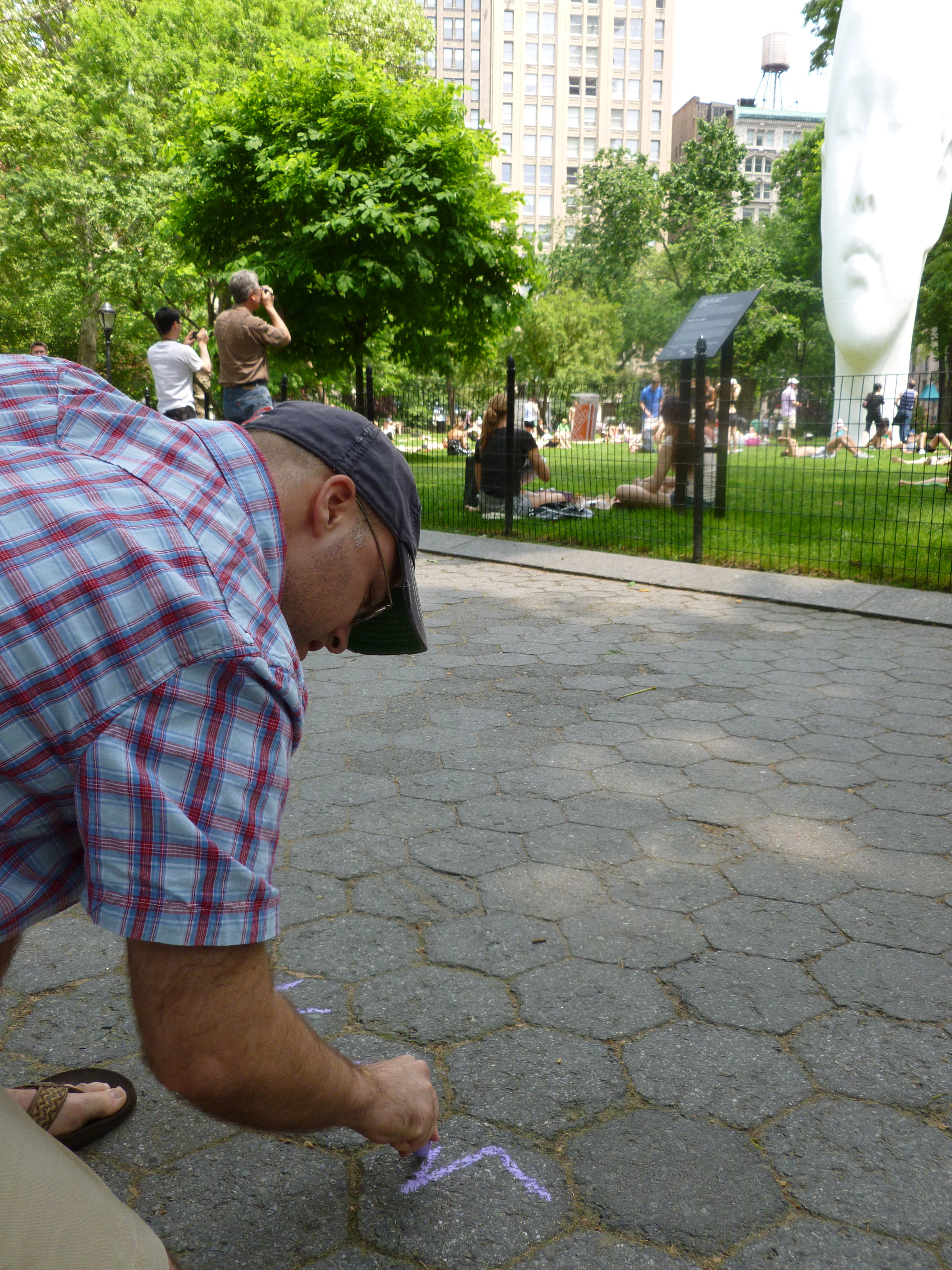
I decided to chalk out the formula for finding the area of a regular hexagon.

I wanted to use the hexagonal tiles as a guide for the writing, so I treated the formula a little differently.
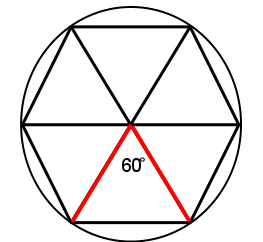
Let’s talk about why this formula works. What we’ll do is divide up the hexagon into six triangles, find the area of one of those triangles and add them up.
A regular hexagon is a six-sided, two-dimensional figure where all six sides are the same length. If you divide this sort of hexagon into triangles, you are also dividing the 360° of a circumscribed circle by six, giving an angle of 60°. Also, note the two red line segments are of equal length since they are radii of the circle.

There is a fun rule about isosceles triangles—their base angles are congruent. So, those two equal angles share the left over 120° of the triangle (remember the sum of the angles of a triangle in Euclidean space is 180°), making them both 60°. All three angles are 60°. Our little triangle is not just isosceles; it is equilateral!
To find the area of our triangle and its 5 identical siblings, we need to multiply: one-half the base times the height. Let’s call the base x and the height h. Turns out h can be found in terms of x using what we know about the special 30-60-90 triangle or using the Pythagorean theorem.
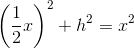
Use algebra to solve for h.

Our triangle’s area, AΔ, is
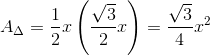
Our hexagon is 6 of these.
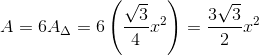
Just like our geometry teachers said it would be.
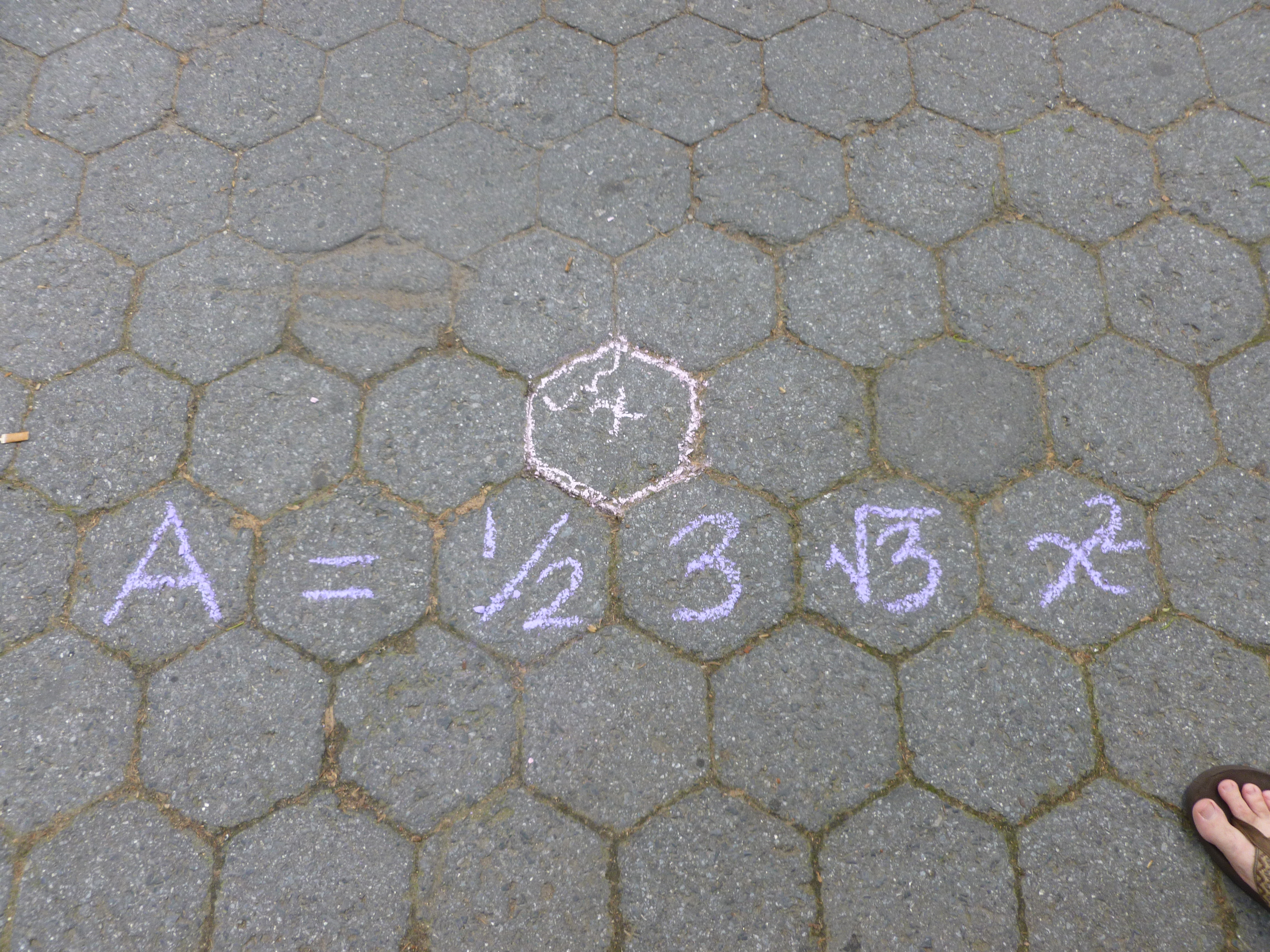
The photographer for this post was Laurie Zimmerman Mann. Check out her site: www.lzmstudio.com.
 Footpath Math: Chalk it up to a math geek
Do you give extra credit to kids who go out and do footpath math?
(note, I am told that it should be Maths, not Math – silly British English)
Laurie and I were just talking about me posting formulas and asking people to send in photos of their work. It is an idea.
I love saying “maths”. It seems to perturb my students, though.