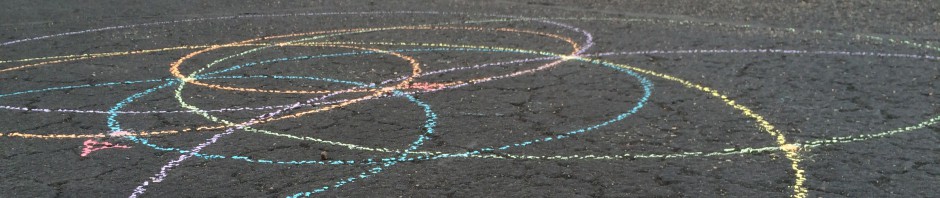
Ecuador
Guest chalker = Julie
Friends of mine, Melissa, Orion, and Julie, traveled to Ecuador this summer. Melissa and her son, Orion, went south in June. In July, Julie was heading down to meet up with Melissa and Orion. She mentioned going to the Equator. First, rather dimly, I said something like, “The Equator runs through Ecuador? … [my mind started to work it out, my mouth caught up] … Oh … Ecuador … Equator.” Julie politely confirmed. Then, I said, “You are going to be at the EQUATOR? I have to give you math to do there.” It is the Equator after all.
I decided to set Julie up with the formula for distance along the Equator.
Before diving into what the equation means, let’s talk about what an equator is. The Equator, at least theoretically, is a great circle. I say “theoretically” because our Earth is roundish. That is, while we clearly don’t live on a cube, the Earth isn’t quite spherical. Plus, the Equator runs up and down mountain ranges. Not quite a perfect circle.
The Latin root of the word “equator” is “equi”, meaning, you guessed it, “equal”. But, when we are talking about the line belting the earth, what equals what? If you are on the Equator, from what two places are you equidistant? Let’s come back to that in a bit.
According to the Wikipedia article, Equator, “An equator is the intersection of a sphere’s surface with the plane perpendicular to the sphere’s axis of rotation and containing the sphere’s center of mass.”1
Let’s try to get “equator” in plainer English.
If you spin a sphere (imagine a basketball), there are two spots, on the sphere, that are not spinning. One of them is on the tip of your finger. These non-moving points are the poles. On the Earth, these points are, of course, the North and South Pole. An equator is the circle you get when you cut a sphere in half keeping your knife equally distant from both poles, right through the middle.
You get a great circle anytime you cut a sphere in half, even if you cut right through the poles. Great circles are the biggest circles on a sphere. While they are the biggest, the shortest distance between two points on a sphere is along the great circle connecting the points. This is a lot like how the shortest distance between two points on a flat surface is a line. In fact, mathematicians consider great circles to be the “lines” of the spherical world. To have the shortest flight from Chicago to Munich you want your pilot to follow a great circle. This is why you would find yourself flying over Canada towards Greenland.2
I mentioned the Equator is a great circle. It is the only line of latitude (east-west, “laddertude” if you will) that is a great circle. Lines of latitude are noted by the angular distance from the Equator, which sits at 0° latitude. The lines of longitude, on the other hand, are all great circles. And, they all go through both the North and South Pole.3
The lines of longitude run north and south and can be used to keep track of how far you are traveling east or west. A line of longitude is specified by the angle between it and the Prime Meridian cutting through Greenwich (not “the village”, the city in England). Angles are used because the distance between two lines of longitude varies as you go north or south. Standing at the North Pole, the lines of longitude are real close together. But, traveling 30°, or π/6 radians4, around the earth along the Equator means traveling a distance about 3340 km, or 2075 miles.
The lines of longitude were very difficult to determine as our ability to keep time was terrible until the 18th century. This is a big deal as some brave souls were crossing the Atlantic as early as the late 15th century. That means the sea-faring folk dealt with at least 200 years without certainty on how far west they were getting. No wonder Columbus thought he made it to India. There is a great book called, Longitude: The True Story of a Lone Genius Who Solved the Greatest Scientific Problem of His Time, by Dava Sobel. It is excellent!
Back to great circles and distance. So far, we know what a great circle is. We know what longitude and latitude are, and we know to note them in angles.
In general, the distance from one point to another on a sphere is calculated using the latitude and longitude of the locations. The Great Circle article in Wolfram’s MathWorld says:
To find the great circle (geodesic) distance between two points located at latitude δ and longitude λ of (δ1, λ1) and (δ2, λ2) on a sphere of radius a,
![d=a\cos^{-1}[\cos\delta_1\cos\delta_2\cos\left(\lambda_1-\lambda_2\right)+\sin\delta_1\sin\delta_2].](https://footpathmath.com/wp-content/uploads/2011/07/codecogseqn.gif)
The radius of the earth is about 6378 kilometers. So, our a is 6378. Since, Julie was on (or close enough) to the Equator, the latitudes, δ1 and δ2 are both zero. Substitute the values of cosine and sine at 0, cos(0) = 1 and sin(0) = 0, to get the equation for distance along the Equator.
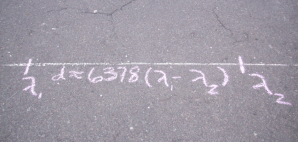
![d \approx 6378\cos^{-1}[\cos\left(\lambda_1-\lambda_2\right)]\;\text{km}](https://footpathmath.com/wp-content/uploads/2011/07/codecogseqn-2.gif)
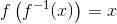
A great thing about composing a function and its inverse is they knock each other out.5

Therefore, the cosines in the equation for d get knocked out.

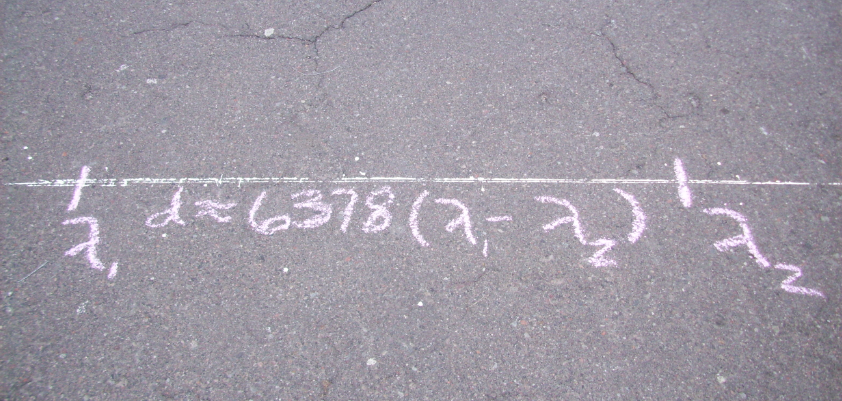
That is what Julie put on the pavement, excuse me, the footpath, near the equator. Since the equator is 0°, or 0 radians6, latitude, we can get to this result even more simply.
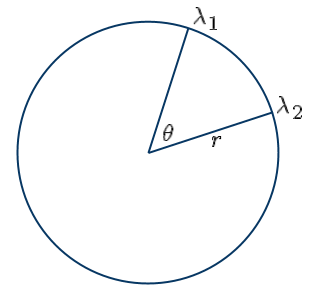 The circumference of a circle, C, is 2πr, where r is the radius of the circle. The length of the arc from angle λ2 to λ1, our d, can be found using the fact a sector of a circle is a fraction of the circumference. What fraction? If we are measuring the angles in radians, then the sector is θ/2π of the whole circle. All there is to do is multiply.

That is, d = rθ. Again, r is the radius of the earth, about 6378 kilometers, and θ = λ1 – λ2. So, we are right back where we were before.


1.↑ This may seem pedantic. I wouldn’t have used the phrase “sphere’s surface”. Even though most folk think of a ball when they see the word “sphere,” a sphere is a surface. That is, a sphere is only the set of points equidistant from a given point, called the center. If we consider a perfectly round and perfectly smooth ball of wood, the “insides” together with the surface form a ball, not a sphere. The sphere is just the surface of the ball.
2.↑ Have fun with the Great Circle Mapper. The link is set up for a flight from Austin (AUS) to Munich’s Franz Josef Strauss airport (MUC).
3.↑ I know what you are thinking, and you are right. Between the two points of the North and South Pole, there are infinitely many routes providing the shortest distance. This never happens in flat, Euclidean space. Two points, one line. You know the drill. This is not the case on a sphere when the poles are involved. Riemann, a profound force for good in 19th century mathematics, worked out this polar infinite anomaly (singularity?) in his 1854 Habilitation lecture.
By the way, I am guessing someone has written a paper called “The Physics of Santa Claus” explaining how he takes advantage of this infinitude of routes from one pole to the other to make his single-night of near omnipresence possible.
4.↑ Angles can be measured in degrees or radians. There are 360° in a full circle. A circle with a radius of 1 unit has a circumference of 2π. (C = 2πr.) A 360° angle is 2π radians, 180° is 1π, 90 is π/2, and so on.
5.↑ f-1 references the inverse of a function. “Composing functions” is what we call the process of doing one function and then the next. For example, if f doubles its input, i.e. f(x) = 2x, then f-1 would halve its input. If you take a number like 6, double it and then halve the result, you get 6 again. If you halve it first and then double what you got, you get 6 back. In general, given certain conditions, applying a function to the output of its inverse returns the original input.
 Footpath Math: Chalk it up to a math geek