Austin, TX
2013/03/09
 My esteemed colleague, Kelley, loves space, outer space in particular along with stars, NASA, telescopes0, and all space exploring accouterments. About a month ago, she was telling me about a special map, a pulsar map. A map like this was sent into outer space on the Voyager as a message to potential neighbors.1 It sort of says, “Let me tell you some things about where I am from… Oh, and if you would like, you can find us… It is sort of around the corner from… Go to that big bright ball of burning gas… Oh, you have one, too? Hmm…” That is just it. How do you tell an alien species where to find you?
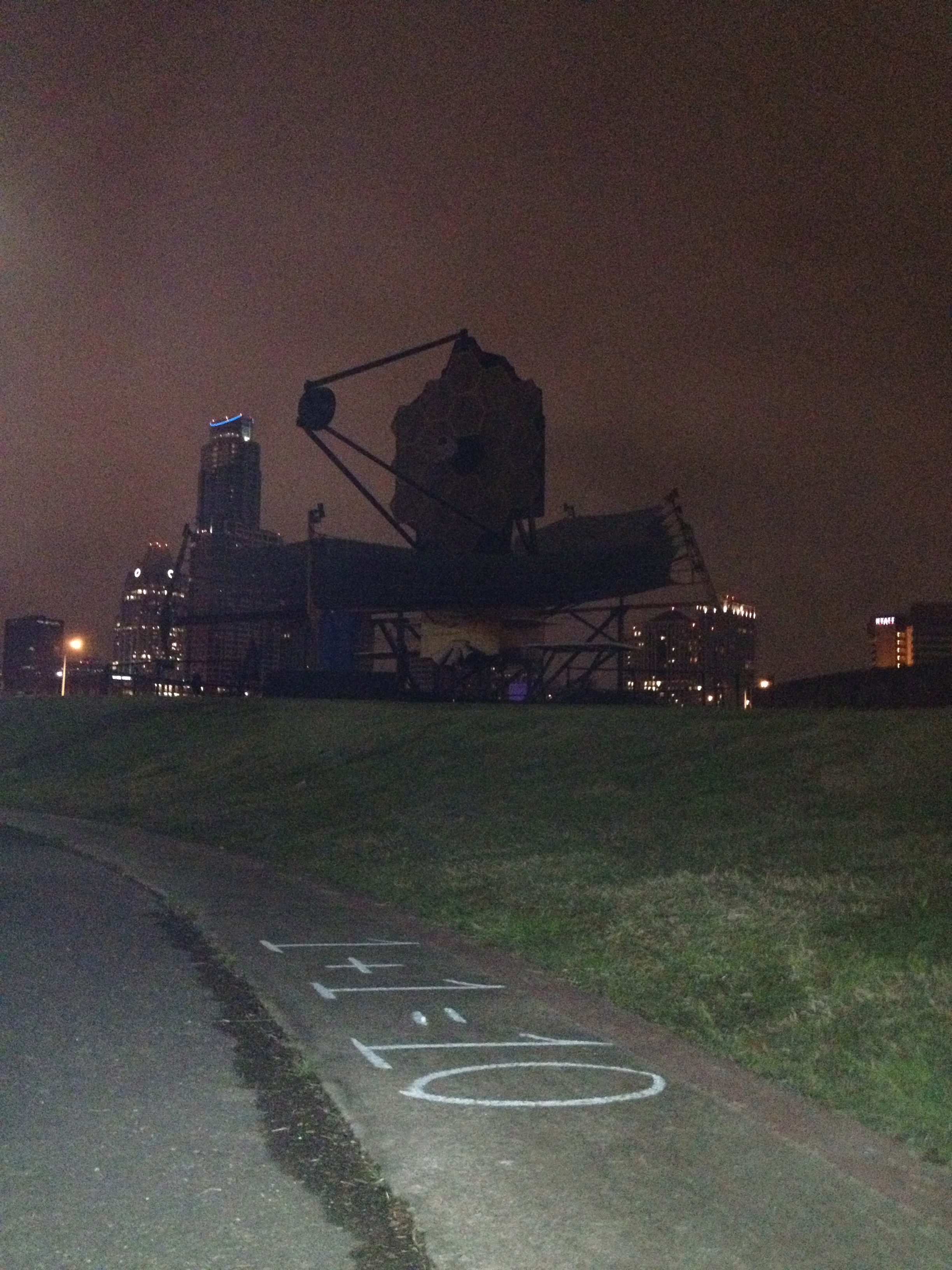 You might try telling them where you are relative to some stars, maybe some massive ones. Stars they might see, too. And, pick some stars you see spinning like mad from your point of view. Yes, good idea. Then, make a map indicating how you see those pulsars from your home world. Now, how should you communicate information about those pulsars? Roman numerals on a rock? You wouldn’t be the first.
You should use binary. Yes, the world of 0s and 1s you may have encountered in your leisurely reading on computer science, binary. It is the simple and elegant system of true or false, on or off, 1 or 0. It works great for lights, toasters, high school tests, silicon chips, and interstellar communication.
Why use binary? Good question. (I will forgo an explanation of electrical circuits and the pedagogipolitical debate about standardized testing to focus on interstellar communication.)
Humans have a 10 finger design. 10 fingers = 10 digits. We usually count our fingers starting from 1 and ending at 10, but that use of 10 requires the digit 1 and the special digit 0. Let’s use the zero as a building block and dub our fingers as 0, 1, 2, 3, 4, 5, 6, 7, 8, and 9. Those are all of the digital building blocks of our early, earthly arithmetic. It’s all base-10.2 Counting, multiplication tables, long division, scientific notation, and more are all base-10.
10 fingers. 10 toes. 10 digits. Base-10.
Will all intelligent lifeforms in the universe have 10 fingers? Will they even have fingers at all? In studying other life on our home planet Earth, we have discovered an important correlate to intelligence: the opposable thumb. Ever try to open a door knob or hold a spoon without using your thumb? Possible? Yes. Easy? No. What does the thumb oppose? Another finger. Do you see where this is heading?
From what I can tell, we are counting on intelligent life having at least 2 finger-like appendages with which to hold tools, count, flip switches, and what not.3 Even if they have more flipping appendages, like us, they will also likely be able to handle base-2, also known as binary.
So, how does base-2 work? A lot like base-10, except it only uses 0 and 1. With ten on base, if you have 9 items and add 1 you note the number of items as 9 + 1 = 10. And, 10 is just 1 ten and 0 ones. 10, with a 1 in the tens place and a 0 in the ones place.
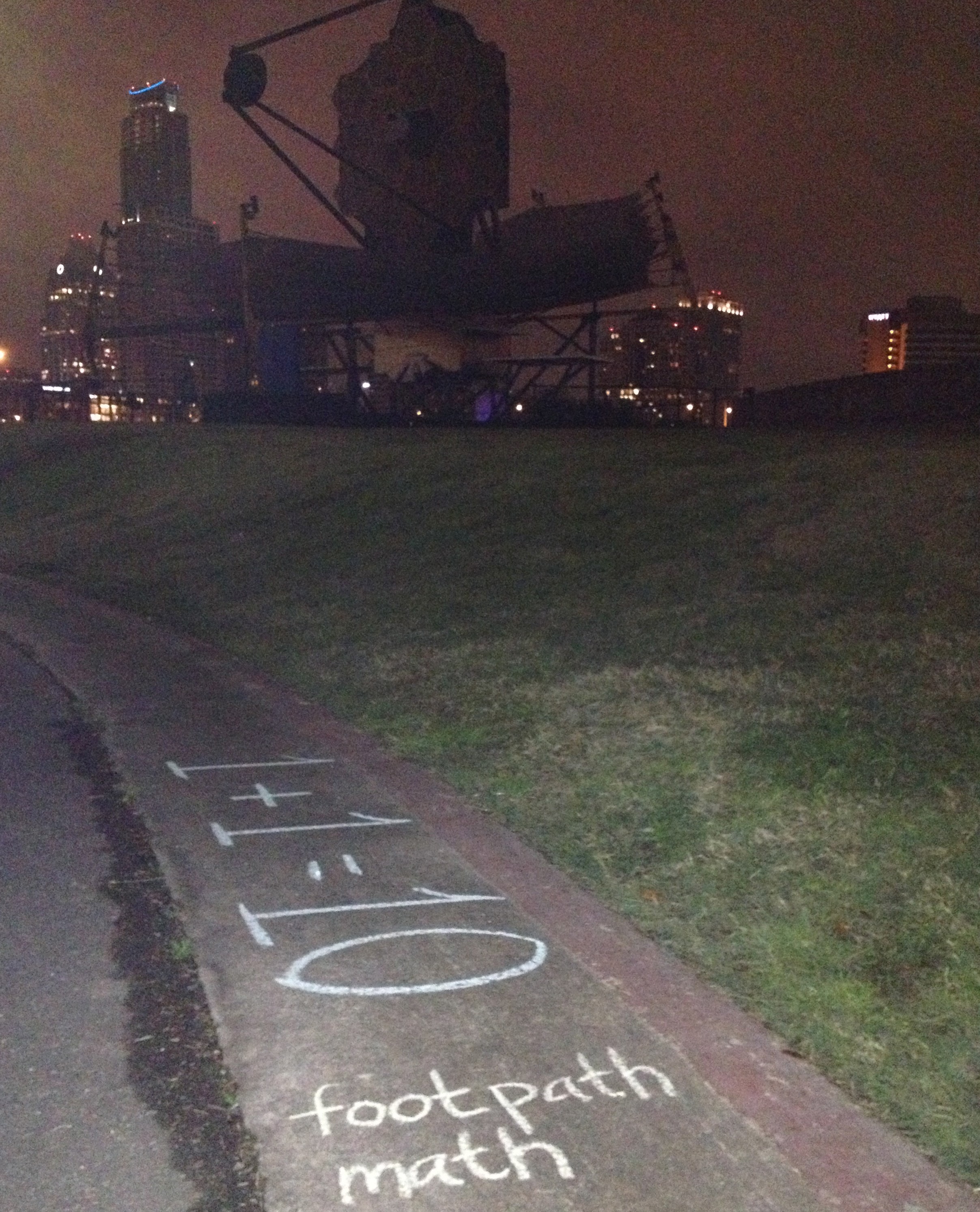
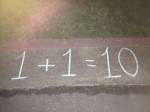
With base-2, when you have 1 item and add another, you note that as 10 also. This time 10 = 1 two and 0 ones. (Yes, 1 + 1 = 10 in base-2.) If you are still on track, you might see how 4 is equivalent to 100 in base-2. Do you?4 If that was fun, try to write 5, 6, 7 and 8 in binary.101
That special pulsar map communicates information about pulsars using binary. The numbers are big, too. For more information on what is communicated and how, spend some time poking around:
- http://voyager.jpl.nasa.gov/spacecraft/goldenrec.html
- http://goldenrecord.org
- http://www.pulsarmap.com
Or, ask your local astronomy buff about it. I did. Thanks, Kelley.
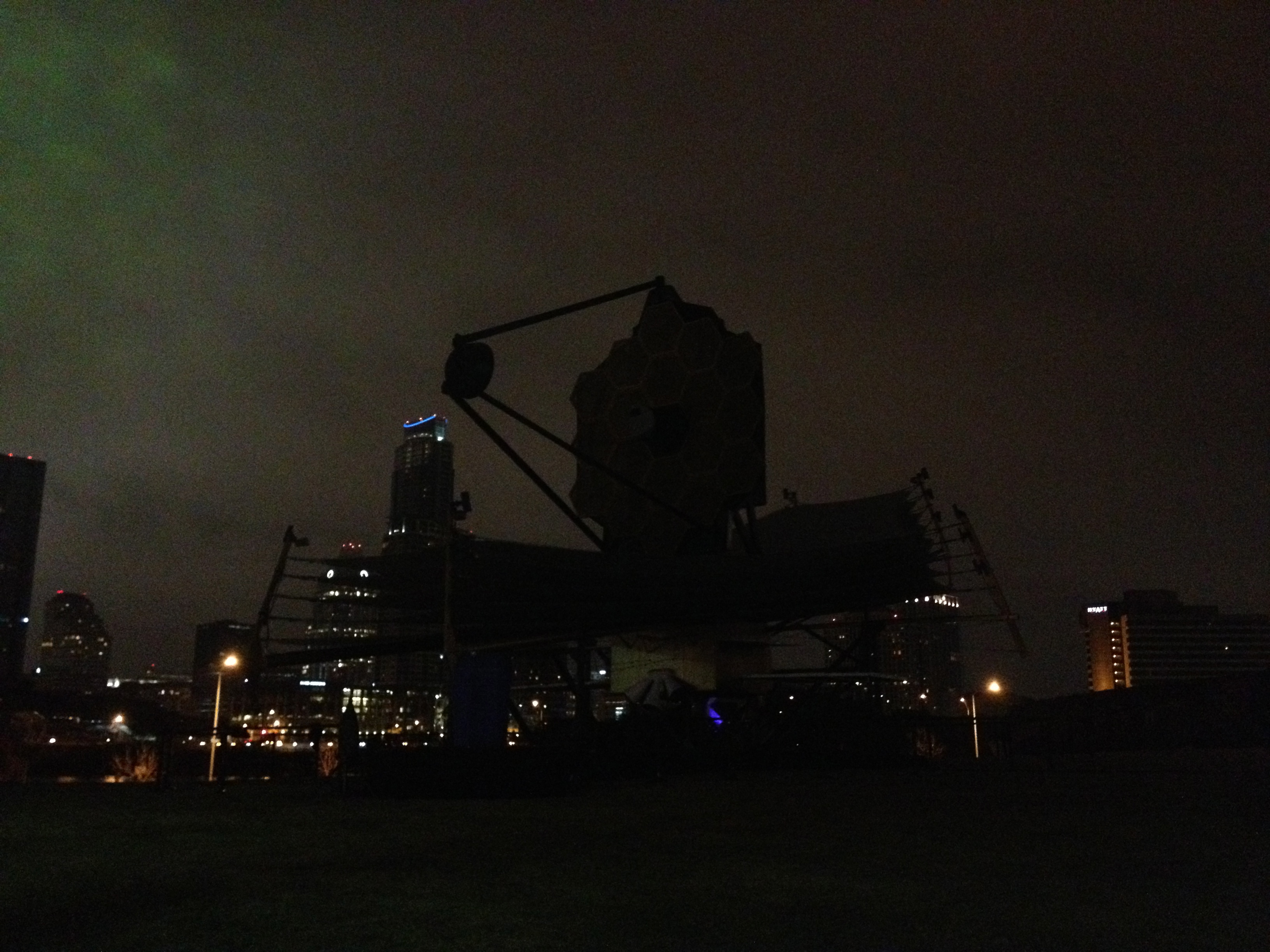 0. This post was inspired by the appearance of a scale-model of the James Webb Space Telescope in Austin over the weekend of 8 March 2013, coinciding with SXSW.
1. A pulsar map appears on the Golden Record: “The Voyager message is carried by a phonograph record-a 12-inch gold-plated copper disk containing sounds and images selected to portray the diversity of life and culture on Earth.” If you thought the NASA page was cool, play the record yourself here.
2. Clearly, it isn’t all base-10. Those computers use base-2 (binary), base-16 (affectionately called “hex,” short for hexadecimal = “hex” + “dec” = 16), and a myriad of prime bases when performing the calculations used in internet encryption.
3. I am no expert on the search for intelligent life. Check out the SETI Institute’s website for expert information.
4. Each place in a number in base-10 represents a power of 10. Ones, tens, hundreds, thousands, and so on are 1 = 100, 10 = 101, 100 = 102, 1000 = 103 and so on. In base-2, just replace the 10 with a 2. The ones place is still the ones place, 20 = 1. Then, you have the twos place, the fours place and so on. 2 = 21 and 4 = 22. So, for 4, put a 0 in the ones place, a 0 in the twos place, and a 1 in the fours place, and voila you have 100.
5 = 101(base-2), 6 = 110(base-2), 7 = 111(base-2), and 8 = 1000(base-2).
 Footpath Math: Chalk it up to a math geek
Eric, you are a “hoot”. I read the whole thing as I always do and of course, got lost along the way…
It happens. I get lost sometimes, too. I hope you got a sense of the telescope. It was very cool!
A Calculus teacher in Michigan really enjoys your well written and thought out posts. I hope I get a chance to see you on one of my trips to Austin !
Thank you, Fred! I would love to see you and catch up.
My favorite t-shirt says “there are 10 kinds of people in the world, those who understand binary and those who don’t”.
1! 😉
I totally echo your Dad’s sentiment. Glad you’re blogging again!
It’s good to be back!