
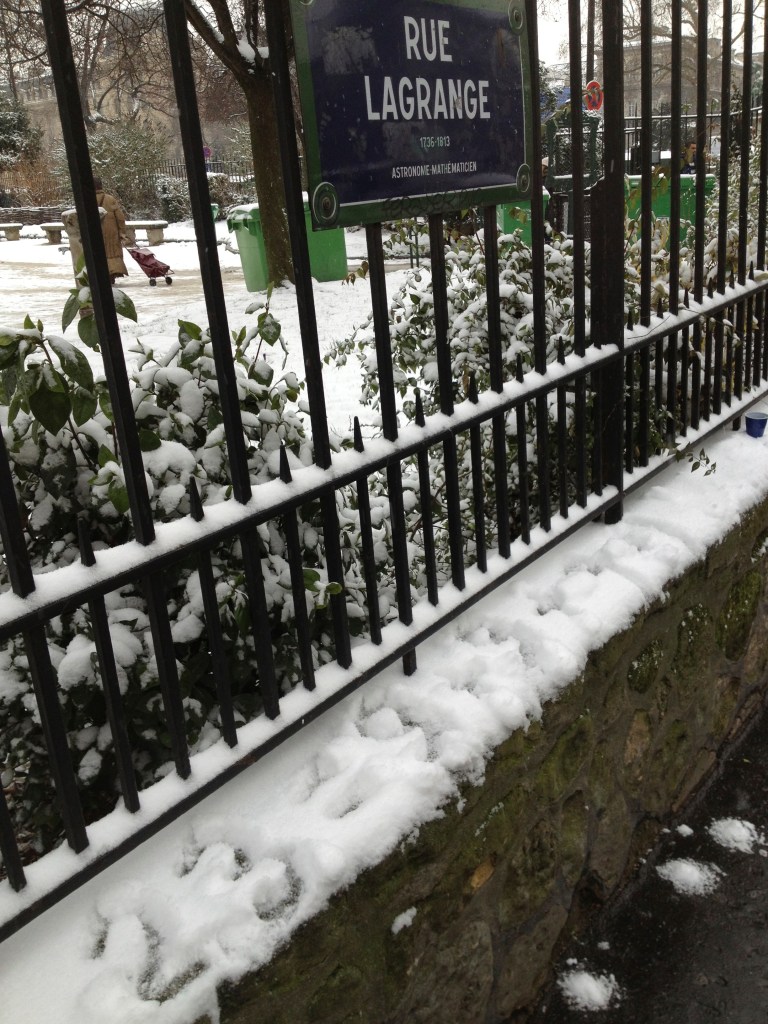
Rue Lagrange
Paris, France
2013/03/12

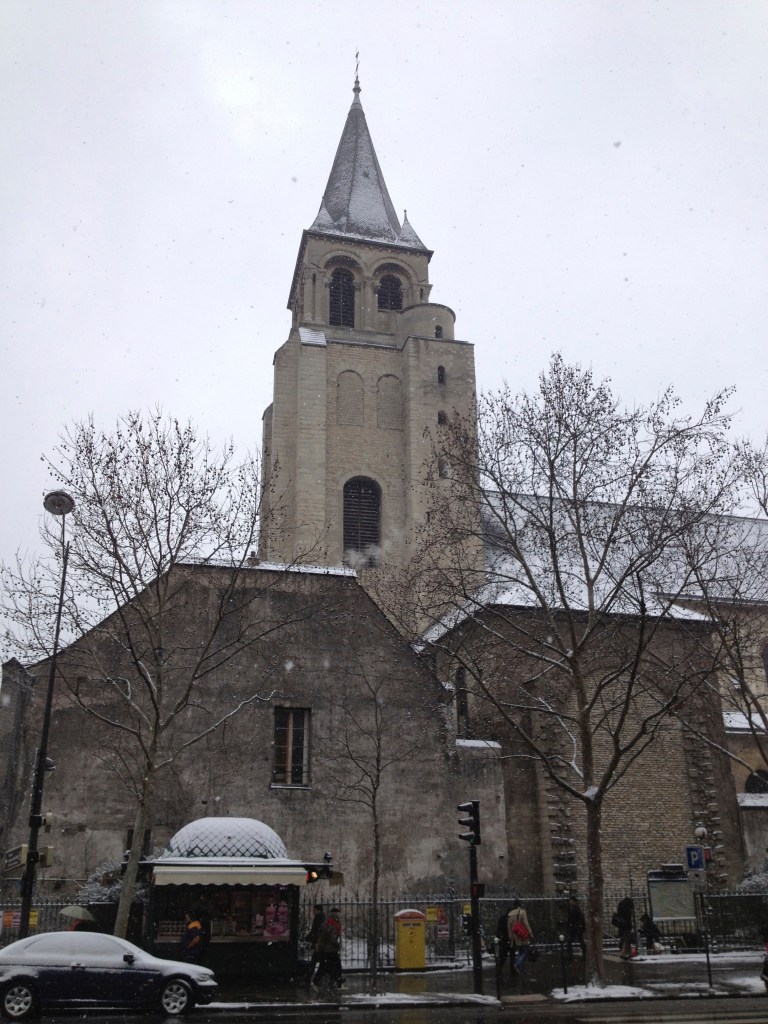
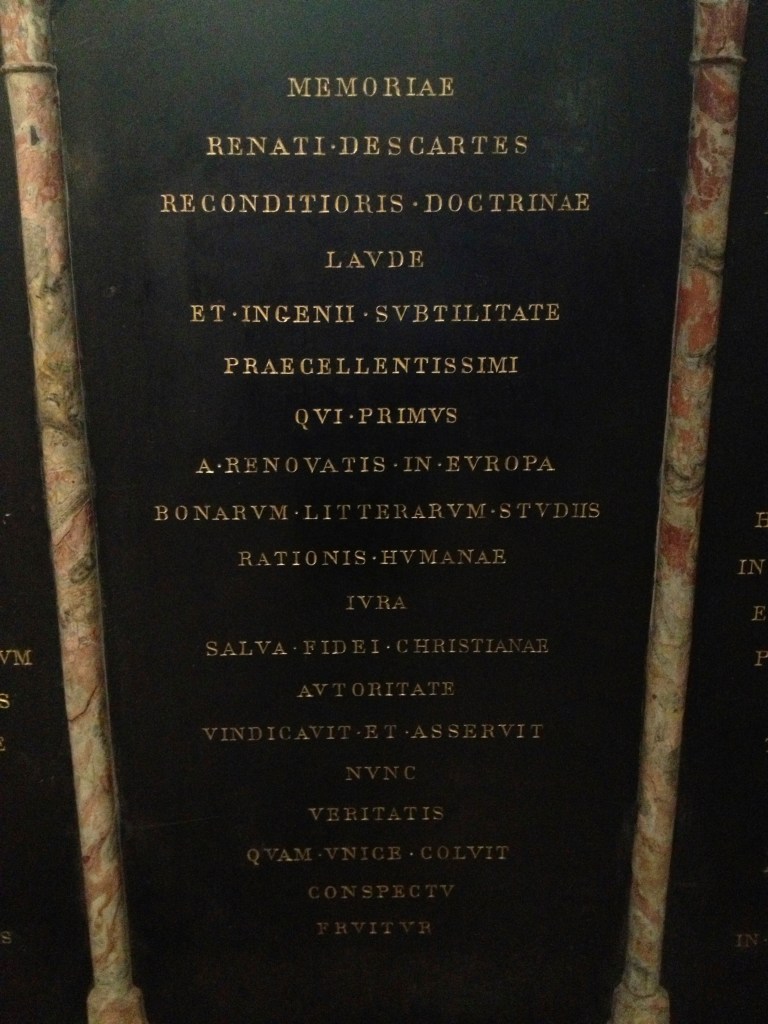
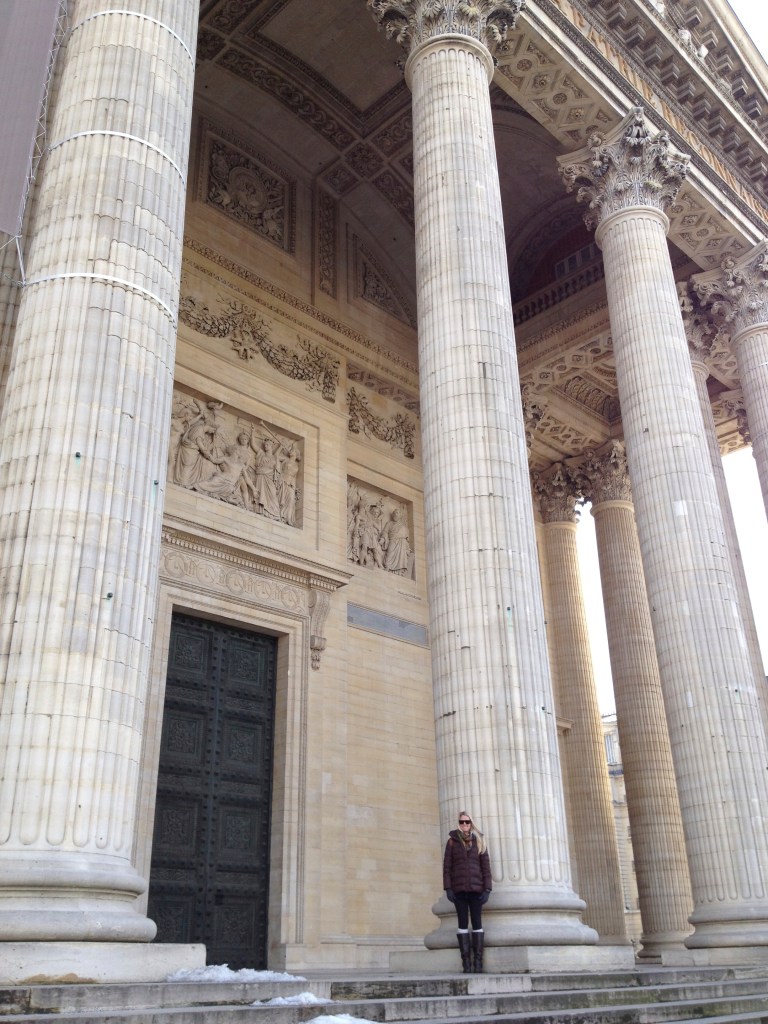
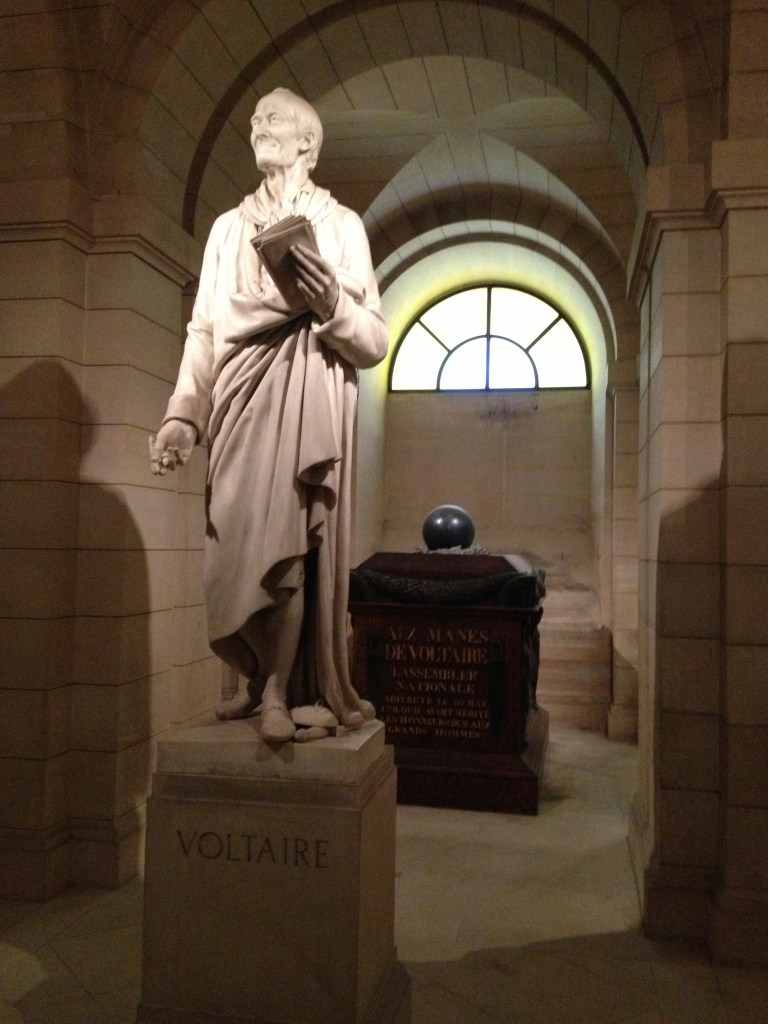
On the flight to Paris, while I should have been sleeping, I was thinking about math. (Not entirely unusual apart from being some 30,000 feet above the Atlantic.) France is kind of a big deal for math history. One of the Paris’ oldest churches, St-Germain-des-Prés, entombs a portion of Descartes.0 The Panthéon in Paris serves as the final resting place for great thinkers like Rousseau, Voltaire, and the mathematician Lagrange. For days leading up to the trip, I had a scrap of paper in my pocket with a list of famous mathematicians who lived and worked in Paris from Oresme to Cauchy to Mandelbrot.

On the flight, I was browsing the Minds of Modern Mathematics app1, and I rediscovered Joseph-Louis Lagrange. Somehow, he wasn’t on my little, pocketed list. He should have been. Lagrange was one of the greats. Powerful mathematicians and monarchs alike wanted Lagrange’s powers in their employ. His work advanced the fields of mathematics and astronomy by leaps and bounds.
At the age of 18, Lagrange published his first mathematics paper.2 Lagrange worked in Turin, his birthplace. Euler, also one of the greatest, attempted to recruit Lagrange to join him in Berlin. It wasn’t until 1766, upon the invitation of Frederick the Great, King of Prussia, did Lagrange go to Berlin. He was there until 1787 after Frederick’s passing when Louis XVI in turn lured him to the Louvre.3 Later, Lagrange was the first professor at the Ecole Polytechnique, home to many history-making mathematicians like Cauchy, Fourier, Poincare, and others.
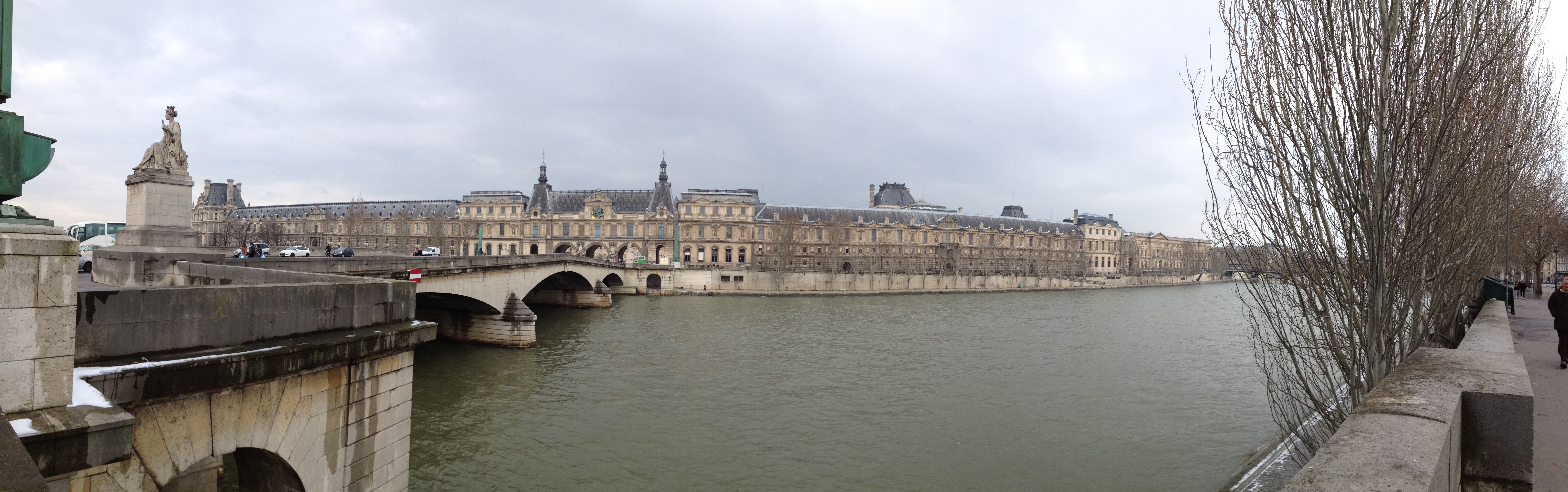
Lagrange lived from 1736 to 1813. For anyone who has studied a bit of French history, these years may spark your attention. Mathematicians inspire me in general, those who lived and worked during turbulent times even more so. Lagrange was in Paris during the first revolution, the Reign of Terror, the barricades, and Napoleon’s rise to power. Unlike our friend Fourier, Lagrange was never imprisoned. Instead, Lagrange was working and being promoted.
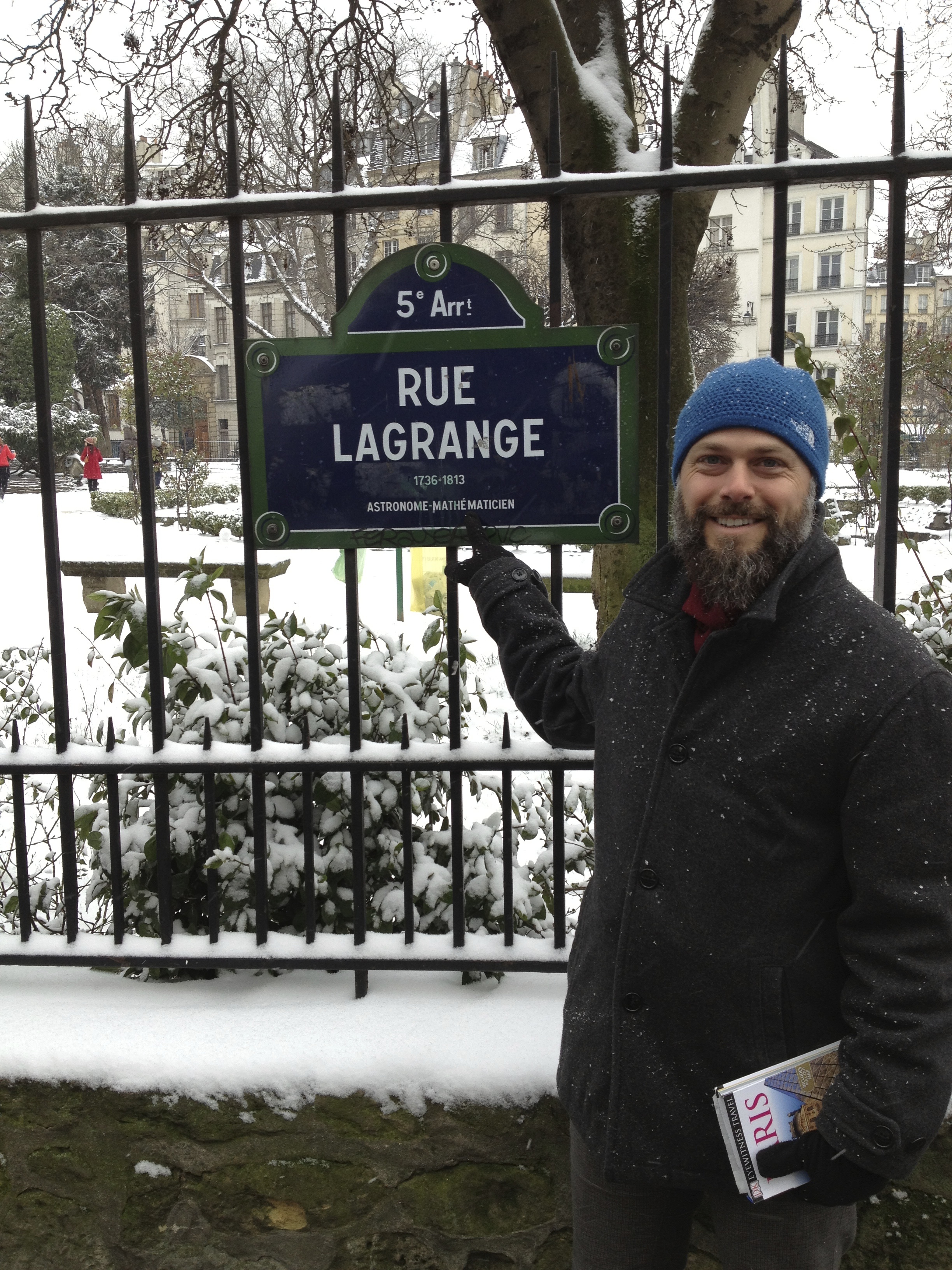
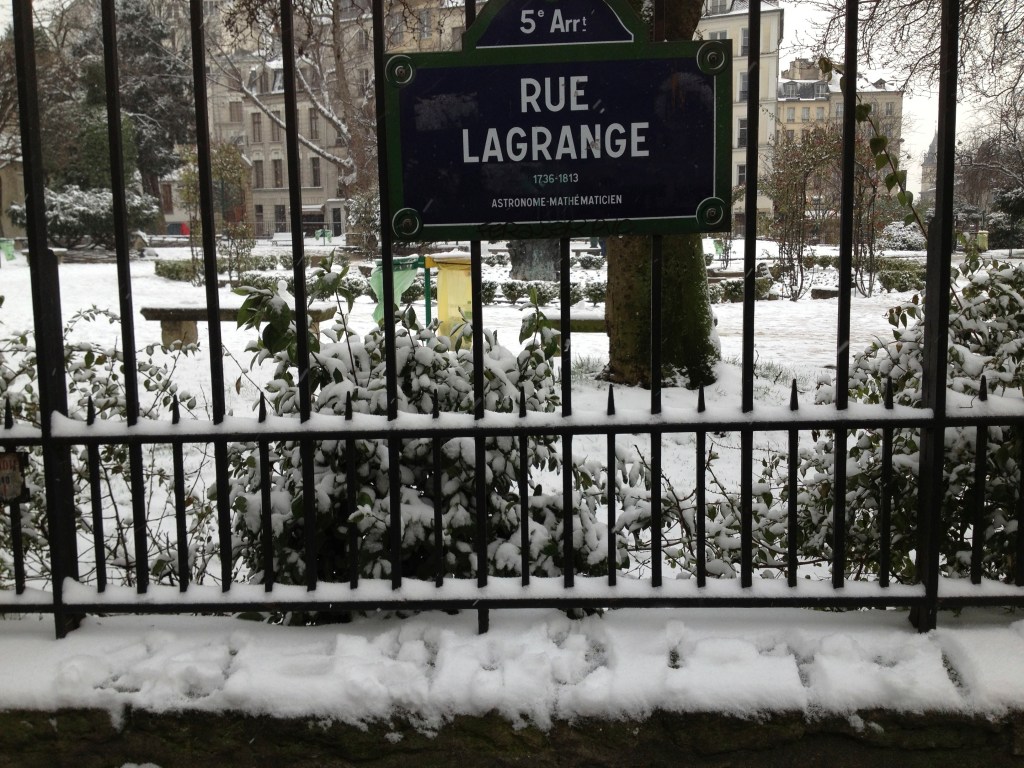
His work was is the field of mechanics (mathematical physics, if you will). For example, some of his early work developed our understanding of the tautochrone helping to establish the Calculus of Variations.4 Lagrange also solved problems in the fields of algebra, number theory, and astrophysics. For details, see the list in Wikipedia. By the end of his career, Lagrange had been named a count of the empire by Napoleon.
Along the way, Lagrange proved Bachet’s conjecture:
Every positive integer is the sum of four squares.
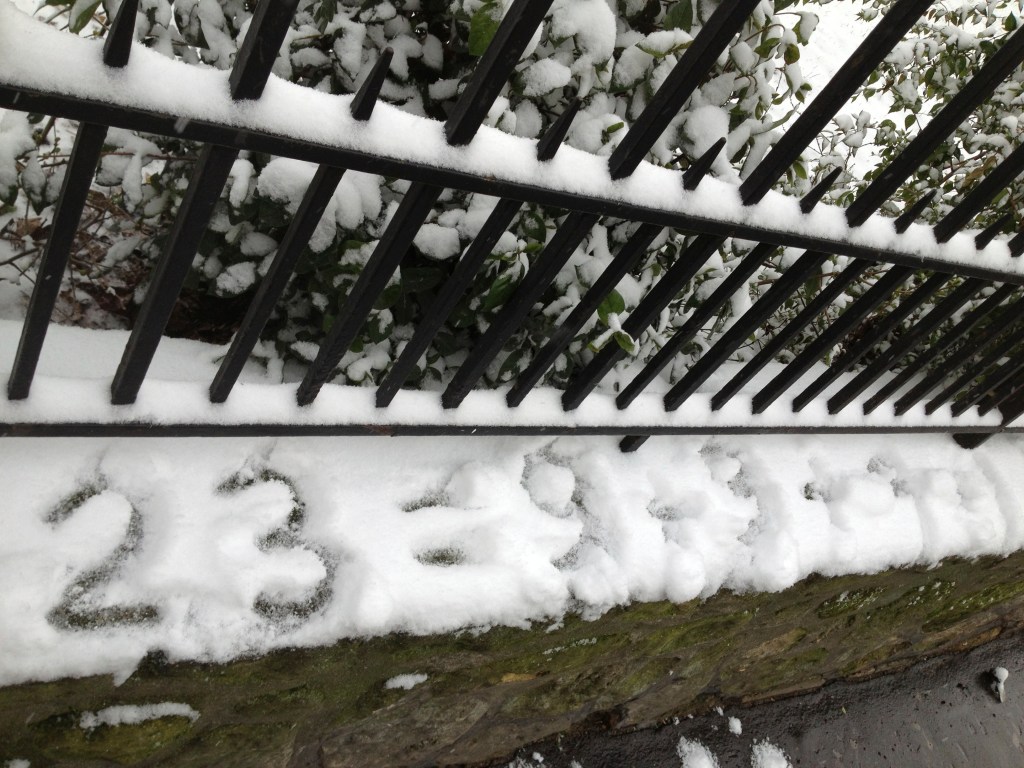
For example, 23 = 9 + 9 + 4 + 1.

This may not be Lagrange’s most complex or important work, but its statement is accessible for many who have studied math even un petit peu. Before we proceed with more examples, let’s get some vocabulary down.
The integers are a set of numbers. This set includes the natural numbers 1, 2, 3, 4 …, the illustrious 0, and the opposites of the natural numbers -1, -2, -3 ….
By “squares,” we mean perfect squares like 1, 4, 9, 25, 36 …. You get these when you square 1, 2, 3, 4, 5, 6 ….5
Lagrange showed that for any positive integer, it is possible to find 4 perfect squares to add together to make that number. Reuse is allowed. And, 0 is okay, too.
For a few more examples, consider:
7 = 4 + 1 + 1 + 1
15 = 9 + 4 + 1 + 1
56 = 36 + 16 + 4 + 0
What about 1, you ask? (Or, maybe you didn’t, but it is a good question.) Can you find four perfect squares to add to 1? Yes.
1 = 1 + 0 + 0 + 0
Now, you try. Pick a number. Any number. Really, any number.
67 = 64 + 1 + 1 + 1
109 = 100 + 9
17,987,417 = 17,986,081 + 1296 + 36 + 4
You never need more than 4 squares.

Epilogue
All of this adding up of squares reminds me of Pythagoras. His people popularized the theorem about the sides of a right triangle:
where c is the length of the hypotenuse. Remember, this doesn’t work for every triplet of whole numbers, just special Pythagorean triplets like 3, 4, 5. It also works for triplets like 1, square root 3, and 2. If we put this into a Cartesian plane, we can see the distance to a point like (3, 3) can be found using the Pythagorean theorem. We saw this in the square root 2 post.
The Pythagorean theorem works just as well in three dimensions. It does. Really. There is an explanation in Wikipedia. That is, the distance to a point in three dimensions, like (3, 3, 3) can be found using the 3D analog.
If we are okay working with this 3D analogy, why not try 4D? (You can think of reasons why not, I know. Let’s see anyway. String theory in the study of particle physics uses something like 11 dimensions. We can handle 4 dimensions; I think.) The Pythagorean theorem for 4D looks like the following.
This gives us a way to find the distance from the origin (0, 0, 0, 0) to the point (x, y, z, w) in a four-dimensional space. This looks a lot like what Lagrange was proving. Instead of d2, we just had n, a whole number.
What does this mean?
The square root of every positive integer is the distance to a point having integer coordinates. Said another way, if you give me any positive integer, I can find a point in four-dimensional space with whole number coordinates where the distance from the origin is the square root of that positive integer you gave me. This is not the case for the usual 2D Pythagorean theorem (Remember those pesky Pythagorean triples?) or for 3D.
In fact, I may be able to find more than one point whose distance from the origin is the square root of the given number. The distance from the origin to (1, 2, 3, 4), about 5.477, is the same as the distance to (2, 3, 4, 1). And, for a number like 17, there are more than one quadruplet of numbers.
17 = 16 + 1
and
17 = 9 + 4 + 4
So, the square root of 17 is the distance to the points (4, 1, 0, 0) and (3, 2, 2, 0) as well as all of the permutations of the coordinates.
0. From what I understand and have seen, the entombment of important personages and the preservation of relics is a common, though not primary, function of Catholic churches around the world. Descartes undoubtedly was an important 17th century thinker worthy of reverence. I mentioned Descartes earlier in the Triangles post.
1. This app for the iPad was from IBM, and it was very cool, inspired by a mural made by the Eames in the 1950s. You may know the Eames for their Herman Miller chairs. Their chairs are great because of the Eames’ ability to be both creative and analytical, to be artists and engineers. I only aspire to such creative powers.
The app showed a timeline of major advancements in mathematics from 1000 to 1950 AD, as did the mural. The app also had a timeline of major political and cultural events. So, at a glance, one could see a bit of what was happening in the world when important math was being done.
2. Mostly, I used the MacTutor History of Mathematics Archive page on Lagrange as well as the Wikipedia page as historical resources.
I also referred to this inventory of Lagrange’s published works:
Taton Rene. Inventaire chronologique de l’œuvre de Lagrange. In: Revue d’histoire des sciences. 1974, Tome 27 n°1. pp. 3-36. http://www.persee.fr/web/revues/home/prescript/article/rhs_0151-4105_1974_num_27_1_1044
Beware, it is en français.

3. The Louvre has not always been an art museum. In the late 12th century, a great defensive rampart was built around Paris. This was the advent of the Louvre. Over the following centuries, the Louvre transformed from royal palace to the birthplace of the Paris salon to the enormity of art galleries we see today. For more, spend a little time on the Louvre website’s history page.
4. In one variable calculus, a common task is to find a value of x where some function of x is the smallest. Minimizing cost or fuel use are good applications of this. Now, calculus of variations gives us a way to find a function where some functional is minimized. A functional is like a function, except instead of the inputs being numbers, the inputs are functions. The definite integral from 0 to 2 is an example of a functional.
5. We call it “squaring” a number since the way to find the area of a square is to multiply the length of a side by itself. This is consistent with how we find the area of a rectangle, length times width. In the case of a square, length = width and area = l*l or l2. So, “to the second power” has become synonymous with “squared.”
A few more photos

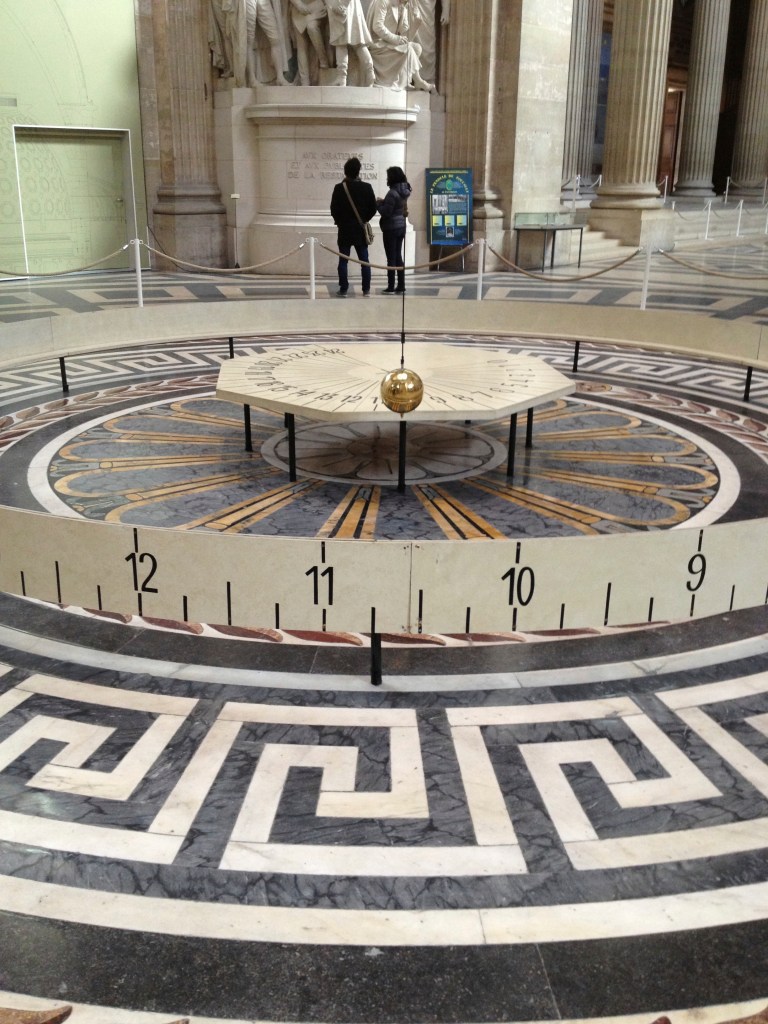

 Footpath Math: Chalk it up to a math geek
You mean the square root of 17 is the distance to the points (4, 1, 0, 0) and (3, 2, 2, 0)
Yes. I think I found myself mixed up in Paris attempting to think in 4D. Thank you.