
Austin TX
2013/04/27
This post began as a rather ambitious endeavor. My hope was to introduce infinite series and then gracefully bounce onto power series on the way to Taylor series. It occurred to me this was too much. Like too many toppings on a pizza, the crust could only hold so much.
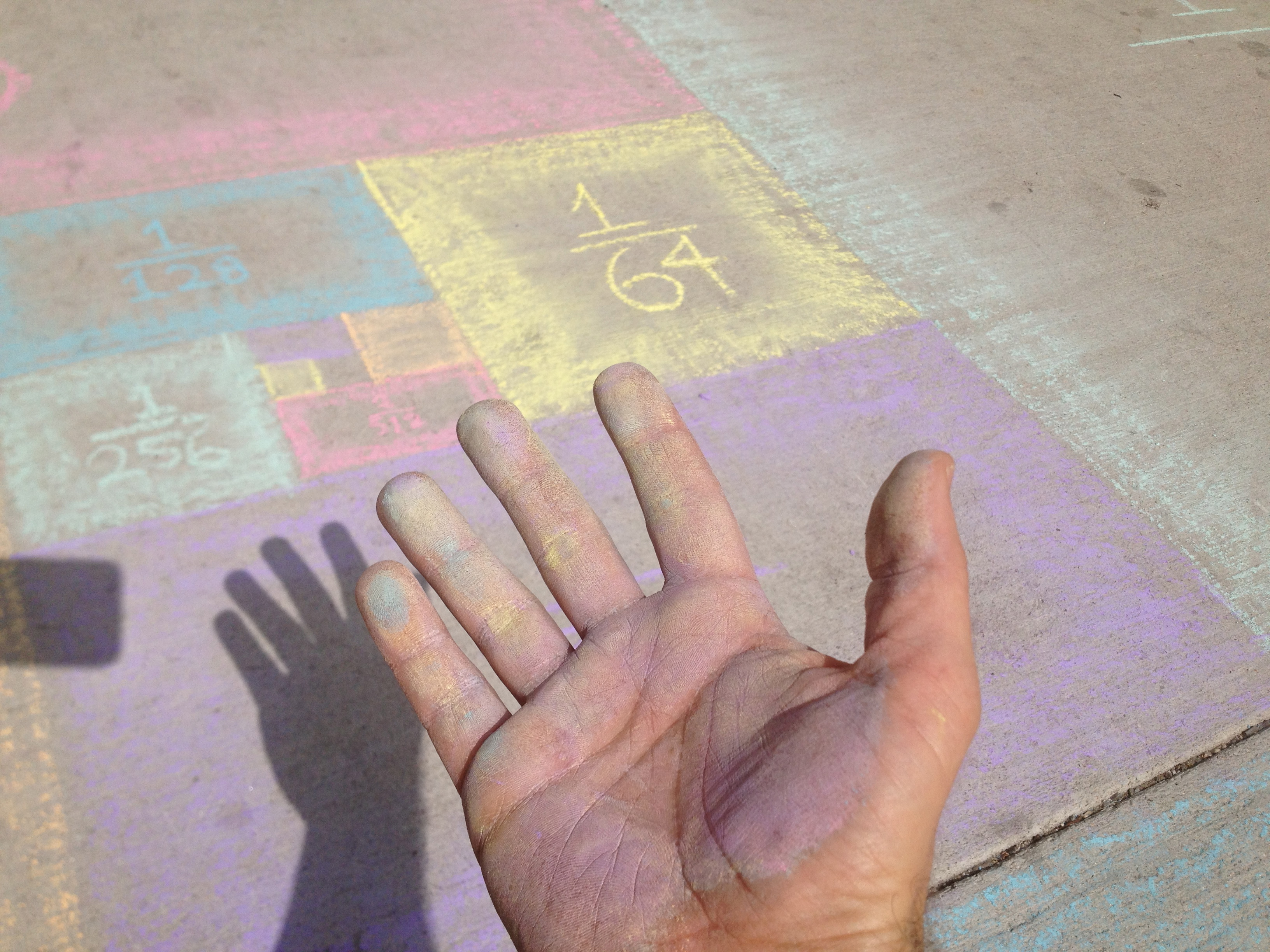 You still might need a fork and knife. Take your time. I tell my students, “The way to eat a pizza is one slice at a time. The way to eat a slice is one bite at a time. And, don’t forget to chew.” This is the first slice. Power series and Taylor series will have to wait until next time. I imagine I will find a way to bridge the gap from this power play to my next post.
Now, for what it is worth, the conceptual underpinnings of this post appeared in an assignment I gave to my Pre-Algebra class earlier this year. (Yes, the same students I talked about in the last post.) If 6th and 7th graders can handle parts of this, I think you can, too.
Let’s get started and see what happens.
In mathematics, a series is a sum of a sequence of numbers. Sequences take all shapes and sizes. Two years ago, I posted about the Fibonacci sequence. Another example of a sequence is provided by the powers of 2:
2, 4, 8, 16, 32, …
Sequences have terms. In the list above, the first term is 2, the second term is 4, and so on.
A series is a sum of the terms of the sequence. A series for the sequence of powers of 2 is
2 + 4 + 8 + 16 + 32 + …
If you missed the distinction, maybe this will help. Terms of a sequence are separated with a comma. Terms of a series are separated with a plus sign. About those plus signs…
A good strategy for adding a whole mess of numbers is to start with a little at a time. The sum of the first three terms, we’ll call it S3 for “the sum of the first three terms,” is
2 + 4 + 8 = 14
Similarly,
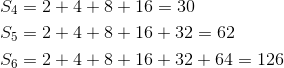
Notice how these partial sums just keep getting bigger and bigger? Also, notice how each new term being added is getting bigger and bigger? As we moved from S3 to S6 we added 16, then 32 was put in the mix, and then 64 was next. From there the pattern would continue and the partial sums would keep growing without bound.
Those partial sums are rocketing off to infinity as we add more and more terms. Will that be the case for any series? Is it ever possible to add up infinitely many numbers and get a finite result?[1]
A good strategy for investigating a question of math is to try multiple examples. Be careful though. The question posed above has the word, “possible” in it. So, one failed example won’t answer the question in the negative. However, if we can find one example where the answer is yes, then, well, yes it is possible.
Here is another sequence, the reciprocals[2] of the powers of 2:

And, here is the series:


Notice what happens when you start to add them up.
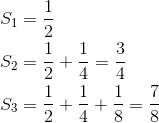
Check out the pattern in those partial sums. This is lovely stuff. I bet you can guess what S4 and S5 are going to be. How about S10?[3]
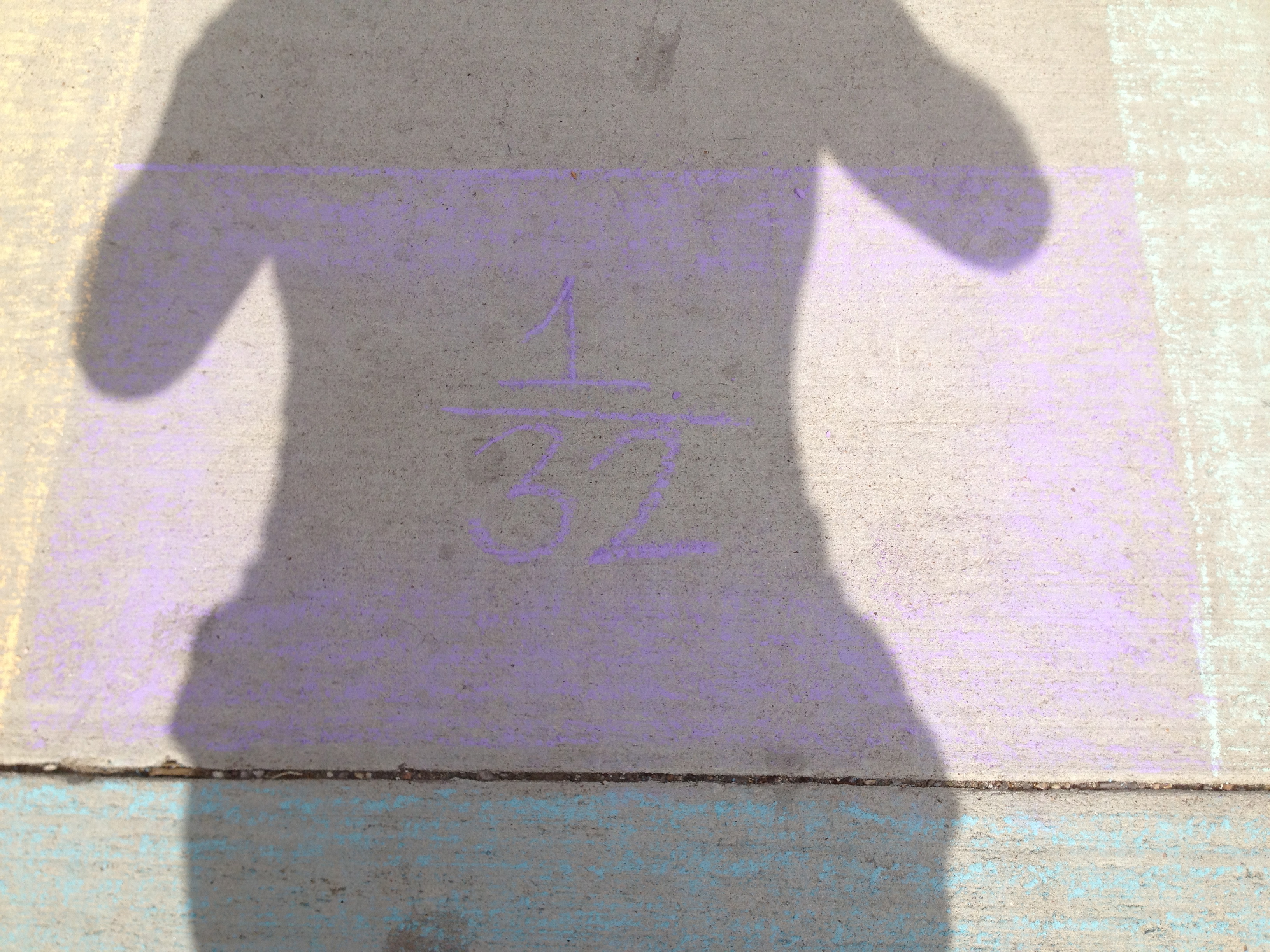
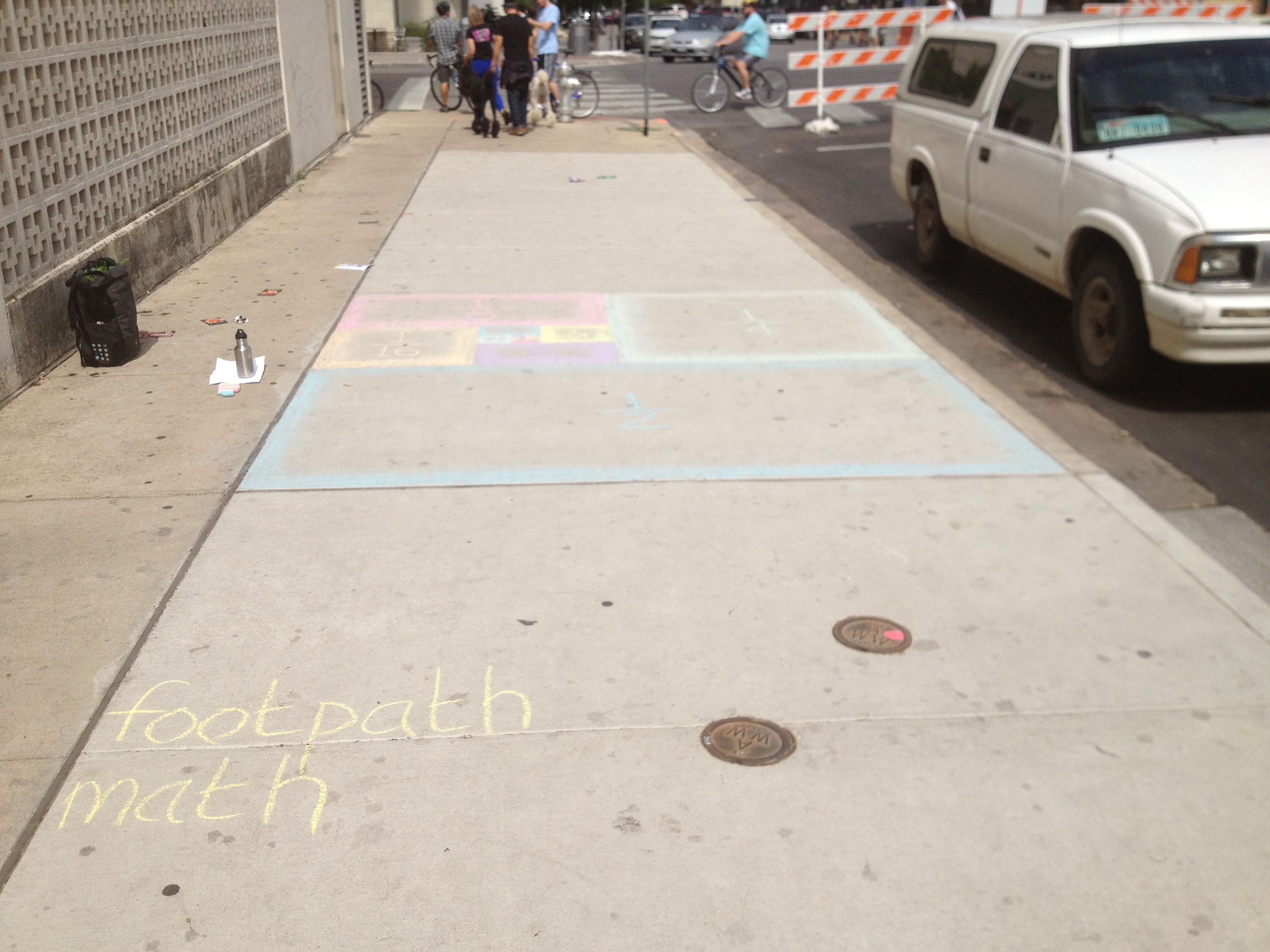
But, how are we going to add up infinitely many terms? You know, the “and so on” bit we have heard? Well, first, I am going to resort to chalk.
Will additional terms ever cause the sum break out of the square?[4]
 Unlike the world of atoms and molecules, geometric spaces and numeric values can always be cut in half. Forever. Halves of halves of halves of halves of …
Maybe you are convinced, but maybe not. If not, maybe some algebra will do the trick.
Warning: what follows contains some cavalier, maybe dangerous, treatment of infinity. I should be actually showing a limit at work instead of simply implying one, but for this venue I like the simplicity. There is an explanation with a more careful treatment in a footnote.[5]
If we could add up all the terms, we might call the sum S∞:

Now, here is a tricky, and possibly illegal bit. We are going to multiply both sides by one-half. (You cannot really do this. It would take infinitely many operations, but let’s see what happens anyway.)

While we are doing an endless number of operations, why don’t we try subtracting:

All that will be left on the right is 1/2. On the left, if you subtract 1/2 of something from the something, you are left with 1/2 of it. So,

Multiply by two (or divide by 1/2) and what do you have?

Again, technically we should not be doing infinitely many operations. (Cauchy isn’t happy with me right now.) It seems to work for this problem, but there are other times when infinity will lead one astray with such a strategy. There is another way. See that footnote.
Let’s go back to the question of whether or not it is possible to add up infinitely many numbers and get a finite result. The answer is, “Yes, it is possible.”


1. ^ Zeno apparently thought the answer was no. Though Zeno is said to have articulated a few paradoxes, “Zeno’s paradox” has to do with always having to traverse half way to somewhere and therefore never being able to get there. I guess Zeno missed the papers Max Planck wrote about the quantum of action. For more on Zeno’s paradoxes, check out the page in the Stanford Encyclopedia of Philosophy, particularly the Paradoxes of Motion.
2. ^ The product of a number and its reciprocal is 1. An easy example is 2/3 and 3/2. They are reciprocals. (2/3)(3/2)=6/6=1. If this sounds too fancy, just think, “Flip it.”
3. ^ 15/16, 31/32, and I’ll let you sort out S10. For those first two, check the sums:
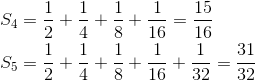
Don’t take my word for it. Add those fractions. Remember to use common denominators.
4. ^ One half is not a square. One quarter is. (1/2)(1/2) = 1/4. It was fun to see this along the way. 1/8? No square. 1/8 is both half a square and two square. 1/16? A square. (1/4)(1/4) = 1/16. Do you see the fractal? Yeah, you do.
I used imgflip Animated GIF Generator to generate the GIF from a set of PNGs. The PNGs are downloaded drawings I made in Google Drive.
5. ^ Here is a careful argument for finding the limit of the sum of the powers of one half. You might have noticed the last term of S4 was (1/2)4 = 1/(24) = 1/16. For any value of n, the last term of Sn is 1/(2n). That is,

Now, this sum doesn’t have infinitely many terms, so multiplying both sides by 1/2 is perfectly legit.

And, this time subtracting the two doesn’t require infinitely many subtractions.

Cancel 1/4, 1/8, and so on to leave behind
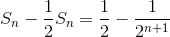
Or, better yet
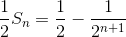
Multiply by 2.

And, we have a formula for finding the sum of the first n terms of the powers of one half. This formula also explains why the sums are always a fraction less than one.
Now, for the good part. Let’s take the limit as n goes to ∞. As n gets bigger and bigger, 2n gets bigger and bigger, and 1/(2n) gets smaller and smaller. (This is like dividing a pizza evenly between more and more friends; each friend gets less and less pizza.) In fact, as n goes to ∞, 1/(2n) heads to zero. That is,

So that, for our sum of the first n terms of the powers of 1/2,

as expected.
 Footpath Math: Chalk it up to a math geek
I love infinite series, but especially Taylor Series ! Nice post !!
Thank you! Taylor is in the works.