
Austin TX
2013/06/16
 This post and the previous are sort of farewell gifts to my students who just finished their first year studying calculus. I love creating lectures (as you might imagine), but they hungered for something else. They challenged, inspired, and reminded me what I love about teaching. For me, the gift of teaching is about being present while people are learning.
Often, class was an inquiry responding to questions. I asked some of the questions. They asked some of the questions. One of the questions was about Euler’s formula. The answer was outside of the scope of our course as we barreled into the AP exam.
Here is my answer. This is for them. (And, if you aren’t one of them, well, read on anyway. This is for you, too. I love it when people learn, especially about math.)
While hanging around Taylor series, it seemed almost requisite to post something about Euler’s formula.

The exponential function ex (a champion for modeling the growth and decay of populations of wolves, bacteria, people, and radioactive materials) meets the trigonometric functions (good for triangles and so much more) all through the power of the imaginary unit i. One way to prove the truth of this formula uses Taylor series expansions. Luckily, we just spent some time with them.
Before we go further, please know Leonhard Euler pronounced his last name as “Oil-er.” Also know Euler was a Swiss mathematician and physicist. He was born in 1707, received his PhD in 1726, lost sight in his right eye after a near fatal fever in 1735, and passed away entirely blind in 1783. Euler was dissertation advisor to Lagrange and has over 78,000 mathematical descendants. Laplace is said to have commented: “Lisez Euler, lisez Euler, c’est notre maître à tous.” (Read Euler, read Euler, he is the master of us all.) (Wikipedia Euler)
On to Euler’s formula then.

We have seen both sine and cosine along the way. Likely, we were introduced to these as ratios of sides of right triangles. Sin x is the sine of an angle x, the ratio of the length of the opposite side to the hypotenuse in a right triangle. Cos x is the cosine of an angle x, the ratio of the length of the adjacent side to the hypotenuse in a right triangle.
So far, so good, I hope.
Then, there is also an i in the formula. I don’t think we have crossed paths with i in this blog. (I have to admit I have a silent chuckle saying these sentences. Sometimes they sound like disturbed proclamations of identity.) Prepare to enter in the world of imaginary numbers.
Over many centuries, humans have been solving quadratic equations.[1] When we tried to solve the following equation things went a bit wonky—a bit like when the Pythagoreans tried to find the distance across the diagonal of a square.[2]

 At first, it seemed like a perfectly reasonable quadratic equation. But, then after a bit of pondering our mathematical ancestor started thinking, “Um… I am having a bit of trouble finding a number such that when it is squared and then added to one, zero results. The squared number would have to equal −1. In fact, upon further reflection, well, I… um… just don’t think it is possible.”
Well, you might be thinking such thoughts unless you have taken a bit of twentieth century high school algebra and someone said, “You are right. There is no real number that when squared results in –1. We need a new set of numbers to find it. We need the Complex numbers.”
“The Complex numbers?!”
Yes. The Complex numbers include values whose squares are negative. In the complex numbers, you can find a number z such that z2 = −1. i is that number.

And, there we have i, the imaginary unit.
More on complex numbers in a bit. For now, we are going to bounce to Taylor series to see one explanation of how
From the post of the same name, we have a Taylor series for sin(x).

Following a similar line of reasoning,[3]

 Take a moment to notice the series for sin(x) only contains odd powers of x, while cos(x) only has even powers. You might have some curiosity about combining them into one expression with all the powers. Me, too. That is precisely for what we are here.
Now, the series for ex is pretty special.

YES! ex has all the powers! But, don’t go getting ahead of yourself. (Or, do. You might just sort it out on your own.) The sin(x) and cos(x) series both have some pesky negatives. You might try adding them or subtracting them, but those negatives will fight back. (They will; I promise.)
So, what do we do? Well, there was a reason we talked about i. If i = √−1, then i2 = −1. Powers of i do something special.[4]

Next comes

and the pattern repeats, coming back to 1 every time i is raised to a multiple of 4. i8 = 1. i12 = 1. i16 = ? Yes, 1.
Let’s put these powers of i to work in a series expansion of eix. All you need to do is drop ix in wherever there was an x.

and then do a little algebra with those exponents.

Using what we just learned about i, this series becomes

Notice how the even powers of x have been liberated of their i‘s. (Since the even powers of i all equal ± 1.) This series of even powers, the blue-ish ones, should look familiar.
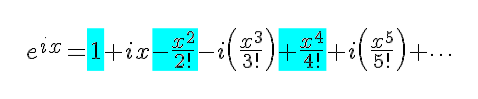
Those are the terms of the series expansion of cos(x). And, if you factor the i out of the non-highlighted terms, you get the series for sin(x). If you are with me so far, you might just see that the series on the right is in fact cos(x) + i sin(x).[5]
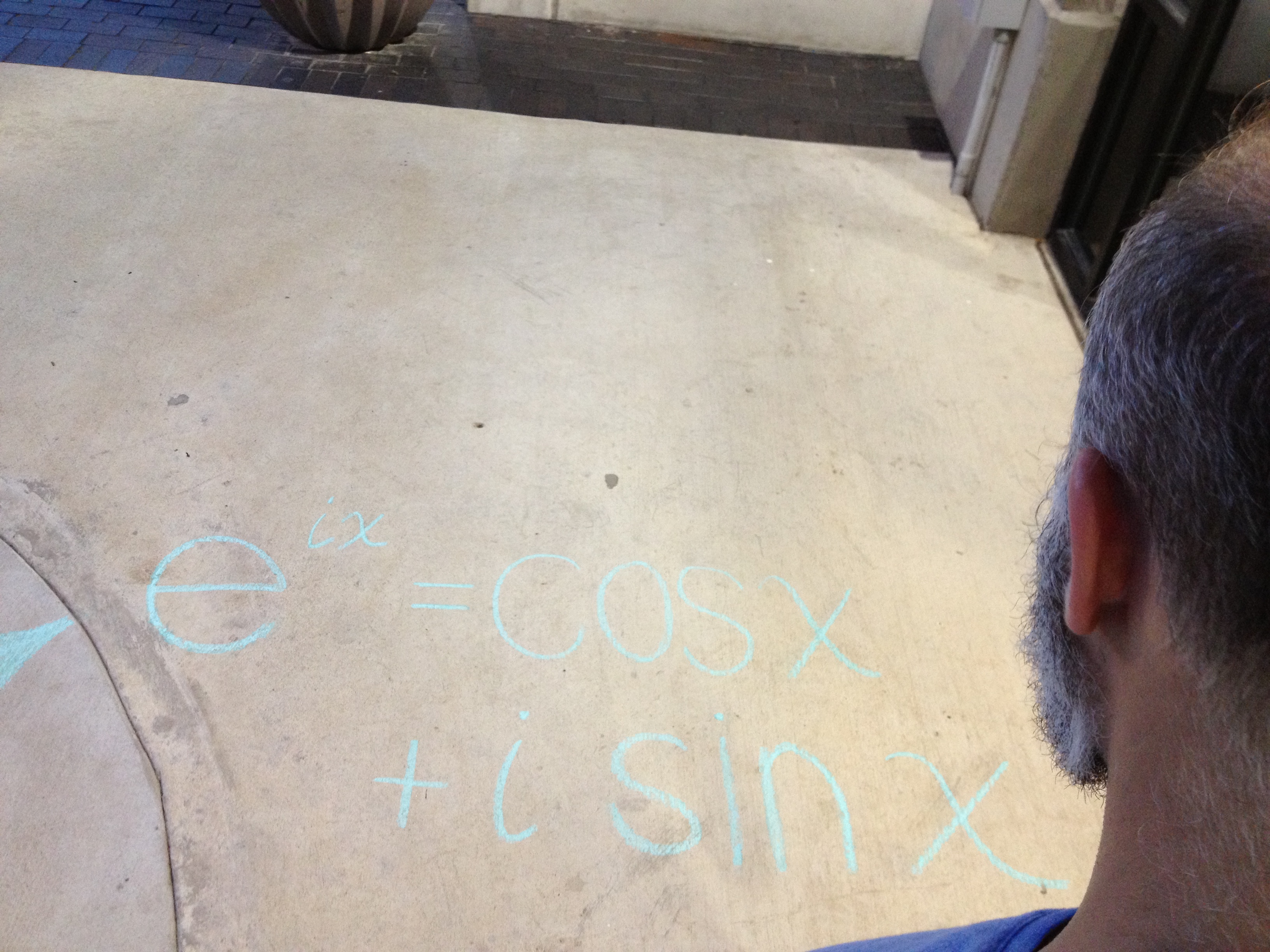
Now that we have confirmed the validity of Euler’s formula, let’s take just a moment to look at one way to put it to work.
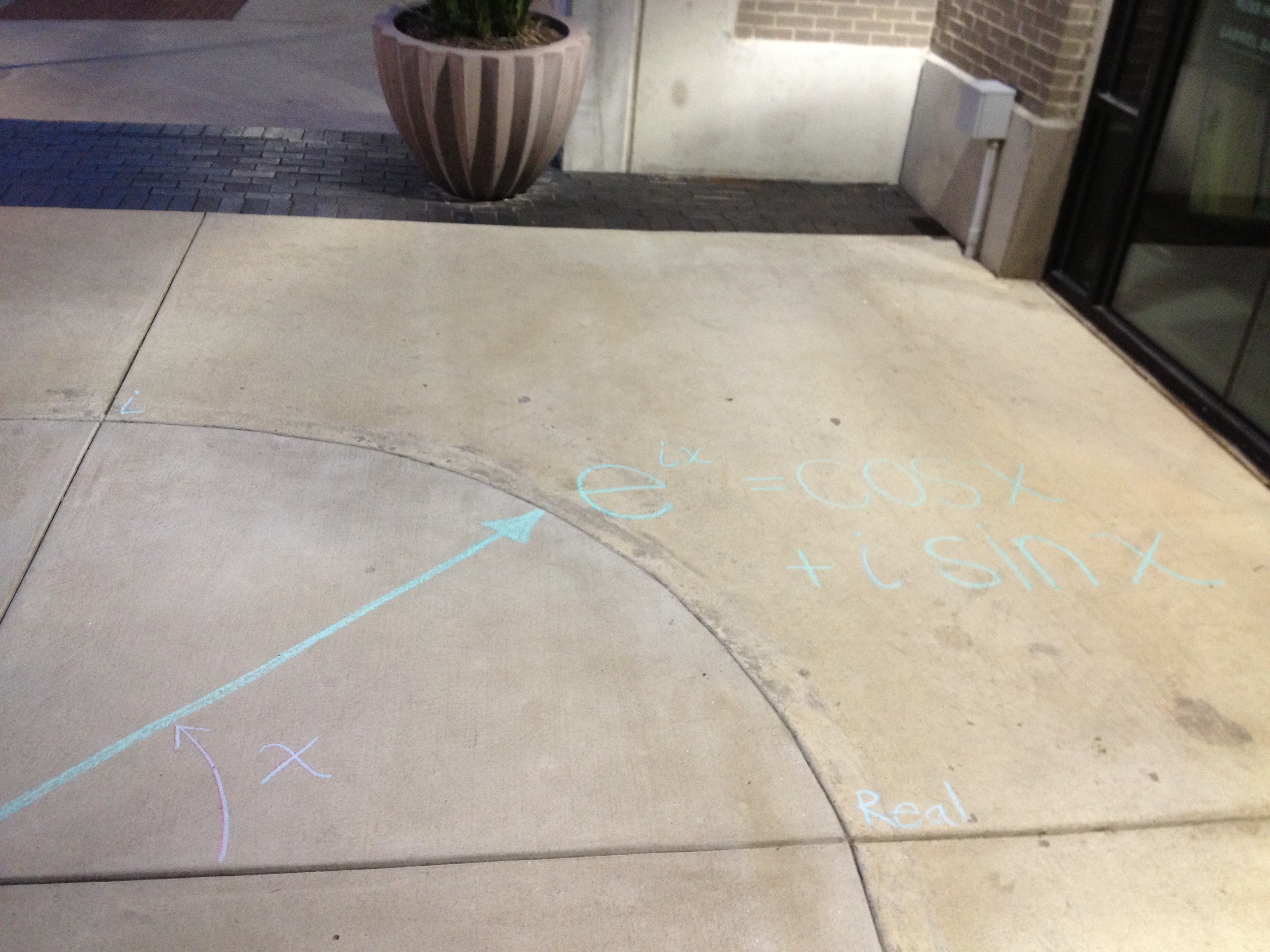 Take one good old fashioned Cartesian coordinate system and use the x-axis just as it is, populated with all of the Real numbers, while letting the y-axis represent all of the imaginary numbers, you will have for yourself the complex plane.[6] If you put a circle with a radius of 1 unit on that plane with its center at the origin (0 + 0i), then eix gives you a quick way to refer to points on the 1 unit circle. (Remember x is an angle in this conversation.) For example,

Those values might look familiar. They are the lengths of the legs of a 30-60-90 triangle. 30° is the same angle measure of π/6 radians. We saw radians in Seattle for angular velocity. Remember? The circumference of a unit circle is 2π. Thus, 2π is the same as 360°, π radians equal 180°, and so on.
So, yeah, what does happen when x = π?


Magic.











Photo credits: Jaclyn Faulkner
1.↑ There are simple quadratic equations like

 where the solution is 2 or −2. (Don’t forget a negative times a negative is a positive.) Those solutions happen to be, not coincidentally, where the graph of the related parabola cross the x-axis.
There are more complicated quadratic equations like

where solving takes something more than number sense. You might complete the square or use the quadratic formula. Either way, you will find the values that make the left-hand side equal to zero are

 The plus or minus sign takes care of providing two answers. First, add root 2 to 2 and then divide by 2. Next, Subtract root 2 from 2 and then divide by two. What you get are again the x-intercepts.
2.↑ The Pythagoreans, as you might recall, worshipped Number. (Yes, with a capital “N.”) The square root of 2 required a new set of numbers, the Real numbers. It rocked their world. The Reals include both rational and irrational numbers.
We faced this kind of demand for expansion of a number system even before that. I can only imagine the farmer who used whole numbers to count her sheep. Then, some neighbor wanted to know if he could buy just part of the sheep. “Part of a sheep?,” our farmer replied. “Yes, I would like to buy the left side.” And, one half was born in the demise of that poor sheep.
3.↑ Calculus students know
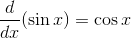
Check to see what happens when you take the derivative of the series expansion of sin(x). If all goes well, you will have yourself a good portion of cos(x).
4.↑ Raising i to different powers isn’t too troublesome. For example,

For more on imaginary numbers, including their history and application in the real world, pick up a copy of Paul Nahin’s An Imaginary Tale: The Story of √(−1). Nahin is a professor of electrical engineering and an author. He also wrote Dr. Euler’s Fabulous Formula—an excellent account of Euler, his formula, and its applications. Be careful though, it is loaded with calculus.
5.↑ One has to be careful when rearranging infinitely many terms.
Adding up 1 + (−1) + 1 + (−1) + 1 + (−1) + … will have you bouncing back and forth from zero. If you rearrange this series to (1 + 1 + 1 + …) + (−1 + −1 + −1 + …), you will be in trouble, because of what is lurking inside that first set of parentheses = ∞. Now, don’t go trying to tell me it will be okay. ∞ − ∞ does not equal zero. Ask WolframAlpha.
The rearrangement of the expansion of ex is legal because the series involved are absolutely convergent.
6.↑ Read more about Euler’s formula and the complex plane in Wikipedia.
 Footpath Math: Chalk it up to a math geek
8 thoughts on “Euler’s Formula”