
Austin TX
 For many years, I was a skeptic about Pi Day. Calendars seem arbitrary, susceptible to the whim of emperors. Pi seems constant. It is the ratio of the circumference to the diameter for any circle (in the Euclidean plane). A friend sent me a link to a NYTimes article this morning about Pi Day. The article encouraged me to celebrate Pi Day as an opportunity to reflect on the mystery of math in general and π in particular.
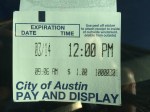
 Pi Day this year has been made a bigger deal than usual. Drop the 20, go with US date conventions, and we are sitting on 3/14/15: the first digits of π ≈ 3.1415. At 9:26:53 this morning, we had even more digits. Wolfram threw a party in Austin during SXSW. At the time, I was a few blocks away chatting with a gentleman from Scotland over some fresh chalk about an infinite series for π.
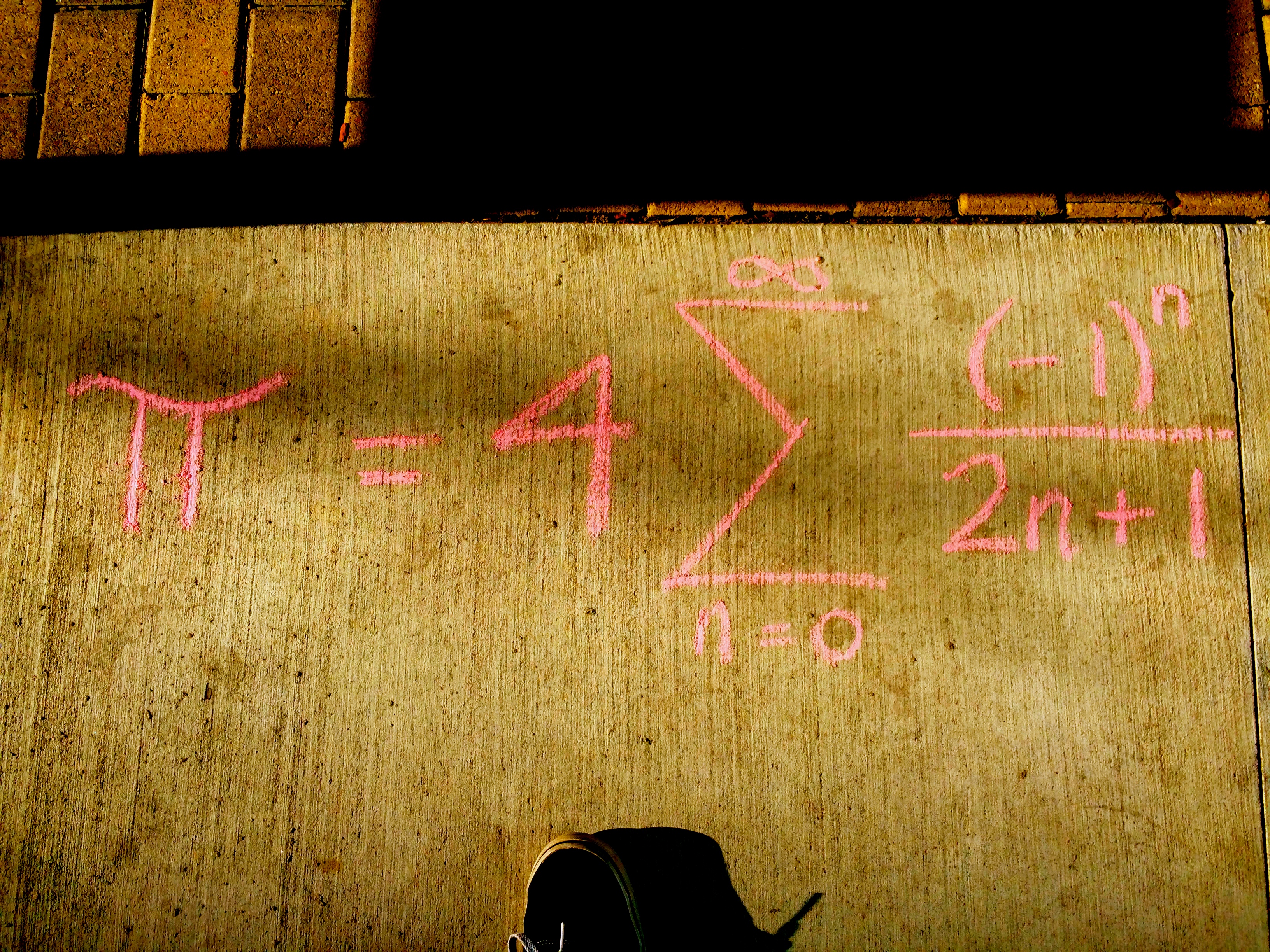
The Leibniz formula for π has been attributed to an Indian mathematician at the turn of the 15th century. Madhava is mentioned in the NYTimes article linked above. He arrived at this expression for π from his infinite series for arctan x. Let x = 1, and π/4 results. I took the liberty of multiplying by 4.
For more on π including a look at Archimedes’ work, check out my post from 2013.


 Footpath Math: Chalk it up to a math geek
It’s a wonderful series, but I hope you have a very large sidewalk and plenty of chalk if you desire enough accuracy for today’s date! SLOW convergence at the edge of the interval !
I am glad you mentioned the rate of convergence. One hundred terms in and we find ourselves still bouncing between 3.13… and 3.15…, just waiting to lock in the 4. Still, I like this series for the historical context and as an entry point to other conceptions and calculations of pi. We needed more powerful algorithms to get to trillions of digits of pi. I am just discovering the work Machin, Ramanujan, and the Chudnovsky brothers did to advance the search.