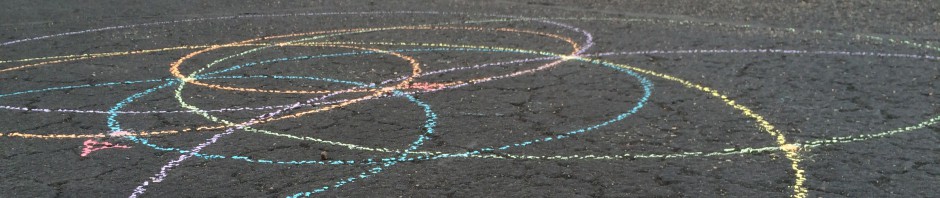
 Just south of Mueller in Austin is the J.J. Seabrook Greenbelt. It is hugged by Pershing Drive and will soon have a trail connected to the trail at Mueller. The creek bed has been re-engineered and, just a few days ago, a bridge arrived ready to span the creek. It was a sight to see the bridge sitting there on the side of the road, waiting to fulfill its purpose.
Like many bridges, this one is a slight arch. I found myself curious. If we only know the span to be crossed, do we know enough to know the distance over the arc of the bridge? In geometric terms, the question is whether or not a chord’s length alone determines the related arc length.
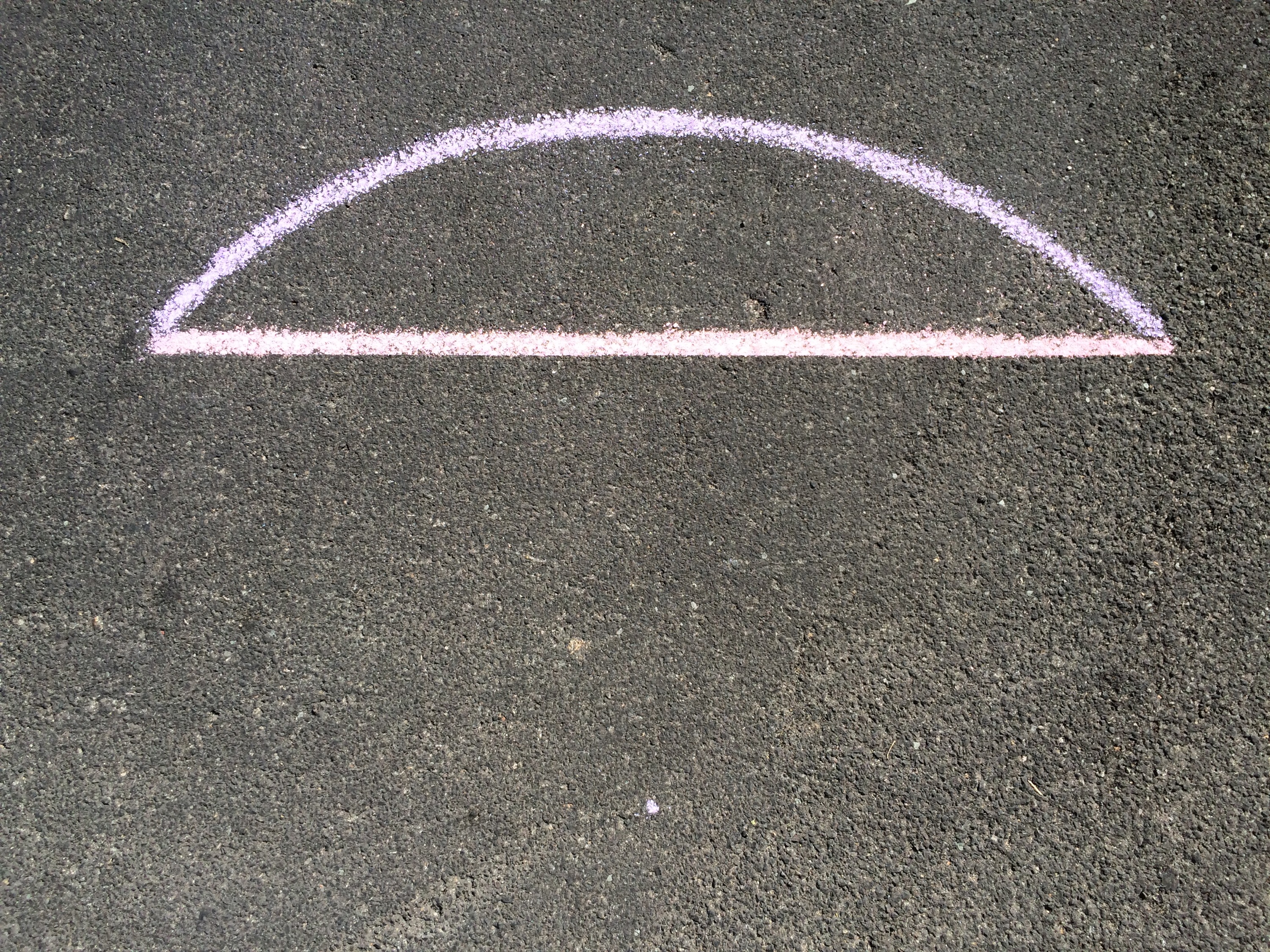
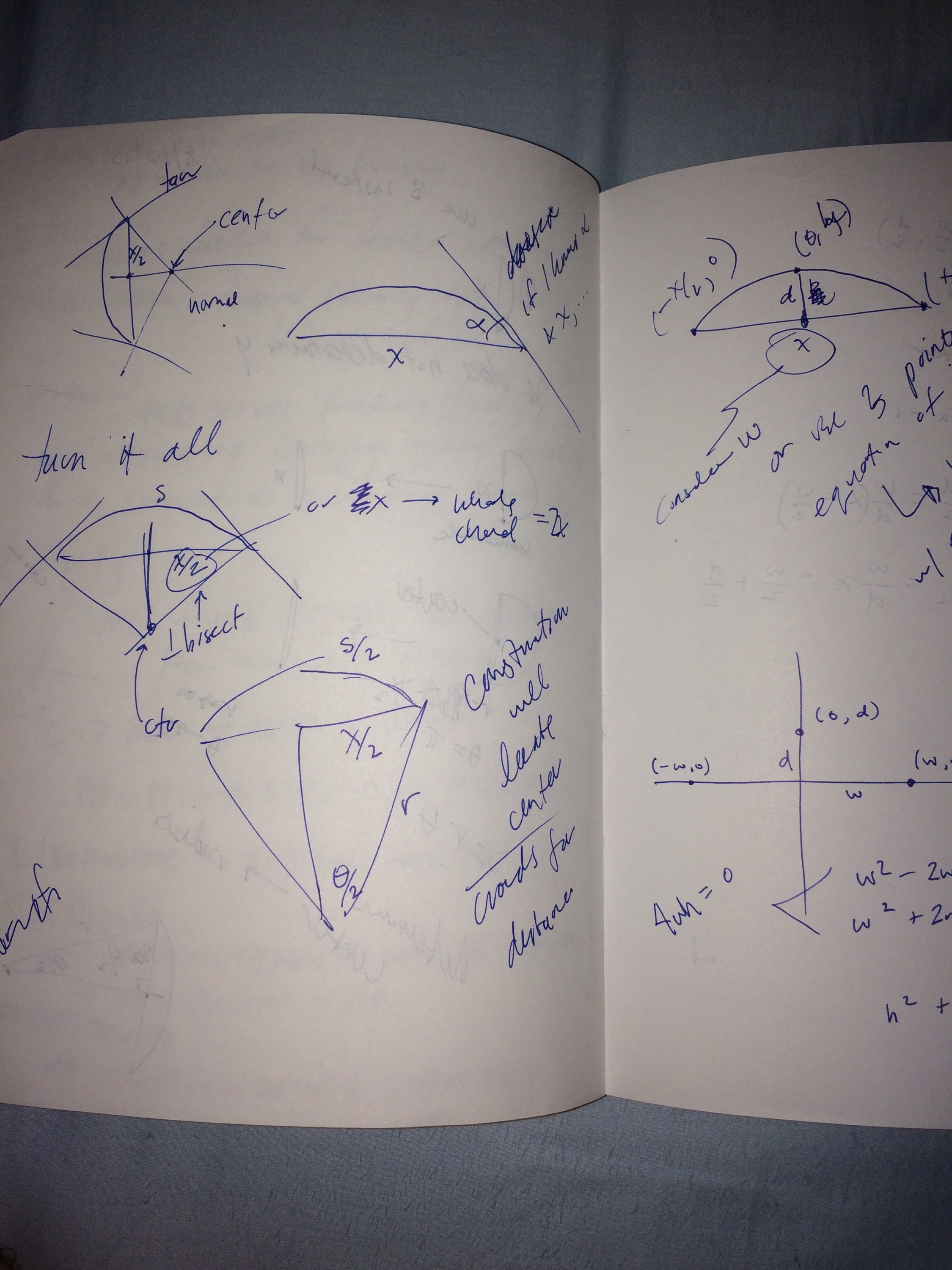 Though I knew many circles could be home to the chord, I attempted to sneak up on the arc length without any additional information. I imagined the center of the circle moving back and forth away from the chord, envisioned tangent lines dictating the slope, and wondered what was the easiest way to lock the arc in place.
 |
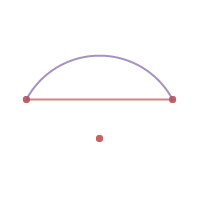 |
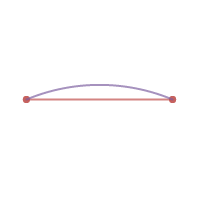 |
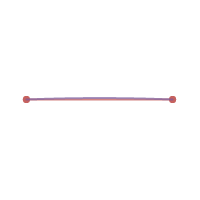 |
Even with the advent of steel, flat bridges don’t maintain their integrity like an arch. Steel has been a game changer, but the arch is as important as the invention of the wheel. It is the wheel. (Still, we would not want a semicircular bridge. Imagine pulling your wagon across that.)
The formula for arc length, s, is s = rθ, where r is the radius of the circle and θ is the central angle. This is a definition of sorts, often in the form θ = s/r as a way to determine angle measure in radians. If I could locate the center of the circle, then I could find the arc length.
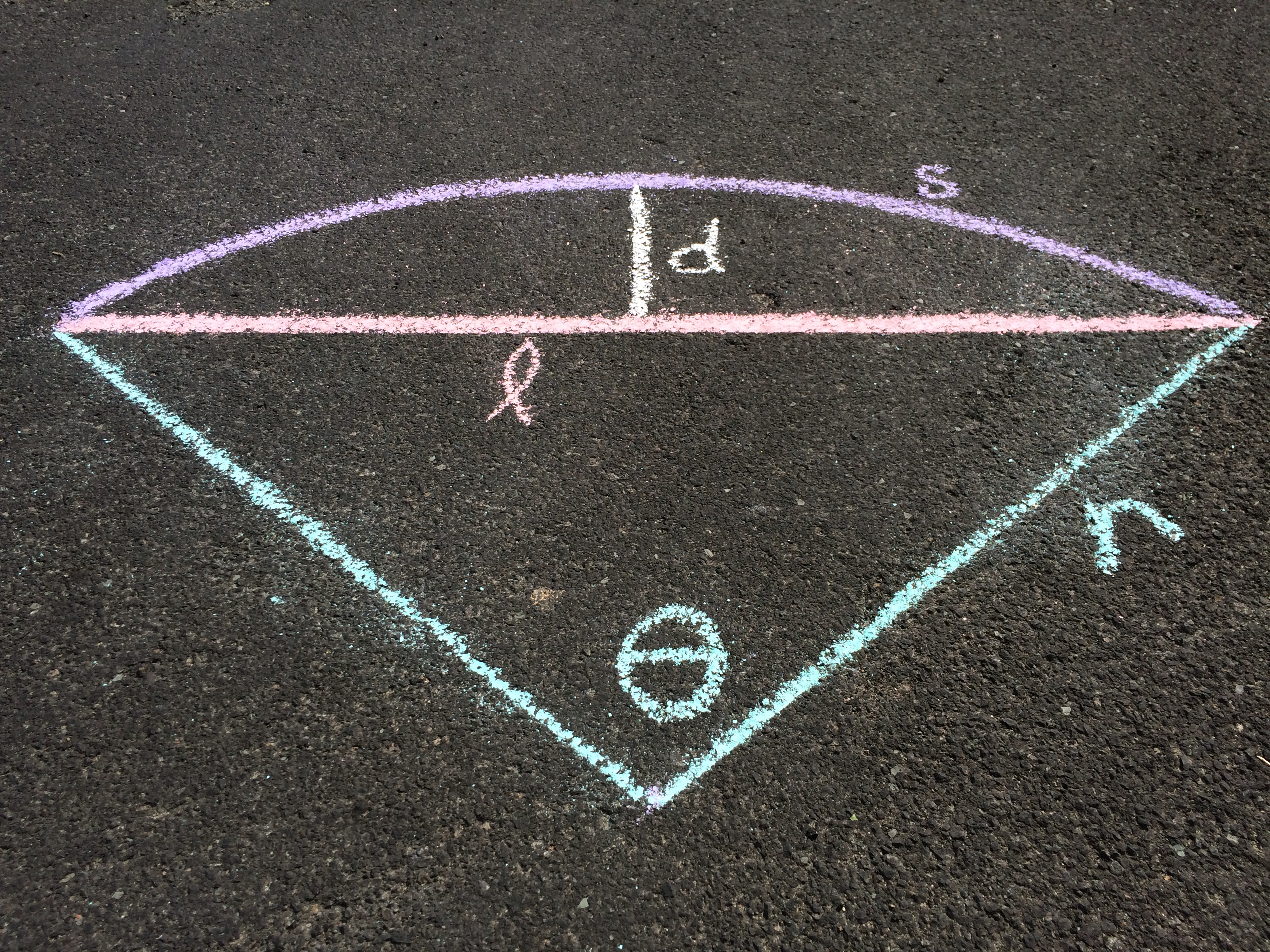
The span is determined by the creek bed. As bridge builders, we would have a specification for the height of the bridge or the steepness. If we know the span, l, and the height, d, we can know the steepness. Then, the rest falls into place: the center is determined; and, the radius can be found.


Aftermath
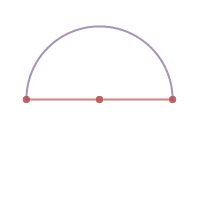
 Given chord (red) length l and height d (black) to the arc (purple).
We’ll use the formula for arc length, s.

To use the formula, we will need to find the radius of the circle, r, and the central angle, θ. If we can find the center, we can know the radius.
 Let w = l/2 and, following Descartes’ example, place this situation in the coordinate plane by centering the chord at the origin (0,0). The endpoints of the chord are (–w,0) and (w,0). The point where the height meets the arc is (0,d).
Next, draw two smaller chords. The chords are segments of lines. (Think: y = mx + b)


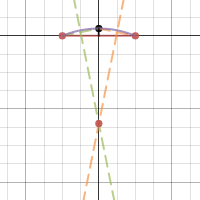 The perpendicular bisectors meet at the center, (h,k). The slopes of these lines are negative reciprocals of the chords’ slopes. Point-slope form will come in handy.


The radius is the distance from (0,d) to the center.

It may seem like we don’t know anything, just a bunch of variables. Remember, w and d are known. For example, w could be 5 m and d could be 0.5 meters. Then, use the formula above to find r.
We still don’t have θ, and we’ll need it to calculate the arc length.
 There is a right triangle formed with the center, the origin, and the point (w,0). The acute angle at the center is half of θ.


With r and θ in hand, we can calculate the arc length, s.

Cancel the leading twos.

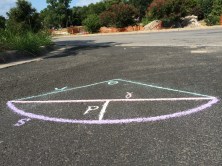 If the bride spans 10 m and the height is 0.5 m, then w = 5 and d = 0.5 m. Plug those into your calculator to find the arc length s is about 10.07 m: only 7 cm longer than the span.
You can see a little more detail in the desmos graph. It has the formulas built in as well.
Also, please keep in mind there is more than one way to tackle this question. I encourage you to find another path to the solution.
 Footpath Math: Chalk it up to a math geek
2 thoughts on “Pershing Pedestrian Bridge”