
 High school geometry changed my life. Really.
I loved proofs. I loved geometric constructions. Life on the Euclidean plane had order; it made sense, in an amazing way.
Need to find the midpoint of a line segment? No problem.
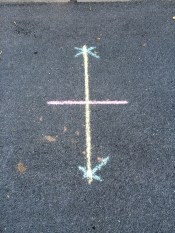 Draw two circles (or just parts of them), and then draw the line determined by the intersections of the circles. Not only do you get the midpoint, you get a perpendicular line cutting the first segment into two equal parts, i.e. bisecting the segment.
The recipe for finding the midpoint was much easier to follow than instructions for finding a date to a dance: draw infinitely many circles, wear cool shoes, and hope she asks you.
How do I know this works? (The geometry, that is.) Back in 1988 AD, we rocked the two-column proof. Around 300 BC, Euclid’s Elements included prose proofs. (Yes, the proofs will be Greek to you, unless you read the English translation.)
The perpendicular bisector results from propositions 10 & 11 of Book 1 of the Elements. The Elements was the beginning of the axiomatic approach to mathematics. Euclid gathered, refined, and expanded known mathematics. In the description below of his proof, you will get a sense of the approach.
Folks at the University of Texas host a PDF of the Elements with side-by-side Greek & English as well as figures. Proposition 10 (“To cut a given finite straight-line in half.”) appears on page 15 along with a proof.
Another great resource for the Elements is the Clay Mathematics Institute. They have side-by-side Greek & English along with high resolution images of “The manuscript MS D’Orville 301 contains the thirteen books of Euclid’s Elements, copied by Stephen the Clerk for Arethas of Patras in Constantinople in 888 AD.” Proposition 10 is here. Be sure to take a look at the image from the 1100+ year old manuscript.
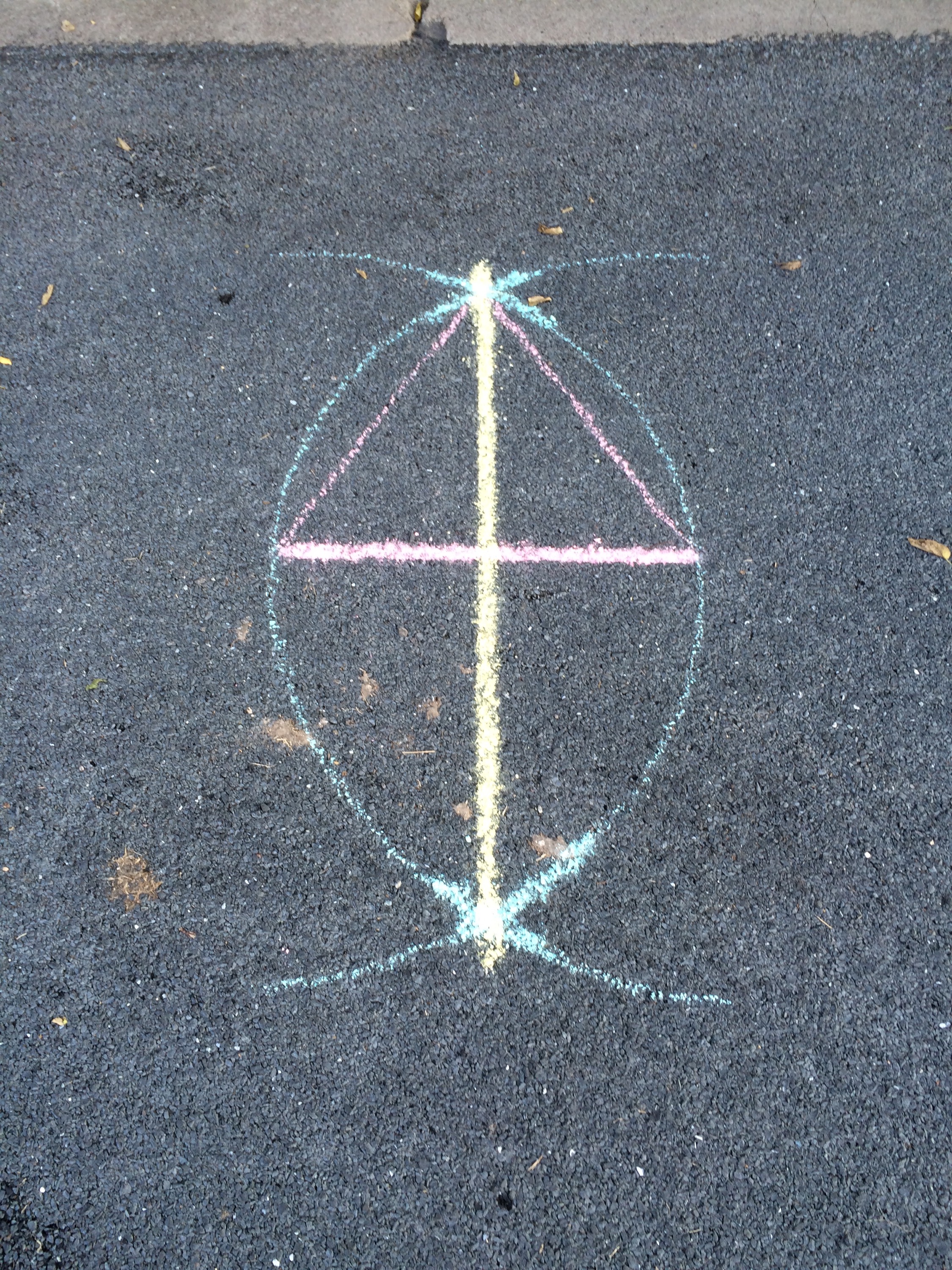 The construction produces a perpendicular bisector. The proof takes a little more work than the construction. Euclid starts by building an equilateral triangle using Proposition 1. According to Proposition 9, the line cutting through the new triangle bisects the angle opposite of the given segment.
Then, Proposition 4 delivers the proof of Proposition 10 by ensuring the congruence of the two segments opposite from the angle-halves. Then, perpendicularity comes from Proposition 8 which insists the angles forming a linear pair are equal. Definition 10 takes care to note the equal angles are right angles: “When a straight line set up on a straight line makes the adjacent angles equal to one another, each of the equal angles is right, and the straight line standing on the other is called a perpendicular to that on which it stands.”


 Footpath Math: Chalk it up to a math geek
One thought on “Perpendicular Bisector”