 Lorenzo Mascheroni was born in 1750 outside of Bergamo in what is now northern Italy. This was before Napoléon Bonaparte was born, much less taking over the world, and Lombardy was under Austrian control.
Young Lorenzo grew up in a wealthy, landowning family. Math folk like to think big, really big, infinitely big. Mascheroni was not the first nor the last mathematician-priest. He was ordained at the age of 17. Napoleon was born two years later.
 After accumulating experience teaching rhetoric, math, and science, Mascheroni became a math professor at the University of Pavia. Three years later, he was appointed rector of the university. This was 1789: the year Mascheroni celebrated his 39th birthday; and the year when, one month and a day shy of Napoleon’s 20th birthday, the French Revolution sparked into action with the storming of the Bastille.
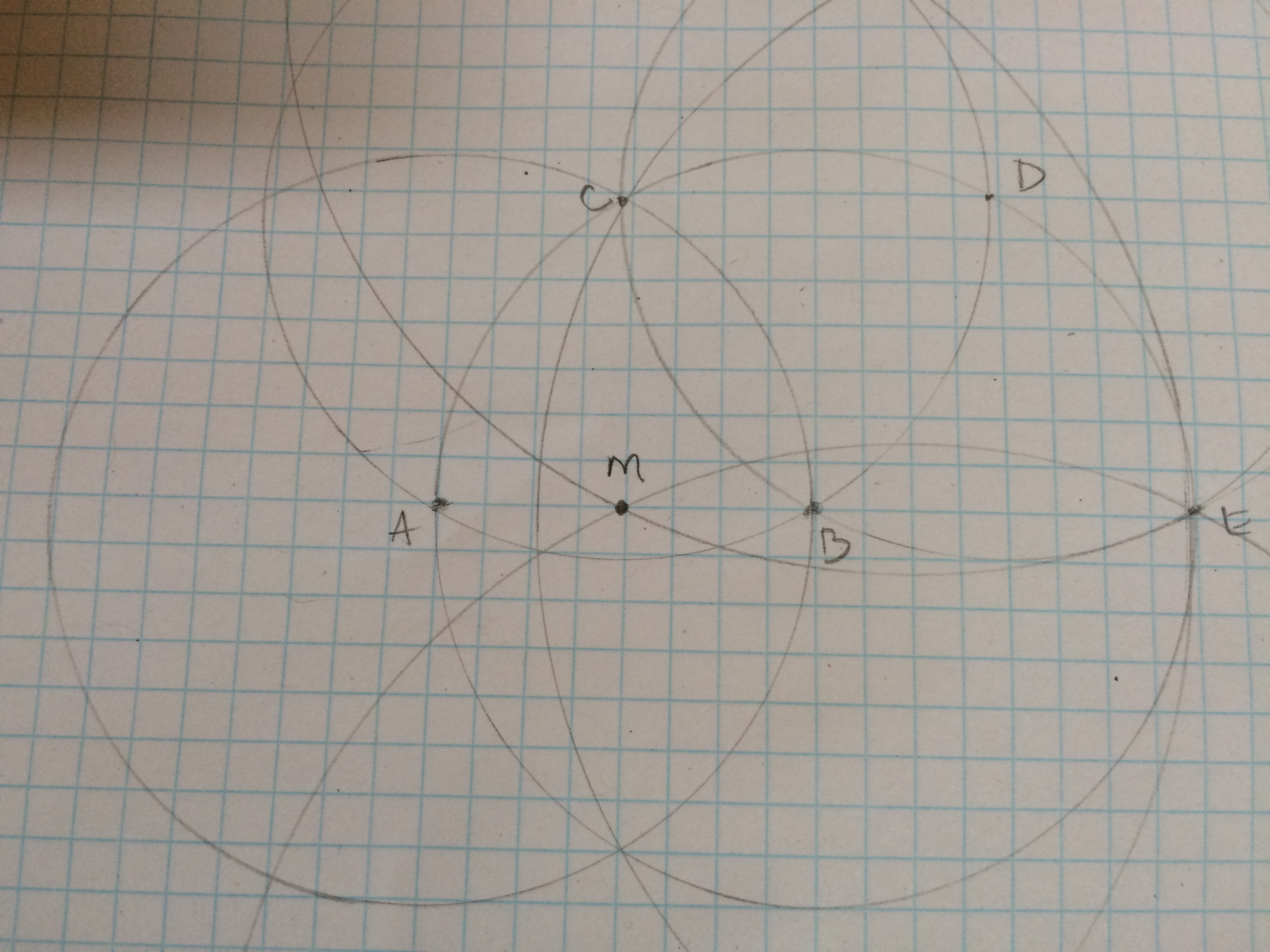
 For Mascheroni, the 1790s started with publishing a paper of annotations on a paper by Euler. Later, while Lagrange and others were at work drafting up a standardized metric system, Mascheroni was working on a proof that any geometric construction involving compass and straightedge can be completed using compass alone.
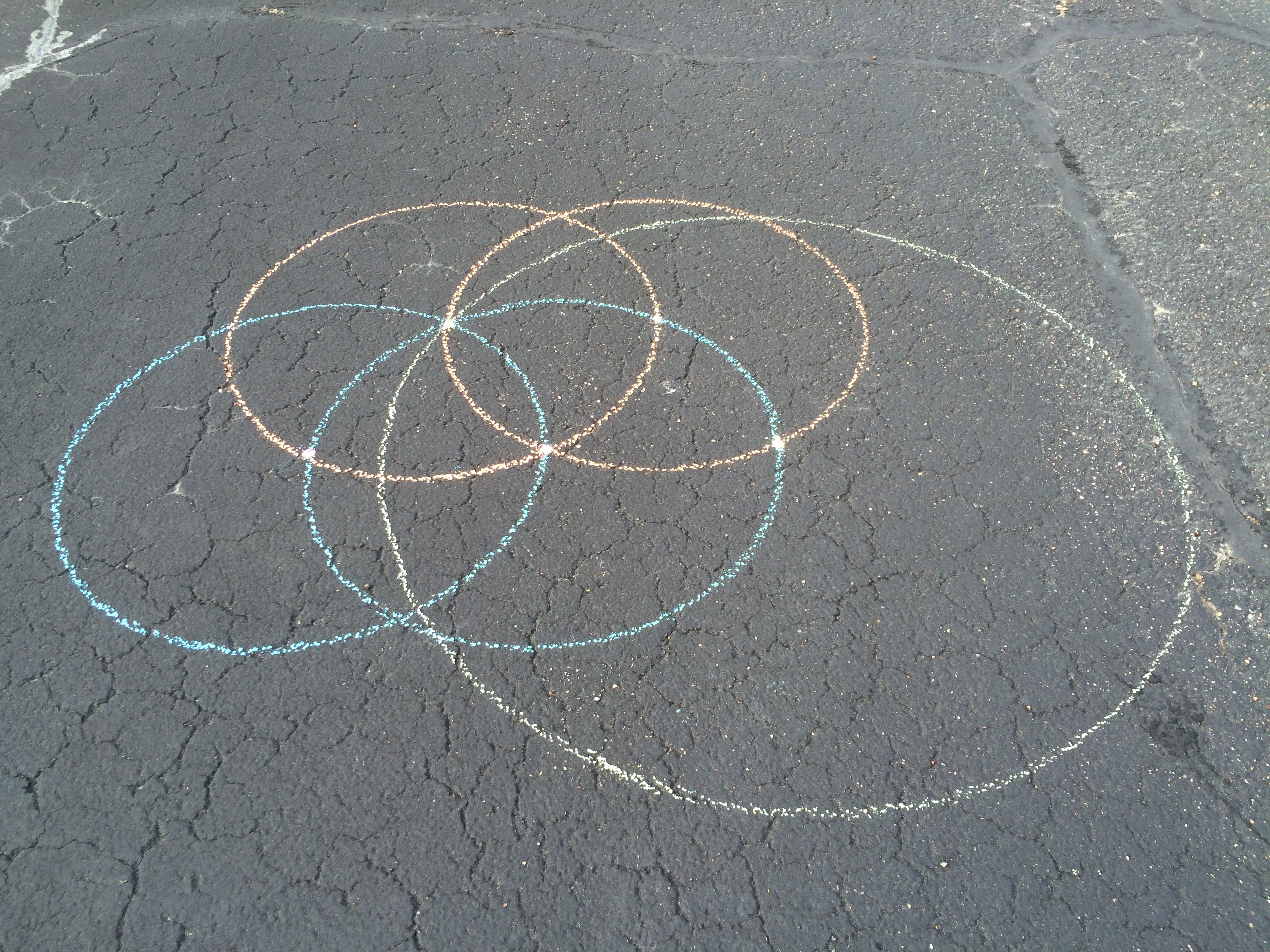 Mascheroni published his results in 1797 in Geometria del compasso. (The text also can be found in the Internet Archive.) The text is dedicated to Napoleon. Pavia was ruled by Austrians until 1797 when it came under the control of the French. Mascheroni is not pandering to a new power; Napoleon is said to be a man “who admired mathematics and was himself an amateur geometer” (Eves 543). (Insert your own joke about rulers, people who like to rule, and so forth.)
 Before the War of the Second Coalition began in 1798, Mascheroni traveled to France to study and report on the new metric system. The coalition of European forces took northern Italy back from Napoleon while he is away in Egypt. (Fourier is appointed governor of Lower Egypt in 1798 while traveling with Napoleon.) Mascheroni was unable to return to Milan, now under Austrian control. Lorenzo Mascheroni dies in Paris due to complications of a common cold at the age of 50, four years shy of Napoleon’s ruler-only construction of an empire.


Construction Notes
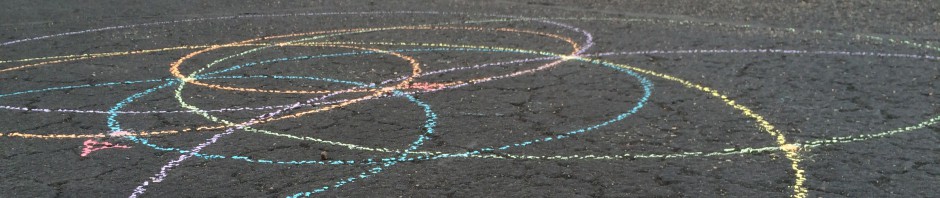
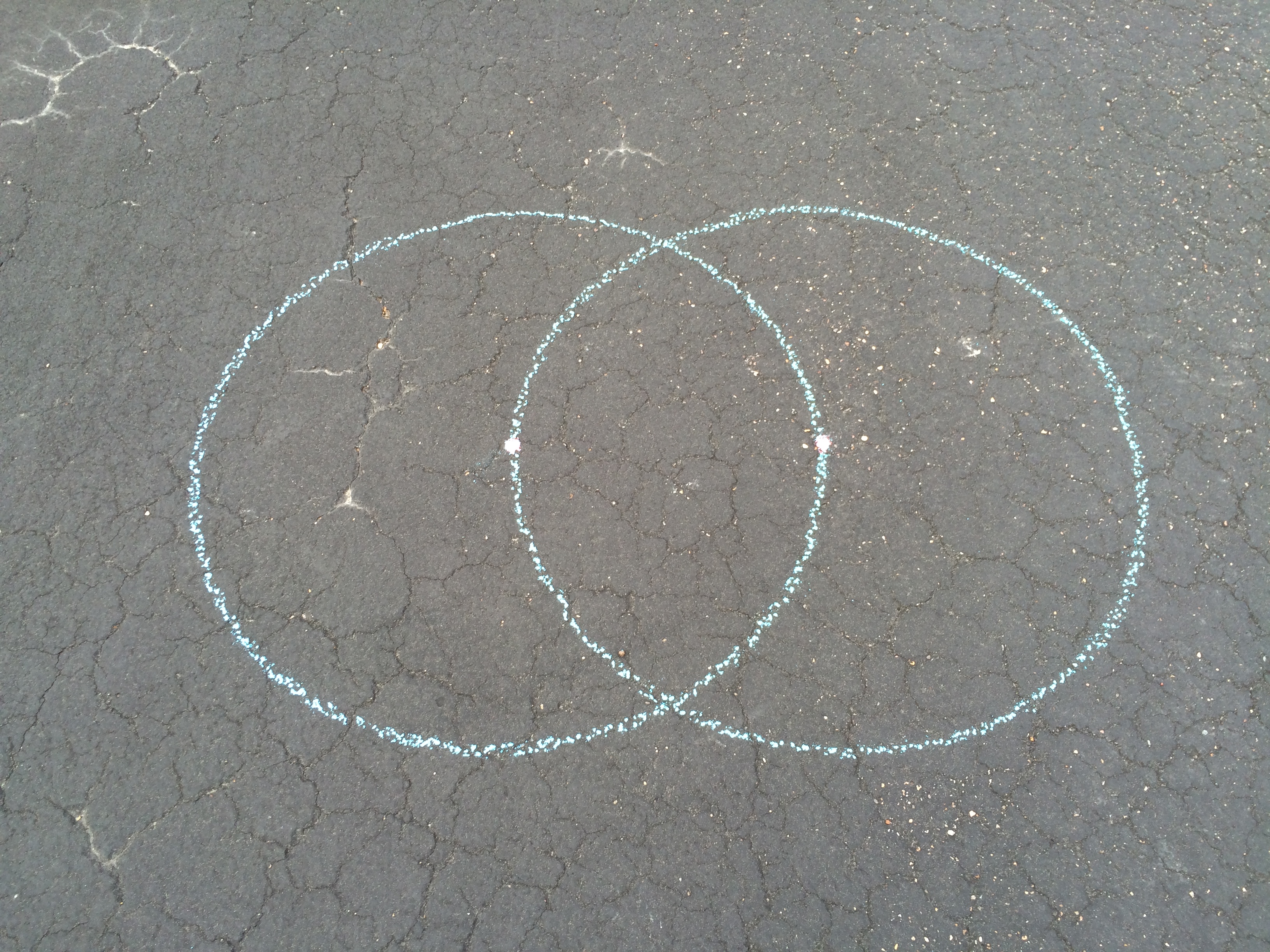
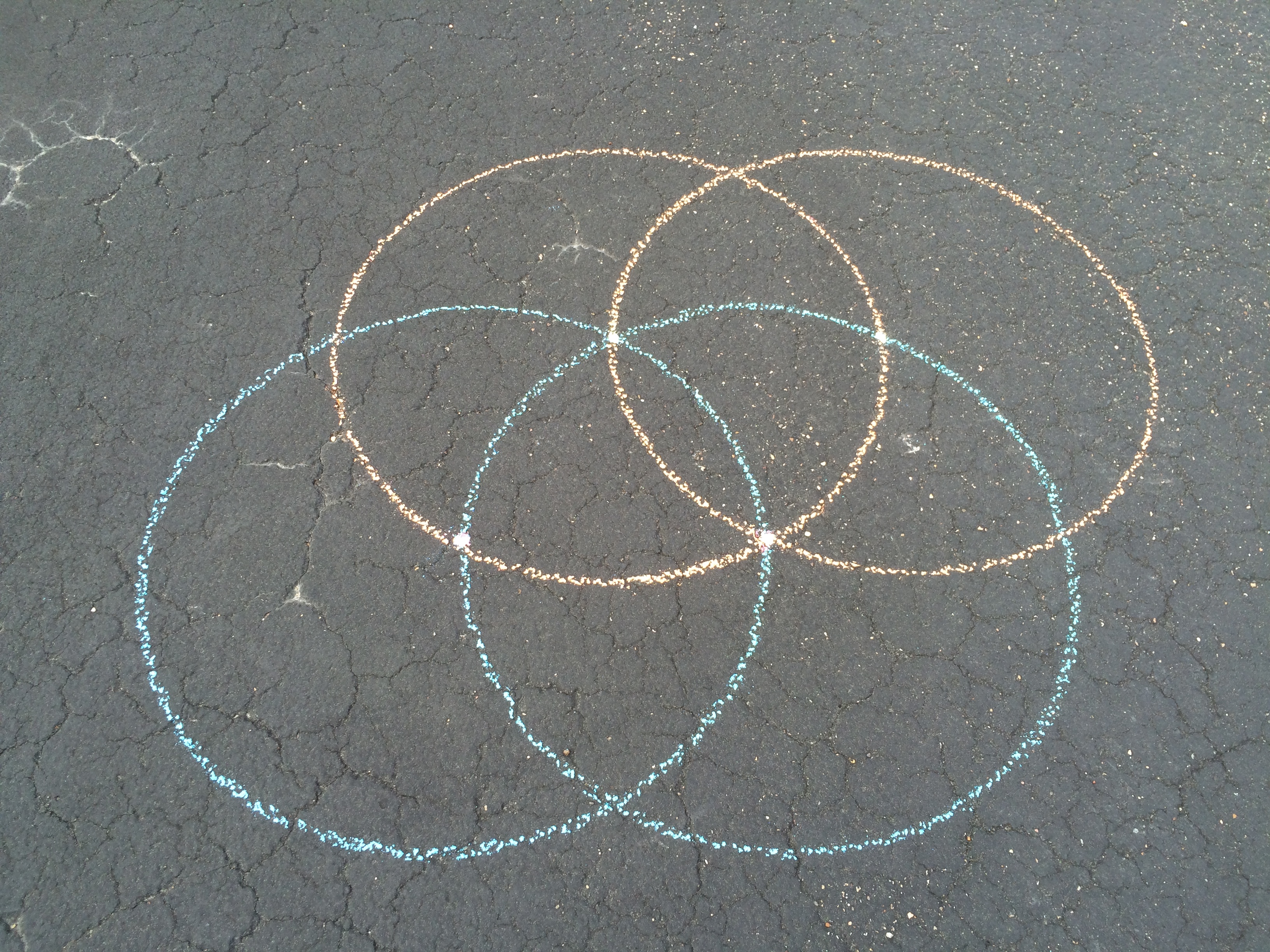
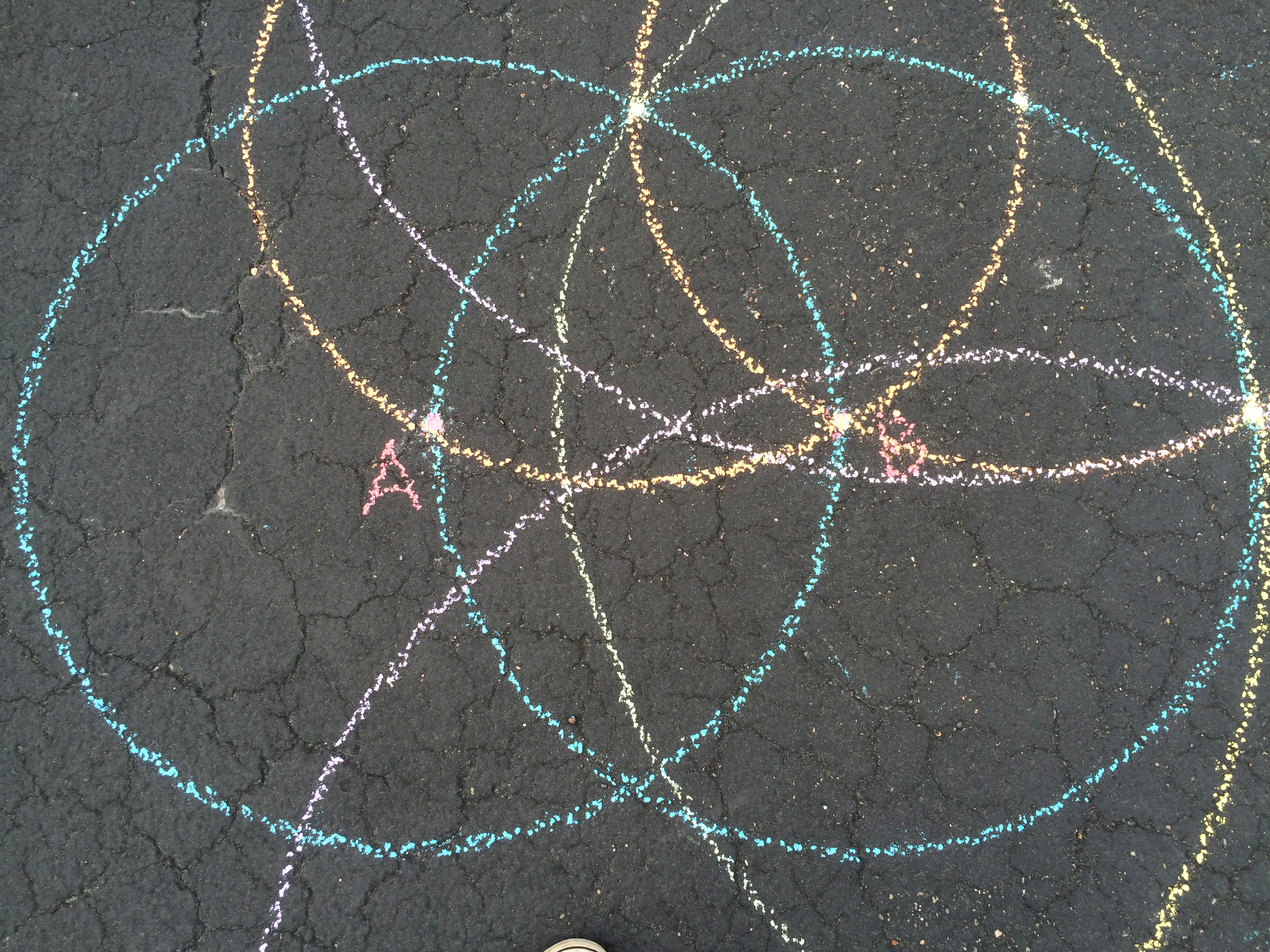
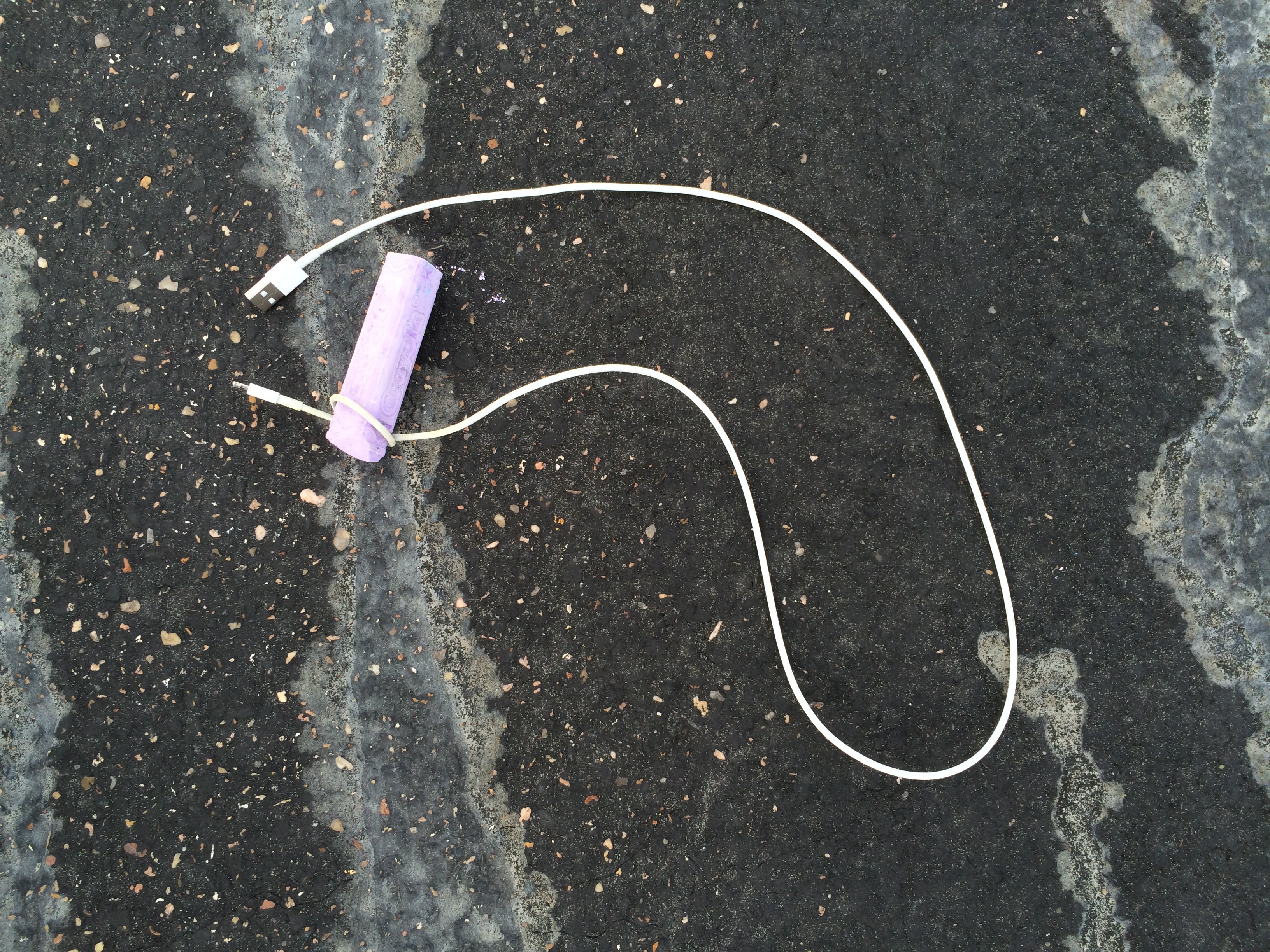 The Mascheroni construction featured here locates the midpoint between two given points. String, USB cable (my hunk of string was too short), and chalk turn out not to be high precision instruments. Maybe I just needed more practice with my tools. I missed the midpoint due to accumulating error. I did a better job with paper, pencil, and compass.
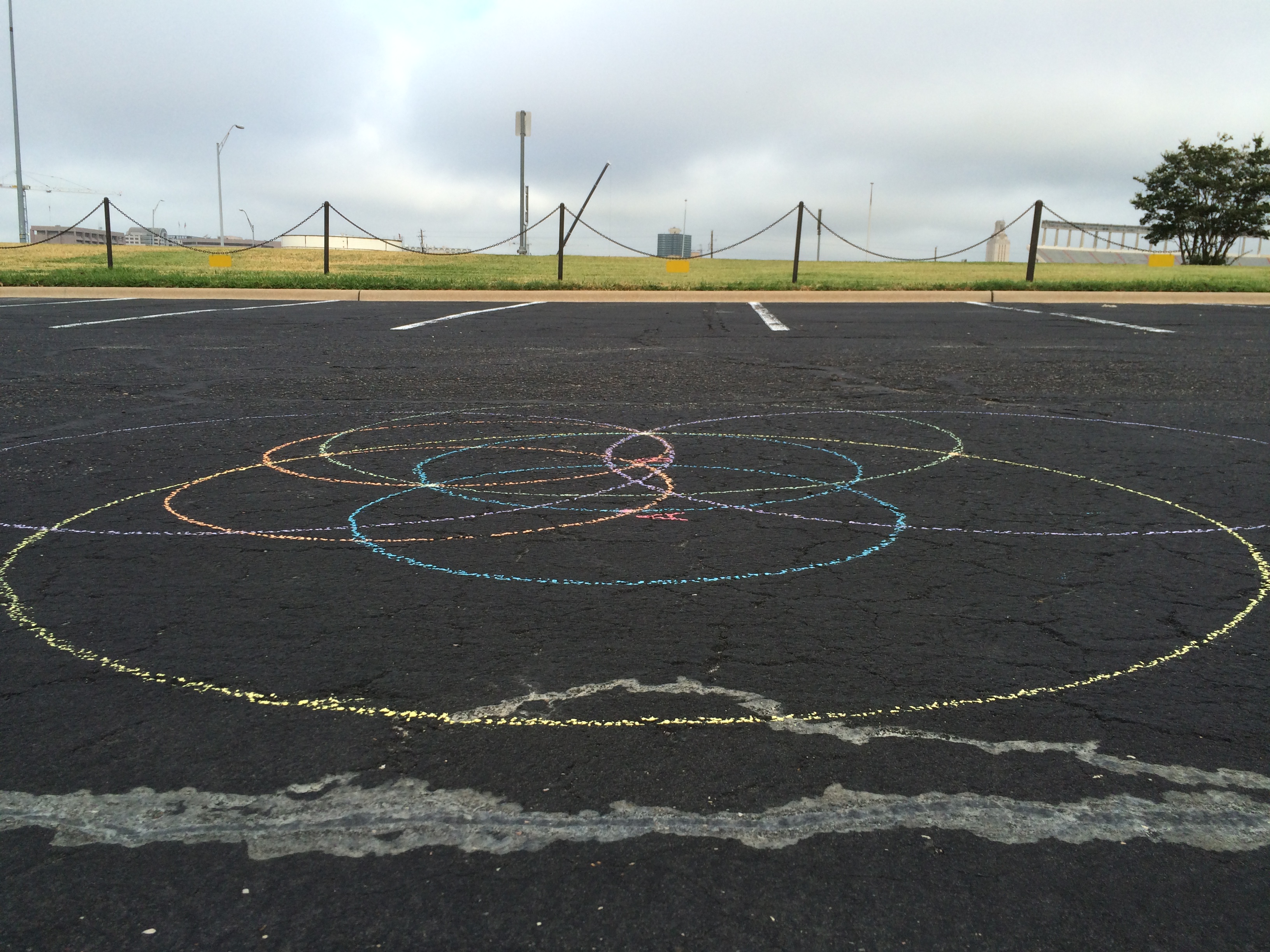
Many construction projects are afoot in Austin, hence those cranes in the background. Condos, offices, and a medical school grow every day. I found a spot just east of I-35 and the university to do a little of my own construction.
In 1672, the Danish mathematician Georg Mohr published a proof of compass-only constructions. Priority for the result lies with Mohr. For more on compass-only constructions, see Bogomolny’s article on Cut the Knot.
References
Bogomolny, A. “Geometric Constructions with the Compass Alone.” http://www.cut-the-knot.org/do_you_know/compass.shtml.
Eves, Howard. An Introduction to the History of Mathematics, 6th Ed. Saunders College Publishing, 1990.
O’Connor, John J.; Robertson, Edmund F., “Lorenzo Mascheroni.” From MacTutor History of Mathematics archive, University of St Andrews.
Weisstein, Eric W. “Mascheroni Construction.” From MathWorld–A Wolfram Web Resource. http://mathworld.wolfram.com/MascheroniConstruction.html
 Footpath Math: Chalk it up to a math geek