
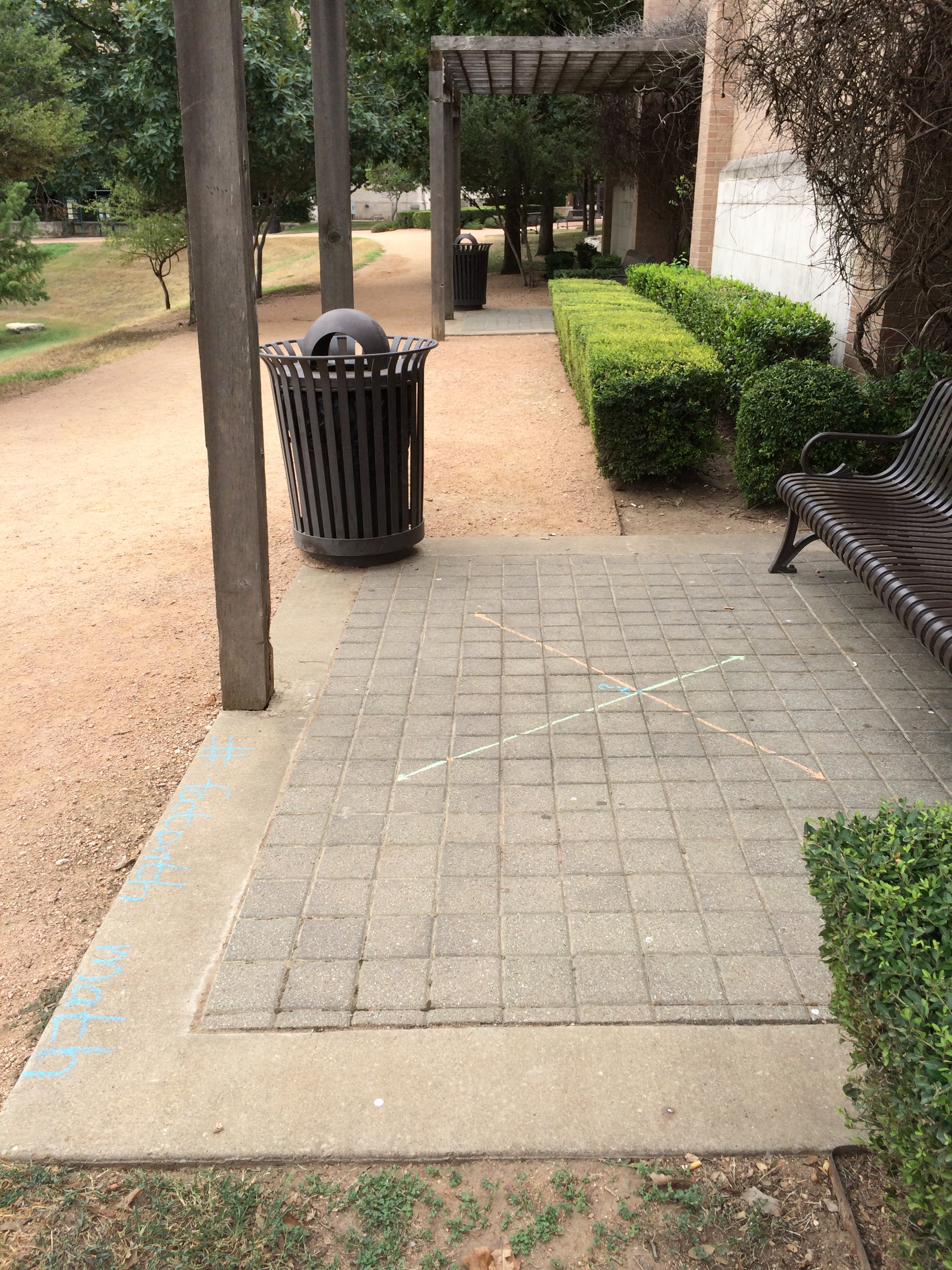
 Life stands up to the downward force of gravity every day. From table legs to your legs, perpendicularity provides balance and strength.
Perpendicular lines played an important role in finding the center of the arc of the bridge in the Pedestrian Bridge post. In writing the equation of those perpendicular lines, I used a concept I picked up in high school Algebra 1. In that post, stated it about as plainly as I learned it: “The slopes of these lines are negative reciprocals….” A little more seems appropriate.
First, a quick refresher on slope. The slope of a line is the steepness, the rate the line goes up or down from left to right. It’s the m in y = mx + b. (I love origin stories, and I tried, to no avail, to find out why m is used for slope. Like others, I thought the m might refer “mountain”, but that is pure conjecture.) If a line has a slope of 3/4, that means it goes up 3 units for every 4 units to the right.
Now, let’s talk about what we mean by “negative reciprocal”. Those two words are a concise way of saying, “the flipped fraction with the opposite sign.” For example, the negative reciprocal of 3/4 is –4/3.
One handy trait of negative reciprocals is they produce –1 when multiplied.

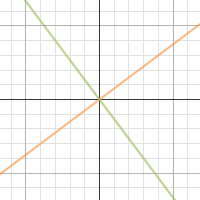
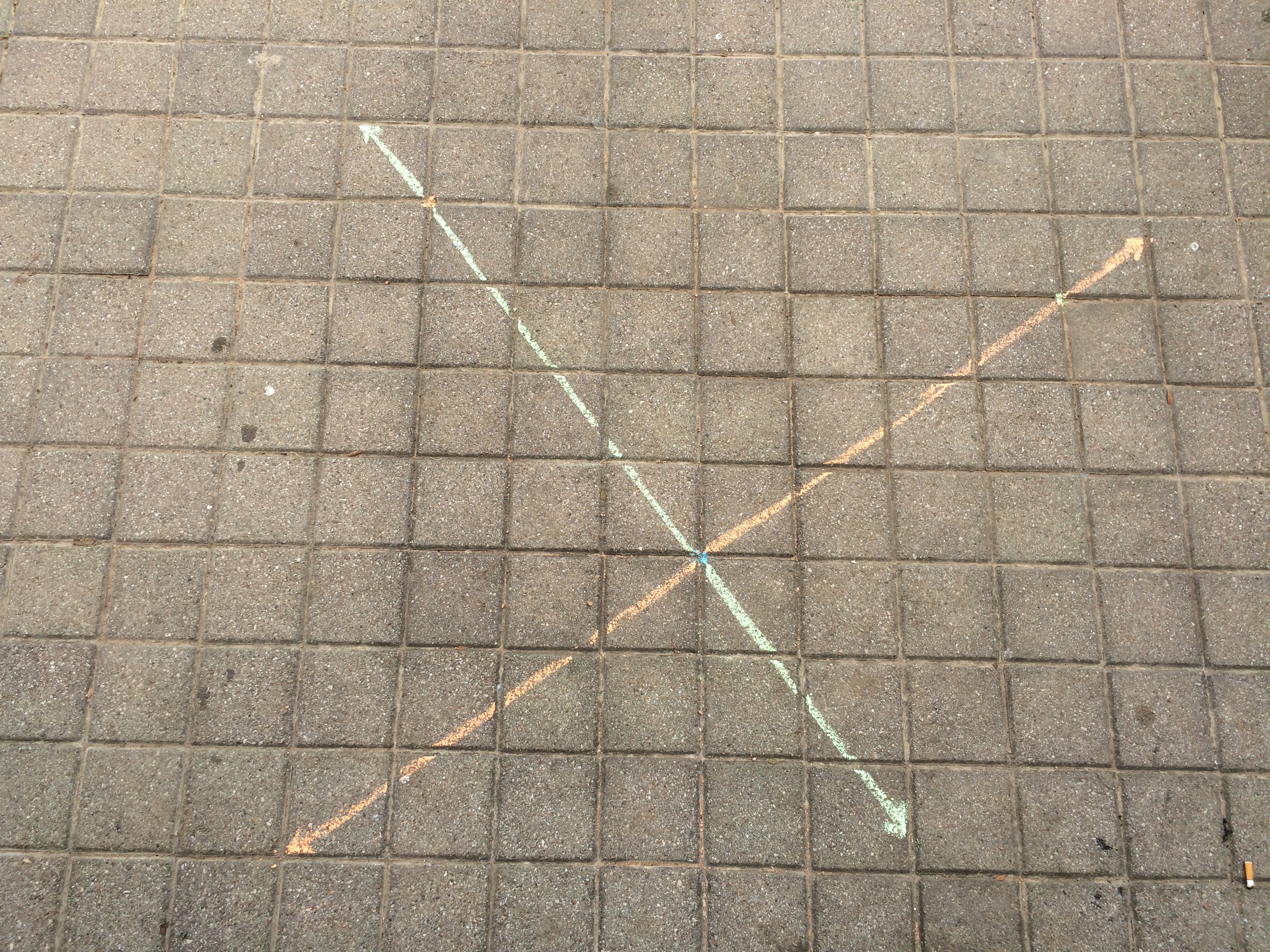
What I learned in Algebra 1 is, “If the product of the slopes is –1, then the lines are perpendicular.” The converse of the statement is true, too. If two lines are perpendicular, then the product of the slopes is –1. I did not simply memorize these ideas, they also seemed to look right.
The next year in high school geometry I would learn to not rely on drawings for proof. (Turns out, unicorns may not be real despite the drawings.) Still, the graphs looked good, and the –1 implies perpendicularity idea seemed to work.
 This past week, I started to wonder. I looked in a couple high school math books. No proofs, just similar if-then statements about the product being –1. I could not recall ever crossing paths with a proof. So, I used a little high school Geometry to complete a proof.
What follows is a proof of the first statement: “If the product of the slopes is –1, then the lines are perpendicular.” If you have had some high school Geometry recently, or if the Pythagorean theorem is in your back pocket, I encourage you to attempt your own proof of this –1 implies perpendicularity business before you read on.

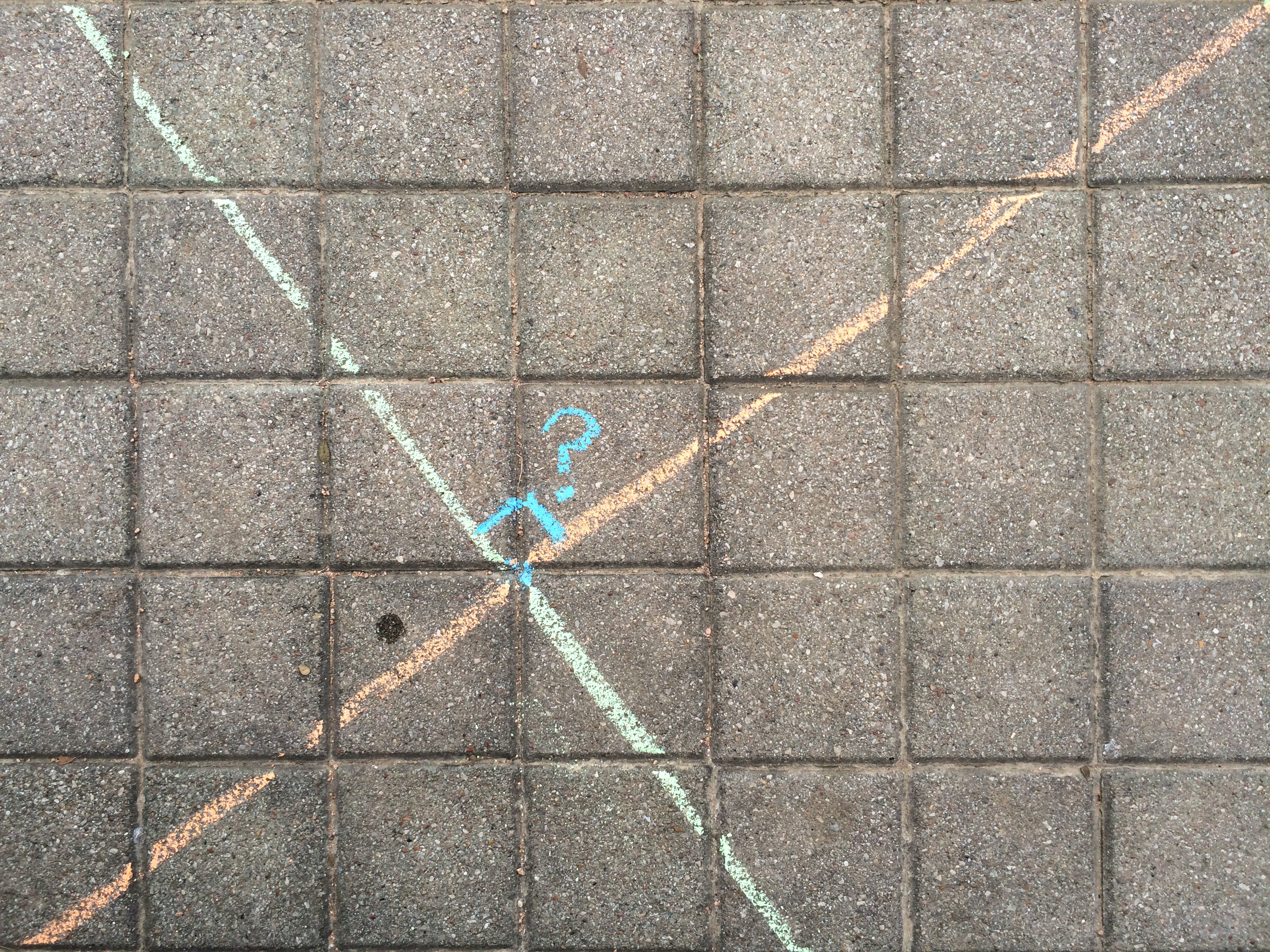

Let’s prove that the lines y = 3/4 x and y = –4/3 x are perpendicular. We’ll hold off on the general case until this one is put to rest. Here is the basic outline of the proof.
- Find points on the lines.
- Make a triangle with those points.
- Use the converse of the Pythagorean theorem to prove the triangle is a right triangle.
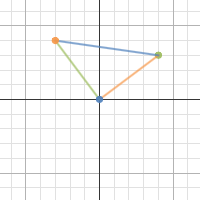
Since the y‑intercept of both lines is 0, both lines contain the origin (0,0). To find a couple more points, just choose x‑values wisely. The point (4,3) is on the first line.

The point (–3,4) is on the second line.

We have a triangle. The question is whether or not the angle at the origin (0,0) is a right angle. The converse of the Pythagorean theorem will come in handy. If the sum of the squares of two sides of a triangle equals the square of the third side (a2 + b2 = c2), then the triangle is a right triangle. (You can find a proof for this in a high school geometry book.)
Time to find some lengths. The distance formula is a child of the Pythagorean theorem.

Use the distance formula to find the length, a, of the segment from (0,0) to (4,3) and the length, b, of the segment from (0,0) to (–3,4).


(Yes, a and b are equal.)
Next, find the length, c, of the segment from (–3,4) to (4,3).

Does a2 + b2 = c2?


Yes.
The triangle with vertices (–3,4), (0,0), and (4,3) is a right triangle with the segment from (–3,4) to (4,3) as hypotenuse. Thus, the angle at the origin is a right angle, and the two lines are perpendicular.
That proves the case for two particular lines. Before proving the general case, notice the following.

Similarly, b2 is simply the sum of the squares of the coordinates of (–3,4).

This works since the other endpoint of the segment is (0,0). (Folks familiar with vectors will recognize the dot product at play here.) If you square both sides of the distance formula, you can get to these same shortcuts.

If you have reached your math limit, stop here. Or, at least take a break. Rest, hydrate, and come back later.



The proof for the general case follows the same path as the previous proof. This time, however, switch out 4 and 3 for u and v respectively. (No great significance to the choice of u and v. We already used a, b, x, and y.) The lines of interest are the following.

The product of the slopes is again –1.

(Note: We suffer no loss of generality by leaving the y-intercepts as zero. The y-intercepts do not affect the slopes of the lines or the angle between the lines.)
Similar points are on the lines. The triangle we want to be a right triangle has vertices (–v,u), (u,v), and (0,0). With a as the length of the segment from (0,0) to (u,v) and b as the length of the segment from (0,0) to (–v,u), a2 and b2 can be found using the shortcut noted above.


Let’s add a2 and b2 before moving on to c2.

Now, our friend c2 will get a little messier, but it will be okay.

Expand the binomials.

Cancel the 2uv terms.

This is exactly the result of adding a2 and b2. Therefore, the triangle is a right triangle, the angle at the origin is a right angle, and the lines are perpendicular.
∎


 Footpath Math: Chalk it up to a math geek
One thought on “Perpendicularity”