
 We staid till, it being darkish, we saw the fire as only one entire arch of fire from this to the other side the bridge, and in a bow up the hill for an arch of above a mile long: it made me weep to see it. The churches, houses, and all on fire and flaming at once; and a horrid noise the flames made, and the cracking of houses at their ruins.
Diary of Samuel Pepys from September 2, 1666
Over 400,000 people, including some of the world’s leading scientists, lived in London in 1666. The Great Fire swept through the city, leaving it charred, ruined.
Sir Christopher Wren was appointed as Professor of Astronomy at Gresham College in London, nine years before the fire. Alongside his astronomical work, Wren attempted to meet a mathematical challenge posed by Pascal in 1658. The challenge involved finding the surface area and volume of a figure created by rotating a cycloid around an axis.

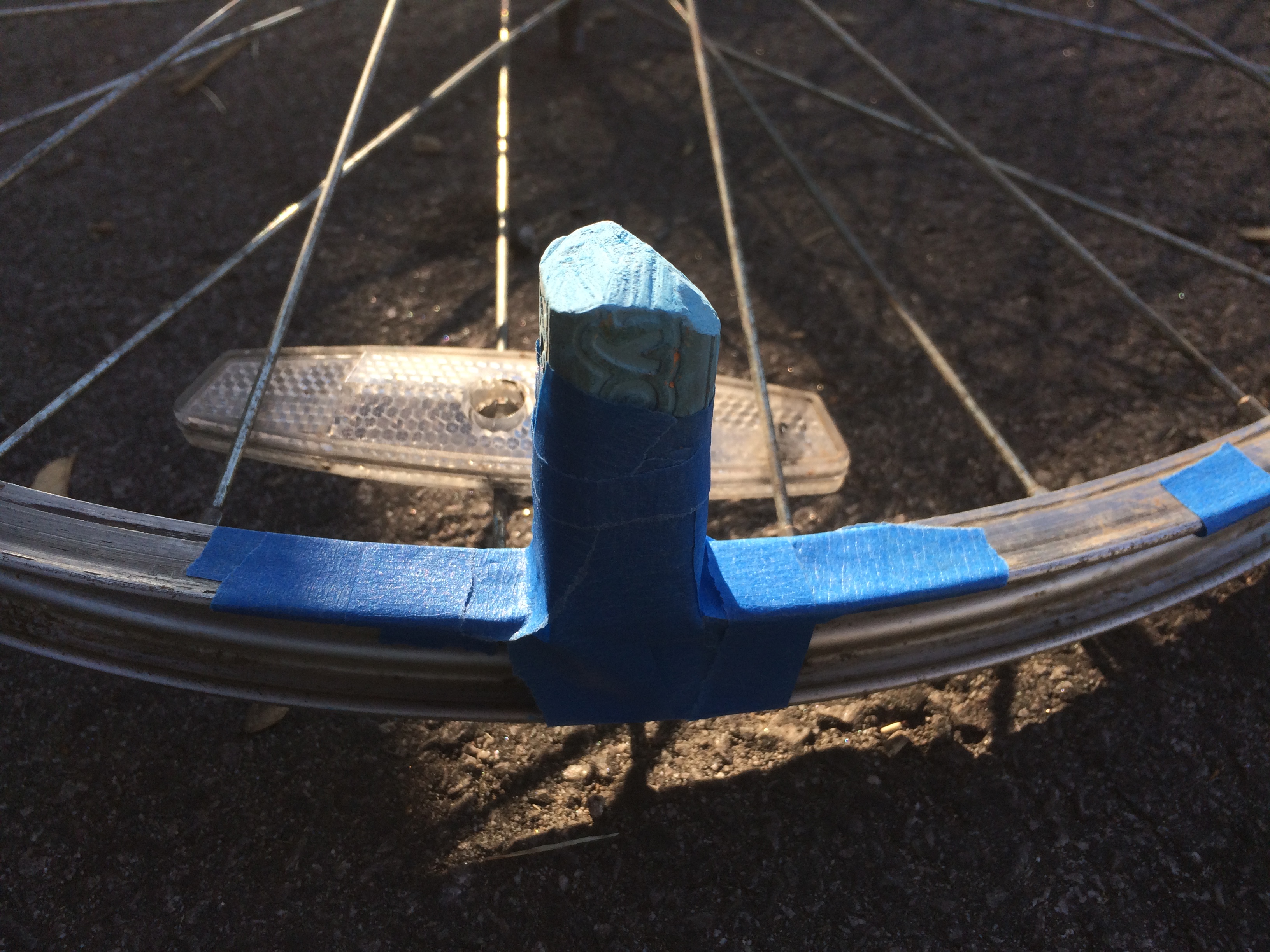
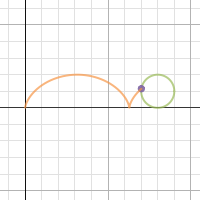 You can create a cycloid by tracing the path of a point on a circle, as the circle rolls along a straight line.
Wren did not find the solutions Pascal prompted, but he did discover the arc length of the cycloid. The arc length of one segment, corresponding to one revolution, is eight times the radius. That is, Wren determined that a point on the circle would travel 8a units when a circle with a radius of a made one complete revolution.
By the 1670s, Newton and Leibniz were both working on calculus concepts, but Leibniz would not publish his work on integral calculus until 1684. Wren and others were investigating Pascal’s cycloid questions without the tools of calculus. Wren used dissections, summing up segments of chords. We would use a definite integral.

In the years before the fire, one might find Wren with Robert Hooke performing experiments from atop St. Paul’s Cathedral or sitting in a coffee shop talking about those experiments. As a founder of the Royal Society, Wren had established himself as a leader in math and science by the time the fire crept its way from the little bakery on Pudding Lane on September 2, 1666.
In the years following the fire, Wren would put forth a plan for rebuilding London and served as architect for the many buildings. Wren’s most famous architectural work can be seen in the rebuilding of St. Paul’s Cathedral. Sir Christopher Wren died in 1723, at the age of 90, 12 years after the completion of the cathedral.
We were not done with the cycloid in 1658. Huygens put the cycloid to work as the solution to the tautochrone problem in 1673, and the Bernoulli brothers, in 1696, found the cycloid to be an answer to the brachistochrone problem.


References
Bragg, Melvin (Host). (Thu 11 Dec 2008). The Fire of London. BBC Radio 4 In Our Time. From http://www.bbc.co.uk/radio4
Eves, Howard. An Introduction to the History of Mathematics, 6th Ed. Saunders College Publishing, 1990.
Jokinen, Anniina. “The Great Fire of London, 1666.” From Luminarium. 23 Mar 2012. http://www.luminarium.org/encyclopedia/greatfire.htm
O’Connor, John J.; Robertson, Edmund F., “Cycloid.” From MacTutor History of Mathematics archive, University of St Andrews. http://www-history.mcs.st-andrews.ac.uk/Curves/Cycloid.html
O’Connor, John J.; Robertson, Edmund F., “Sir Christopher Wren.” From MacTutor History of Mathematics archive, University of St Andrews. http://www-history.mcs.st-andrews.ac.uk/Biographies/Wren.html



 Footpath Math: Chalk it up to a math geek
One thought on “Cycloid”