
 Trigonometric identities are like a set of high quality knives, staying sharp even when asked to slice, cut, and chop day after day. In Sine Squared, I used a Pythagorean identity to coax the value from an integral.

 An identity is an equality statement. x = x is an identity; x equals x for any value of the variable x. This is distinct from an equation such as x + 3 = 7, which only works for a particular value of x.
The Pythagorean identity above is true for any value of θ. That last symbol, the one before the period, is theta, the eighth letter of the Greek alphabet.
Pre-calculus courses are teeming with trigonometric identities. Some students hope to know them all, while some of us choose derivation as a means of reducing the memorization load. Of course, it tends to help if you have a bit of knowledge from which to derive new knowledge.


If you know some basics, then knowing one Pythagorean identity means you have two more identities well within your grasp. (In this case, a bird in hand gets you two from the bush.)
Divide the identity above by cosine squared.

Or, divide by sine squared instead.

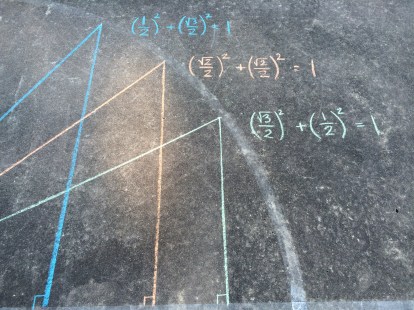
 But, how do we know the original is true for any value? Good question. If you would like a brief explanation, keep reading. Otherwise, I encourage you to investigate with a right triangle.
Recall that sine and cosine can be defined in terms of a right triangle. The sine of an angle is the ratio of the length of leg opposite of the angle to the hypotenuse. Some students remember this as “opposite over hypotenuse.” Cosine is the ratio of the length of the adjacent leg to the hypotenuse, i.e. “adjacent over hypotenuse.” Cosine is the sine of the complementary angle, hence the name co-sine.
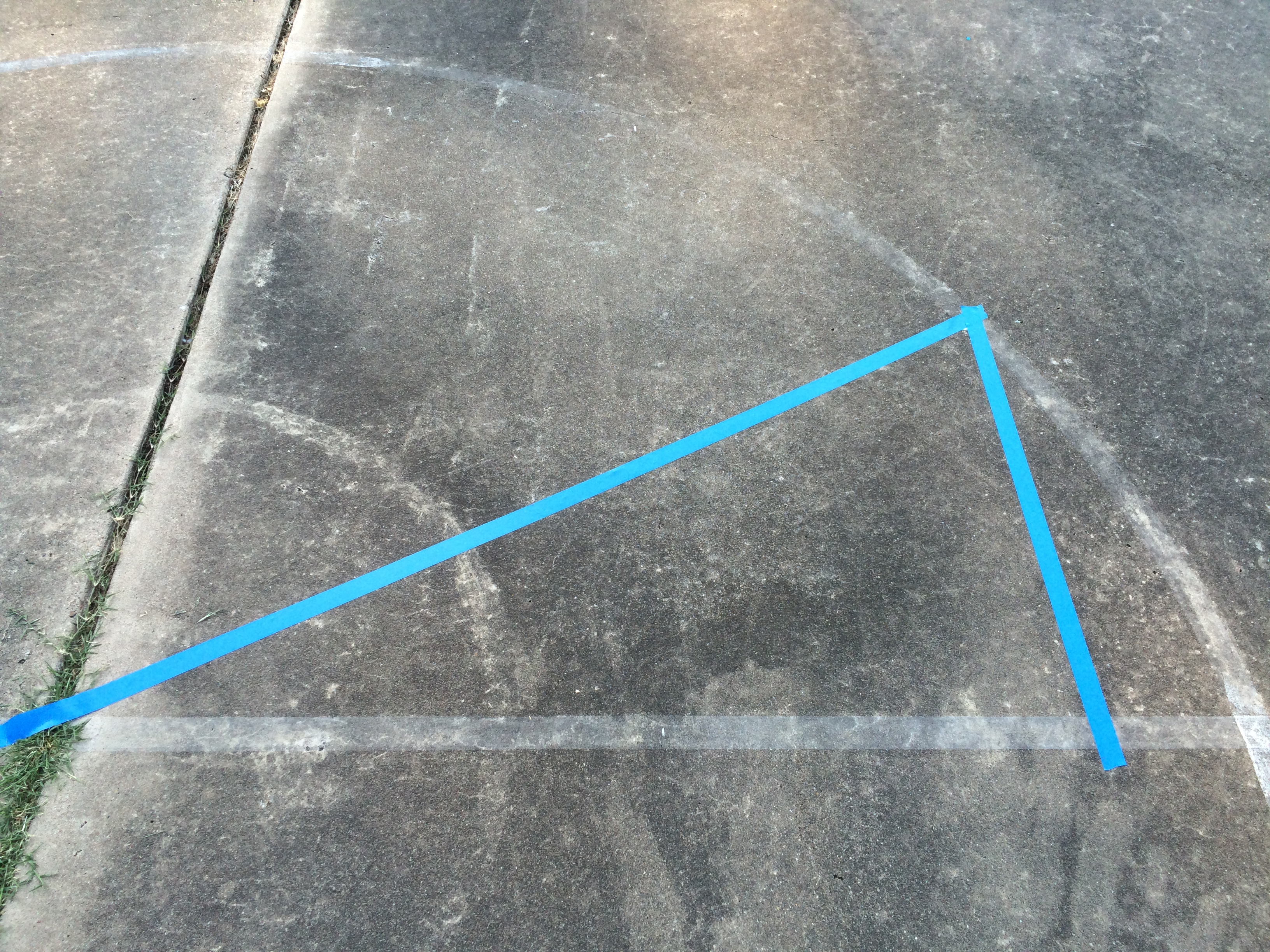 If the length of the hypotenuse is 1, then the sine of an angle is the length of the opposite leg. And, the cosine is the length of the adjacent leg. Now, what was the idea named for Pythagoras?

In this situation, c is the length of the hypotenuse, so it equals 1.

Do a bit of substitution, and you have yourself a proof.


 Footpath Math: Chalk it up to a math geek