
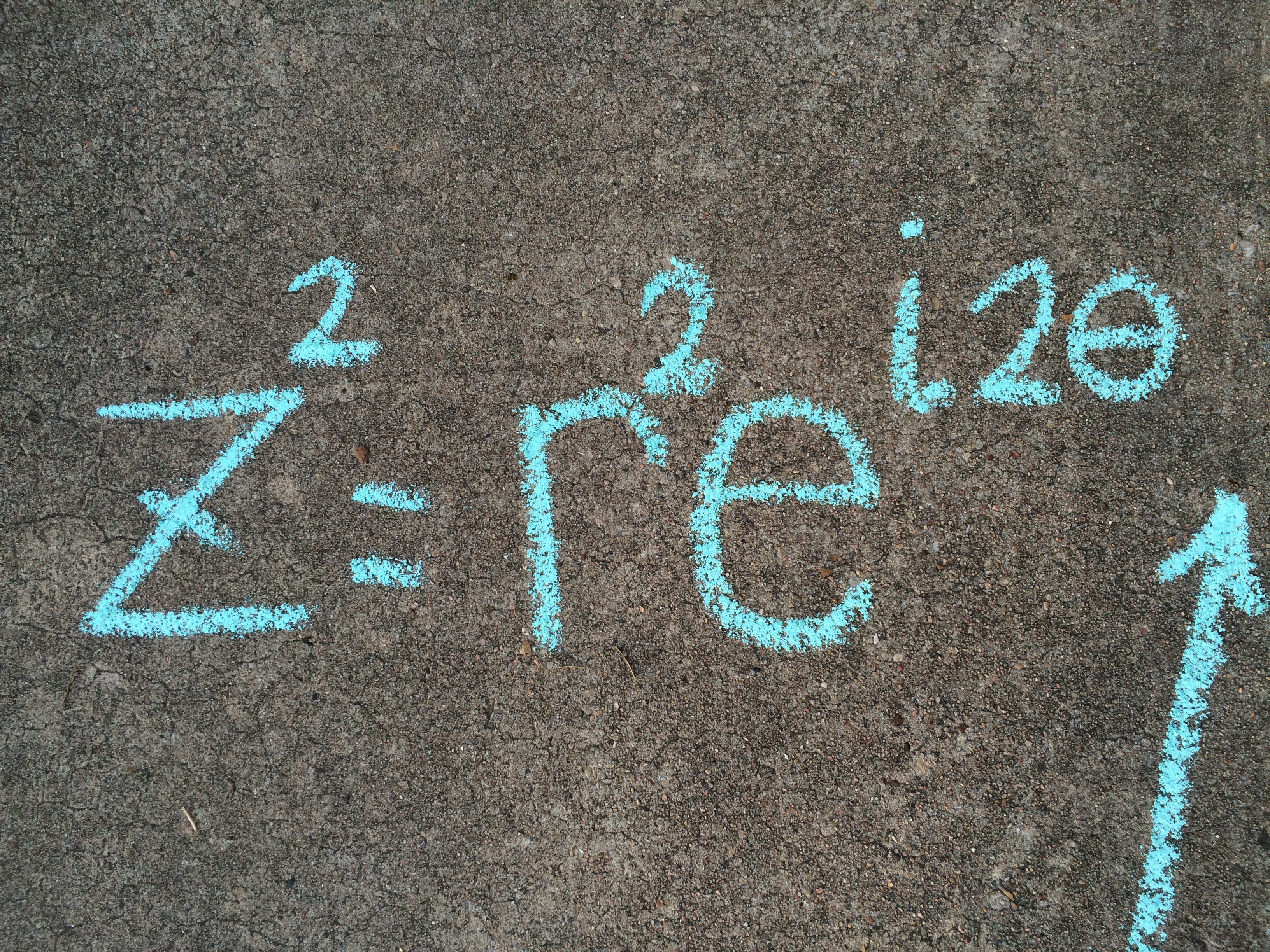
To square a complex number,
square the length,
and double the angle.
 A vector is a directed line segment, an arrow if you will. Think of a complex number, z = a + bi, as a vector from the origin (0,0) to the point (a,b). In polar form, z can be written in terms of r, the distance from the origin, and θ, the smallest angle of rotation from the positive x‑axis to the directed line segment. Wessel, Argand, and Gauss among others gave us the gift of this conception as we moved into the 19th century. Their work used trigonometry to recast z in terms of r and θ.

As you may have seen in the last post, the polar form takes on sleek, modern stylings when we use Euler’s formula.

But, why would you choose polar over Cartesian, i.e. rectangular or xy-based coordinates?
 We tend to think in a Euclidean paradigm of space: straight lines, flat planes, and right angles. The rectangular conception is a useful model, as long as we remember it is a model. Thinking in Euclidean terms can simplify giving directions through a city or building houses. But, there are circumstances when complex numbers in polar form ease calculations.
In 1893, Charles Steinmetz presented a paper in Chicago to the International Electrical Congress. In his paper, Steinmetz presented methods using complex numbers and algebra to answer electrical engineering (EE) questions. This was a great simplification. Prior to Steinmetz’s work, answering these questions involved solving differential equations.
If you want to see more detail on using complex numbers to answer an electrical circuit question, I suggest checking out Dr. Andrew Yeagle’s course notes: Complex Numbers and Phasors. If you take a look, know that our friends in EE use j instead of i for the imaginary unit. They do so because i was spoken for. It represents electrical current.
 If I want to find the value of z2 in rectangular coordinates, I need to remember to distribute. (3+2)2 does not equal 32 + 22.


Remember if i is the square root of –1, then i2 = –1.

Where did that point end up? The real part of z2 is a2 – b2 and the imaginary part is 2ab. Next, find the magnitude and angle of z2. Use a bit of algebra to find the magnitude, |z2|.

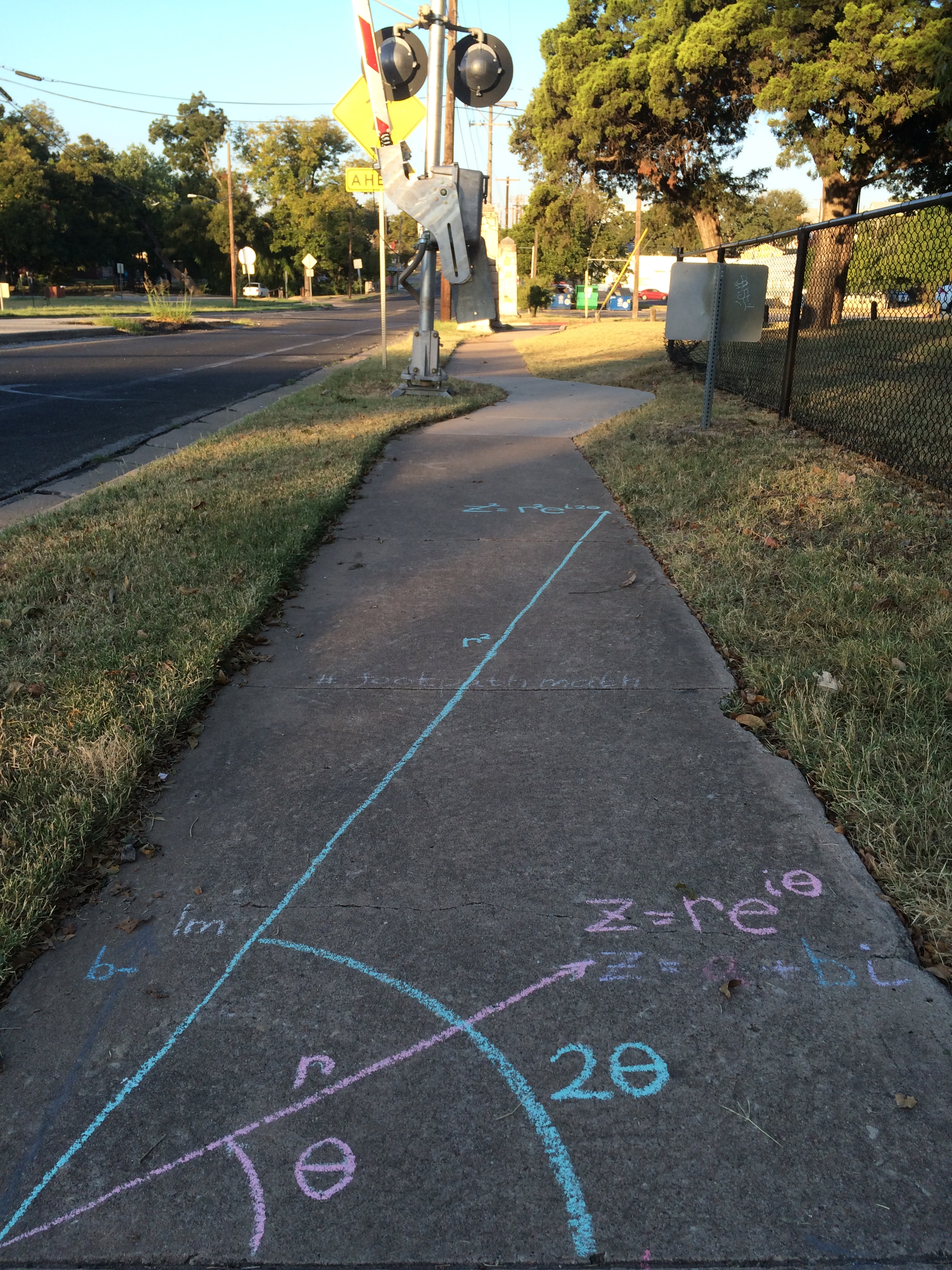 Let’s try polar instead. The polar form of complex numbers eases computation.


The magnitude got itself squared, and the angle went
and doubled.


References
Nahin, Paul J. An Imaginary Tale. Princeton University Press, 1998.
 Footpath Math: Chalk it up to a math geek
One thought on “Square of a Complex Number”