
 Abraham de Moivre was born in France in 1667, a year after the Great Fire in London. de Moivre arrived in London in the late 1680s. Leading up to his emigration, life in France for Huguenots, i.e. French Protestants, was growing ever more uncomfortable.
As Louis XIV consolidated power, he grew to see religious tolerance as a sign of weakness. In 1685, with the Edict of Fontainebleau, Louis XIV revoked the protections afforded to Protestants by the Edict of Nantes. Huguenots were expelled and imprisoned. de Moivre was imprisoned in a priory at the age of 18, presumably with the intent of conversion.
 Within a few years, de Moivre made his way to London. Despite the distraction of persecution (or maybe because of it), de Moivre had been studying math of his own for years, and, in London, he worked as a private math tutor. He carried pages of Newton’s Principia in his pocket so that he might read and study on his way from one appointment to another.
Over time, de Moivre befriended both Halley and Newton. He served on the commission of the Royal Society that attempted to sort out who found calculus first: Newton or Leibniz.
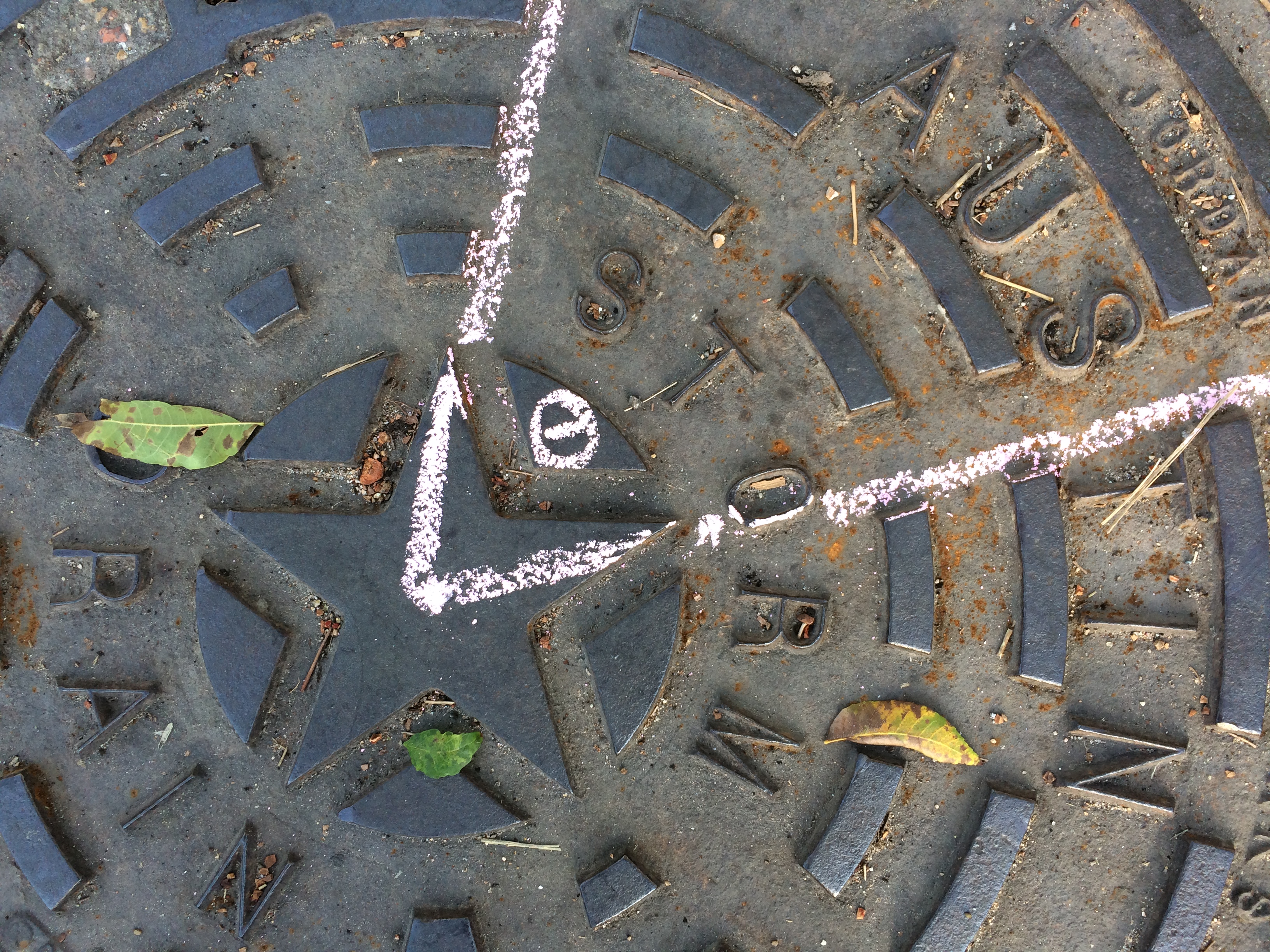 Early in the 18th century, de Moivre published a paper which included a formula for the power of a complex number. This was before Wessel, Argand, or Gauss cast complex numbers as geometrical objects and before Euler worked his magic. However, we have the benefit of living in de Moivre’s future, and we can use what conceptions we might.
Recall, polar coordinates were introduced in a recent post.
| Polar | Rectangular |
 |
 |
Then, in the last post, things went square.
 |
 |
Recall from a couple of weeks ago, a, b, and r have a trigonometric relationship. If I choose a point such that the magnitude, r, is 1, then a = cos θ and b = sin θ. Let substitutions commence.
 |
 |
Invoke Euler’s formula on the left.
 |
|
I think you will agree that z2 = z2.

If you let n = 2, this last equation is a consequence of the shortcut known as de Moivre’s formula.

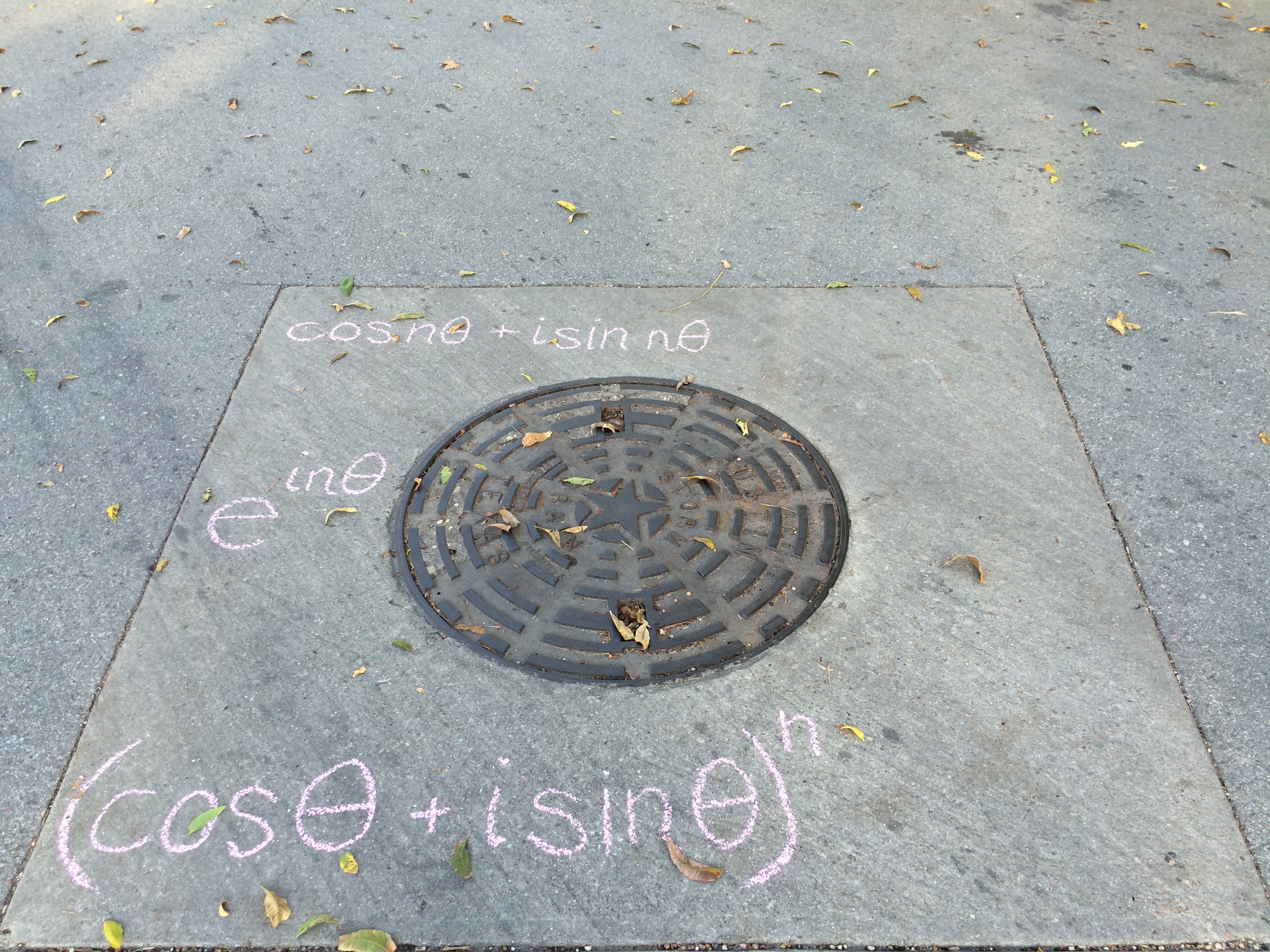
 de Moivre published this formula in 1722, before Euler’s formula was available. A couple of decades later, Euler proved de Moivre’s formula for any real n. Of course, Euler had access to Euler’s formula. de Moivre’s formula gives us a shortcut to trigonometric identities. Let’s go back to the equation above with cos 2θ + isin 2θ and do a little footwork.
Given the graphical representation of complex numbers, you might accept the fact that when two complex numbers are equal, the real parts have to be equal and the imaginary parts have to be equal.
| Real | Imaginary |
 |
 |
Voila, formulas for cos 2θ and sin 2θ.
Late in life, de Moivre starting sleeping 15 minutes more each night. He predicted he would die when he reached the day when he would sleep 24 hours. That day came in November of 1754.


References
Ball, W.W.R. A Short Account of the History of Mathematics. Macmillan & Co., LTD. 1912.
Nahin, Paul J. An Imaginary Tale. Princeton University Press, 1998.
O’Connor, John J.; Robertson, Edmund F., “Abraham de Moivre.” From MacTutor History of Mathematics archive, University of St Andrews. http://www-history.mcs.st-and.ac.uk/Biographies/De_Moivre.html





 Footpath Math: Chalk it up to a math geek