
 I have been working with some middle and high school students this fall. It has only been a few short years since they were learning the basics. They retain some of those basics as disembodied rules, rules with no meaning or purpose. The situation seems to hinder them from experiencing the beauty and wonder that is high school Algebra I. (If you just made a strange sound of disgust or dismissal, maybe your own experience was hindered as well? Either way, I invite you to read on.)
Let’s set the stage for some of the beautiful questions, such as why a negative times a negative is positive or why a number to the zero power is 1, by going back to basics.
When we first learn about addition, we are just crawling our way from learning how to count. We typically learn addition as a way to find the total number of objects in two sets. Our math worksheet has a drawing of 2 cherries and a second drawing of 3 cherries, and we ponder, “How many cherries?” None, right? There are 2 drawings of cherries, but no cherries to speak of. Yet, we have a strange power to think abstractly and know there are 2 + 3 = 5 cartoon cherries.
 The year goes on, and we do a whole mess of addition. Then, one day our teachers says that 2 and 3 is not 5, but 6. Welcome to multiplication.
Multiplication is repeated addition. We may interpret the product 2 times 3 as having two sets of 3, i.e. having three two times. The product 2 × 3 is the sum 3 + 3 = 6. We learn that multiplication does not care about order. We call that being commutative. Having three two times is the same as having two three times.

In this interpretation of multiplication, one factor is the number of objects in a set and the other factor is the number of sets. (Yes, there are other interpretations.) Asking what 571 times 8 equals is the same as asking what you get when you add 8 571 times, 8 + 8 + 8 + …. What do you get?
 The days shorten, lengthen, and shorten again. We multiply all kinds of madness, such as 14,732 by 529, just for fun. Then, our teacher asks us to multiply a number by itself. Over and over again. (The multiplying, not the asking. Well, maybe both.)
Exponentiation is repeated multiplication. Adding again and again, sure. But, repeated multiplication? Questions of population growth and compounding interest call for repeated multiplication. We don’t always appreciate the shorthand of using a superscript as an exponent, or power, to mean repeated multiplication, especially when the exponent is as small as 2.

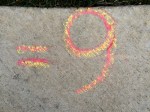
We can see that 3 to the second power, 32, means 3 times 3. Then, remembering that 3 times 3 means 3 + 3 + 3, we get 32 = 3 ⋅ 3 = 3 + 3 + 3 = 9.


Somewhere along the way our teacher also told us to stop using × to mean multiply and suggested using ⋅ or parentheses. (If you choose the ⋅, don’t let it slip and become a decimal point.) Math notation has grown and developed over the centuries. We didn’t start using exponents to represent powers until Descartes used them in 1637.
Then, there is two to the third.


Exponentiation cares about order.

Don’t worry, I haven’t forgotten the inverse operations of subtraction, division, roots, or logarithms. I just set them aside for now.






Reference
Ball, W.W.R. A Short Account of the History of Mathematics. Macmillan & Co., LTD. 1912.
 Footpath Math: Chalk it up to a math geek
3 thoughts on “Repeated Operations”