
 We like reversible processes. If I earn 5 dollars, I want to be able to spend 5 dollars. Subtraction undoes addition. It is the inverse process. All is well, until you subtract 5 dollars from your account that only has 3 dollars in it. You might have some negative feelings about that.
Multiplication has an inverse process as well. We can think of multiplication as a way to note having a multitude of sets. Seven times 5 means I have a seven sets of 5. It’s like having seven $5 bills. If you decide to split your 35 dollars amongst 7 friends, they each get 5 bucks. Division undoes multiplication. Just don’t try to divide 35 dollars amongst zero friends. That’s a no-no.
We can undo addition and multiplication. Exponentiation deserves an inverse, too. In fact, exponentiation gets two inverses. You see, it depends on what we know and what we want to know.
If I want to know what got cubed to get me 125, then I use a cube root. Cube roots undo cubes similar to how square roots undo squares. If you know a square’s area, the square root tells you the length of a side of the square. A cube root returns side length for volume.
![(what)^3=125\quad\Rightarrow\quad what=\sqrt[3]{125}=5](https://s0.wp.com/latex.php?latex=%28what%29%5E3%3D125%5Cquad%5CRightarrow%5Cquad+what%3D%5Csqrt%5B3%5D%7B125%7D%3D5&bg=ffffff&fg=232323&s=1&c=20201002)
 But, let’s say I want to know how many times 5 got itself multiplied to get me 125.

We are after the exponent, not the base. We need a different inverse operation. Division won’t do it. 125 / 5 does not equal 3. A fifth root won’t work.
![\sqrt[5]{125}\ne3](https://s0.wp.com/latex.php?latex=%5Csqrt%5B5%5D%7B125%7D%5Cne3&bg=ffffff&fg=232323&s=1&c=20201002)
Yet, something done to 125 will give up the 3.
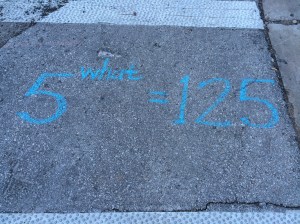
That something involves the 5.

Let’s just call that “Something” what John Napier called it, a logical way to do arithmetic, a logarithm. The logarithm (base 5) of 125 is 3. “Log” just means “undo the exponentiation.”

Log base 5 of a number answers the question “to what do I raise 5 to get that number?” If you want to know what power to raise 5 to get 625, find the log base 5 of 625.


Aftermath
Since the number e is so darn special, we have a special log for it. Instead of writing “log,” we write “ln” for “log base e,” and we say “el en.” A Mercator (not of projective fame) was the first to call the logarithm base e the “natural logarithm.”
Mercator published Logarithmotechnia in 1668 in Latin and used the phrase, “logarithmus naturalis.” Hence, “ln” instead of “nl.”
 Footpath Math: Chalk it up to a math geek
One thought on “What to the what?”