Austin, TX
2011/09/11
 Ten years ago, I stood in shock, frozen in front of a TV in an apartment in Phoenix, watching as a building in New York City exploded and then crumpled to the ground. My mind and heart crumpled with it. In greater horror and confusion, I watched as a plane flew into the neighboring tower. Then, I witnessed one of the most disturbing scenes I have ever seen, people jumping out of the tower from several stories up.
I watched as bodies tumbled through space for what seemed like an eternity of time. I watched, gritting my teeth and clenching my fists, as tears streamed down my face. I watched people fall to what seemed like certain doom, and I did not understand.
Was there any hope in such a seemingly desperate act? Was the alternative—staying inside, fighting through stairwells overwhelmed by an ocean of bodies and terror, having watched as the first tower collapsed and knowing full well the stone and steel beneath your feet was not the impenetrable fortress we imagine sky scrapers to be—was the alternative a clear death sentence?
I watched the first tower reduced to a pile of steel girders, obliterated stone, and crushed flesh from more than a thousand miles away through an electrical appliance. The people in the second tower watched the devastation from only several yards away through glass windows. What else could they do? What would our deepest survival instincts require of us? What would our insatiable appetite for living have us do?
Jump.
Hope.
Pray.
And, jump.
 My heart was ripped through my eyes as tears poured down my face, watching as mothers, daughters, husbands, and lovers fell under the unforgiving force of gravity. Falling, seemingly with no will, but proceeded by an ultimate, and likely final, act of will—the will to survive, the determination to live—given by a moment of clarity. And, now, ten years later, I begin to understand their choice.
Yes, those folks were jumping from a collapsing building, and they were jumping for what seemed like the one chance they had to live. The one chance they saw to live fully, to risk everything for a chance to be alive; a chance to see their sons, fathers, wives and lovers again; a chance to die of old age having lived a full life. Or, if nothing else, they jumped to have a chance to live for a few more moments with no doubt in their willingness to be alive.
So, with the deepest respect for lives lost, I dare to share the basics of what happens to objects under the force of gravity near our earth’s surface. This is not meant to be graphic, or coldly clinical, but, rather, I hope to understand the horror I witnessed.
Gravity is a force, causing objects to accelerate toward one another. This force, this pull, also known as gravitation, is the source of life. “Gravitation causes dispersed matter to coalesce, and coalesced matter to remain intact, thus accounting for the existence of the Earth, the Sun, and most of the macroscopic objects in the universe.”1
Given the relative massiveness of the earth, we feel inextricably pulled toward its core. Not just pulled, accelerated. Galileo taught us much with his experiments dropping objects from the “leaning” Tower of Pisa. He discovered these objects accelerate uniformly under the force of gravity. That is, for example, a golf ball and a bowling ball will both fall faster and faster at the same rates.
Near the surface of the earth, for each second an object falls, its speed increases by about 9.8 meters per second, or 32 feet per second.2 If you drop a stone, after one second, it is moving 32 feet per second, about 22 miles per hour. After 2 seconds, the stone is traveling 64 feet per second, about 44 miles per hour.
For objects falling like this, a mathematical function can be used to model, i.e. represent, the object’s distance from the ground, its height, over time.

v0 is the initial velocity, and h0 is the initial height. This is a quadratic function with a parabolic graph. The parabolic shape makes sense given falling objects move faster as time progresses.
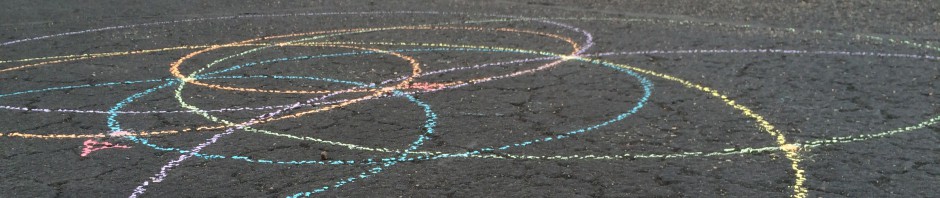
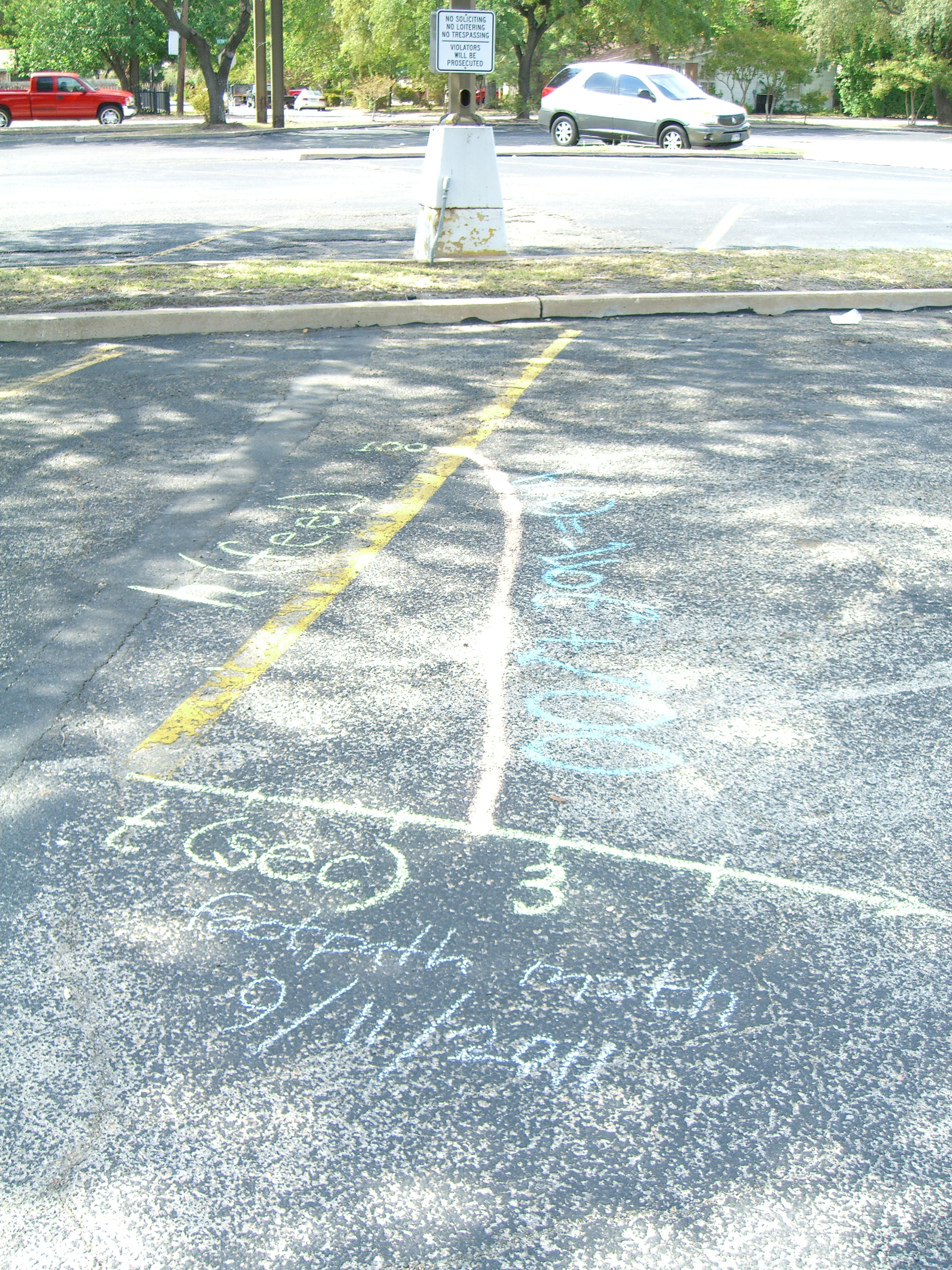
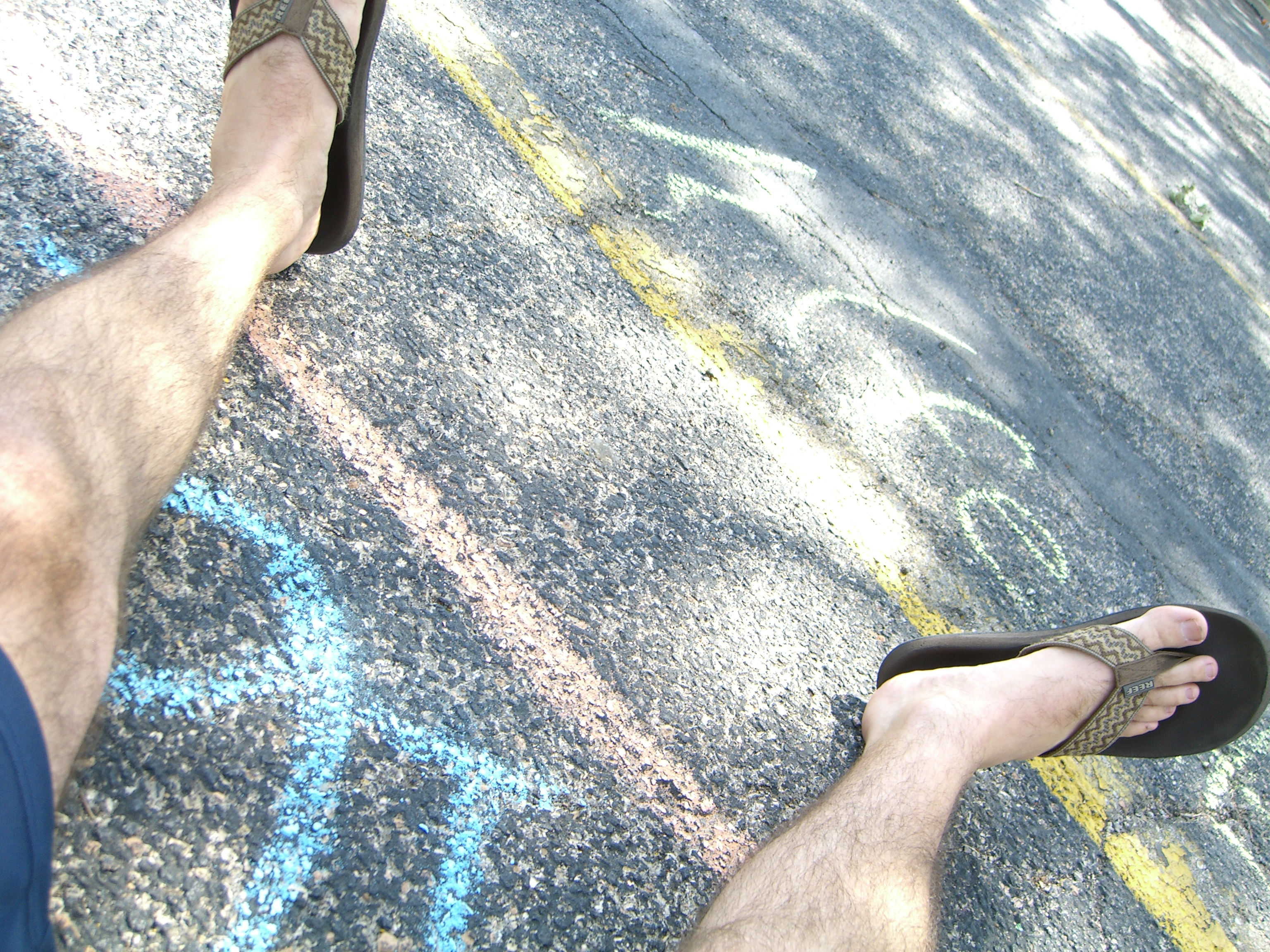
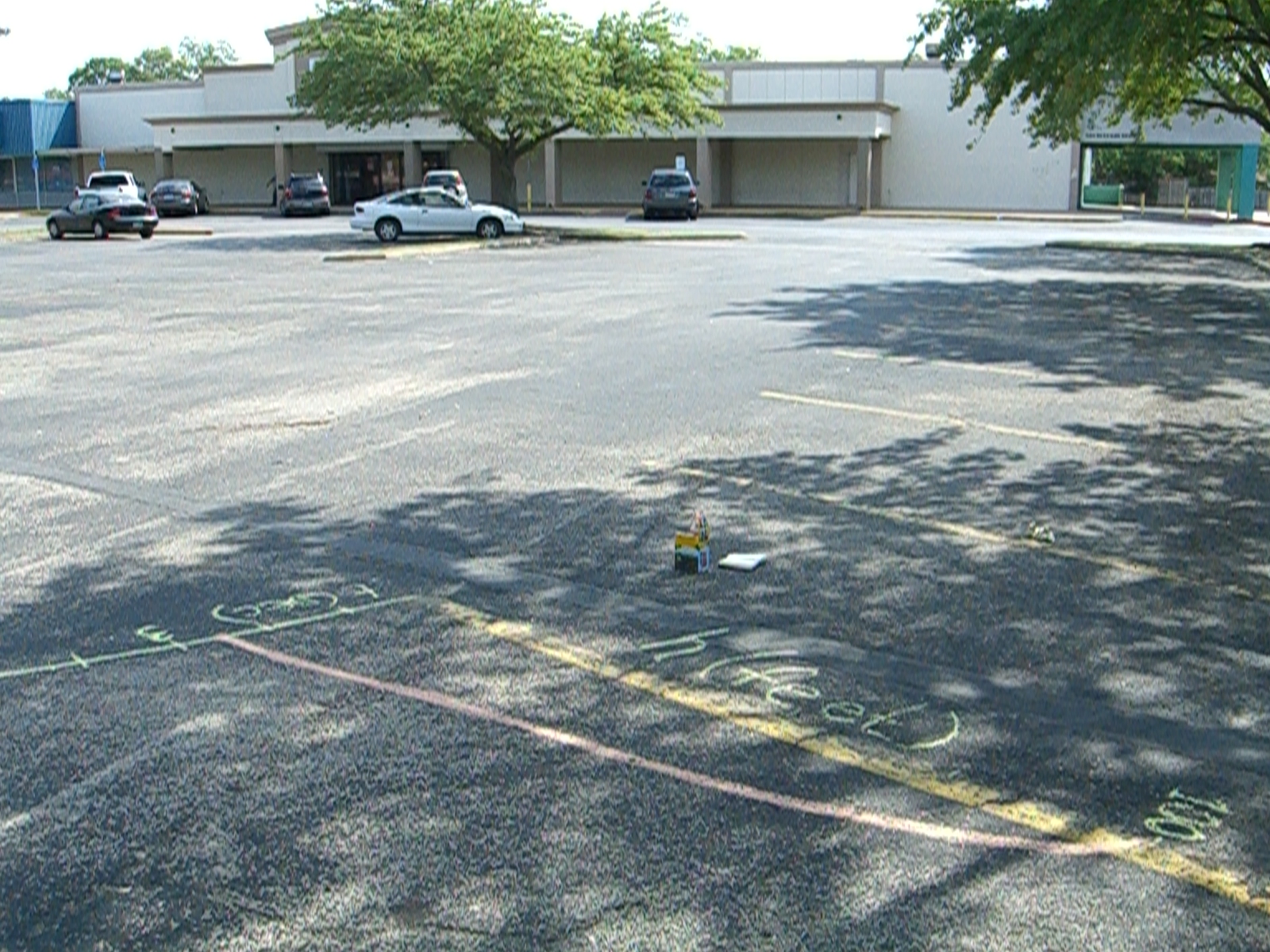
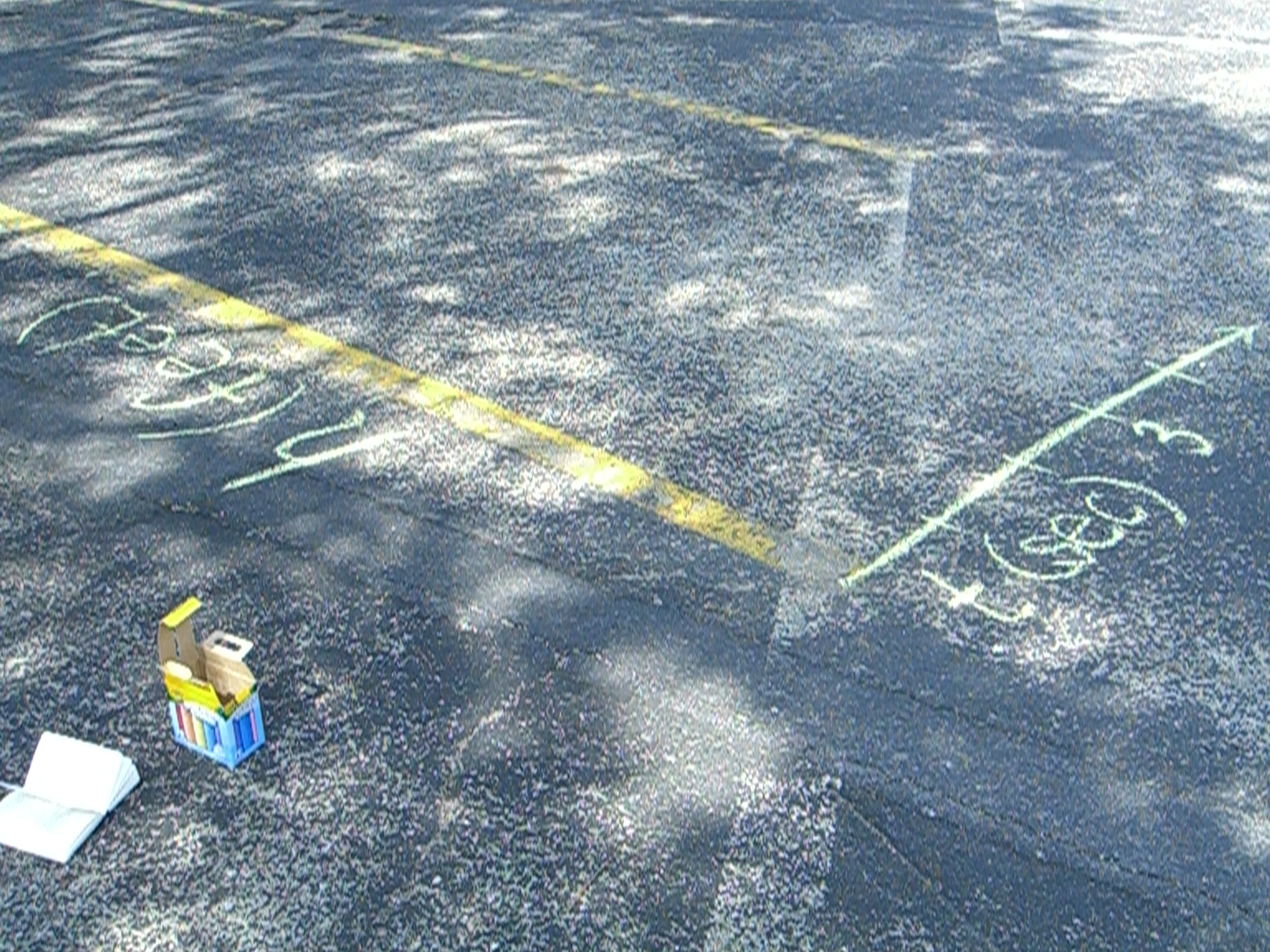
 My chalking was a little shaky. You can see there is a flatter spot around 1.5 seconds. That should not be there. The graph does get steeper as time progresses to match the increasing velocity, but not irregularly.
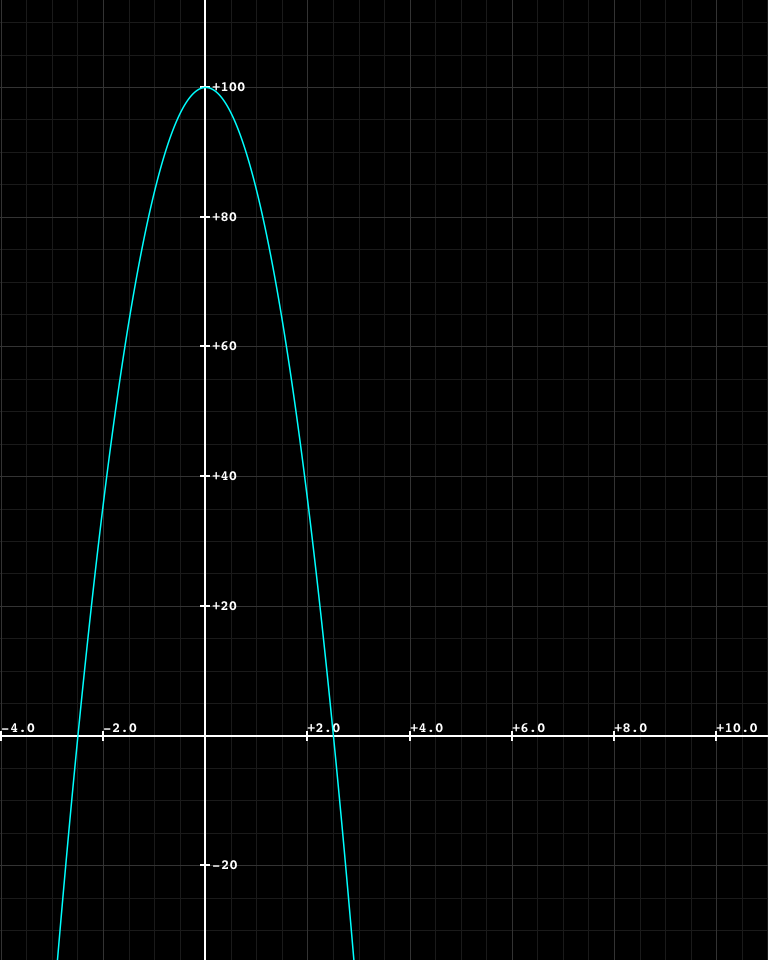
If an object was dropped from 100 feet off of the ground, the function,

could be used to determine the height of the object after t seconds. Notice, there is no v0t-term, since the object was simply dropped, not thrown. In this scenario, the object’s height after 1 second, h(1), is 84 feet. Two seconds after the drop, the object is 36 feet off the ground. And, by the time three seconds have passed, the object has already hit the ground, traveling in excess of 44 miles per hour. The images in this post are graphs of this particular h(t).3 The graph is not the path of the falling object. The object in this example falls straight down. The graph is the object’s height as a function of time. The shape is the result of the object’s increasing speed. The place where the graph crosses the t-axis, at 2.5 seconds, can be found using the quadratic formula.
This brings me uncomfortably close to connecting these ideas about quadratic functions and falling objects to what I witnessed ten years ago. I chose 100 for the initial height, the h0, because 1 story of a building is about 10 feet. Ten stories is about 100 feet.
Those courageous, or terrified, folks who jumped from the World Trade Center tower likely did not just fall. They likely jumped. This would have v0 …
I won’t continue to write this. It is still too terrible. I want to understand fully. The chalk, the pictures, and writing this are all making sense of the tragedy, and I don’t feel right continuing to investigate this as a physics problem. It is a physics problem, and the investigation could be valuable. Yet, I cannot hold back the tears, and the people who lost their lives that day were not my mother, sister, wife, or friend. They were strangers, and I cannot fathom the pain, the loss, suffered by those who lost dear ones on that day.
Plus, though I speculate, I also cannot truly fathom the thoughts and feelings of those dear souls who chose to jump, from too many stories up, over the inevitable alternative. I am trying to make sense of what I saw and making an effort to live with deep respect for the choices others make. I can try to heal my heart and mind in the face of such a devastating event. I can be and am willing to courageously choose to live fully.

1. http://en.wikipedia.org/wiki/Gravitation
2. The acceleration due to gravity is about 9.8 m/sec2. Acceleration is the rate of change of velocity. This means the velocity, or speed, of a falling object increases by 9.8 m/sec each second it falls.
Also, it is useful to note 9.81 m/sec2 and 32.2 ft/sec2 are better approximations and approximations nonetheless. The force of gravity between two objects is a function of the distance between the two objects. Newton’s law of universal gravitation describes this relationship.
3. This image was created on an iPad 2 using the Graphing Calculator HD app, version 1.0.4.
 Footpath Math: Chalk it up to a math geek
My story is from memory. I didn’t consult a news source until this morning. Daily Mail has an all too moving and at times disturbing article about those who fell from the towers. Some jumped/fell from as many as 97 stories up.
Thanks for honoring the day with your heart, love.
Thinking leads to feeling, feeling leads to being present, being present leads to miracles. Thanks for getting us on the path.
That was hard to read but I’m glad you wrote it. Also, what Raymond said. Love you.
Thank you all for the encouragement, kind words, and love.
That was very moving. The lives of so many leaping in hope of living’. Mom