Space Needle, Seattle WA
12/23/2011
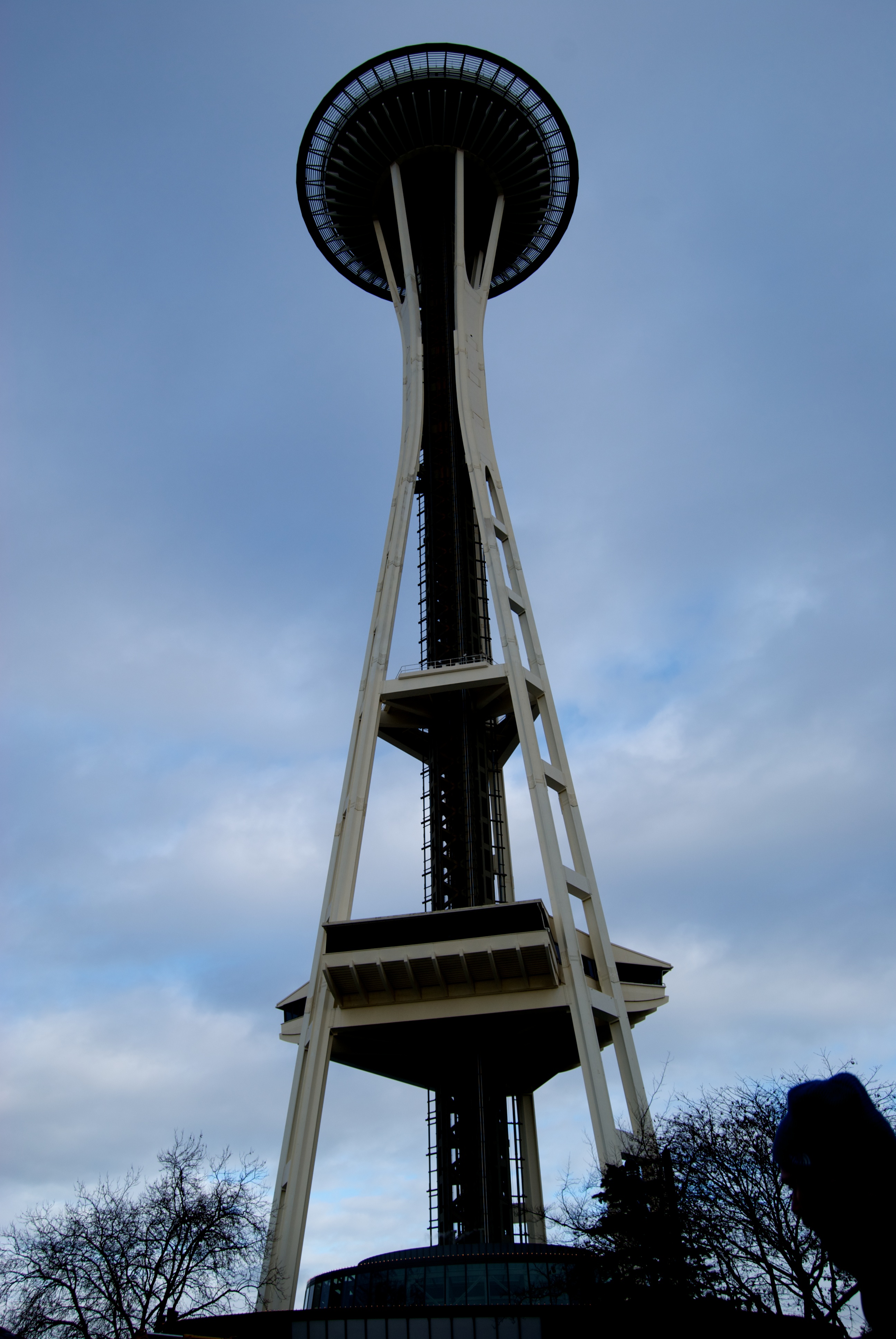 Sitting in a coffee shop in 1959, Edward E. Carlson was imagining and sketching a tower of the future to stand tall above the 1962 World’s Fair in Seattle. After many iterations and the input of architect John Graham, the flying saucer-inspired shape we know (and, at least some of us, love) came into being. 1
The Space Needle in Seattle stands 605 feet tall. The whole saucer does not rotate. Only a 14-foot wide section next to the SkyCity Restaurant’s windows rotates. A 1.5 hp motor drives the rotation, and the rotating section completes 1 revolution every 47 minutes. Also, the restaurant sits at 500 feet with diameter of 94.5 feet.
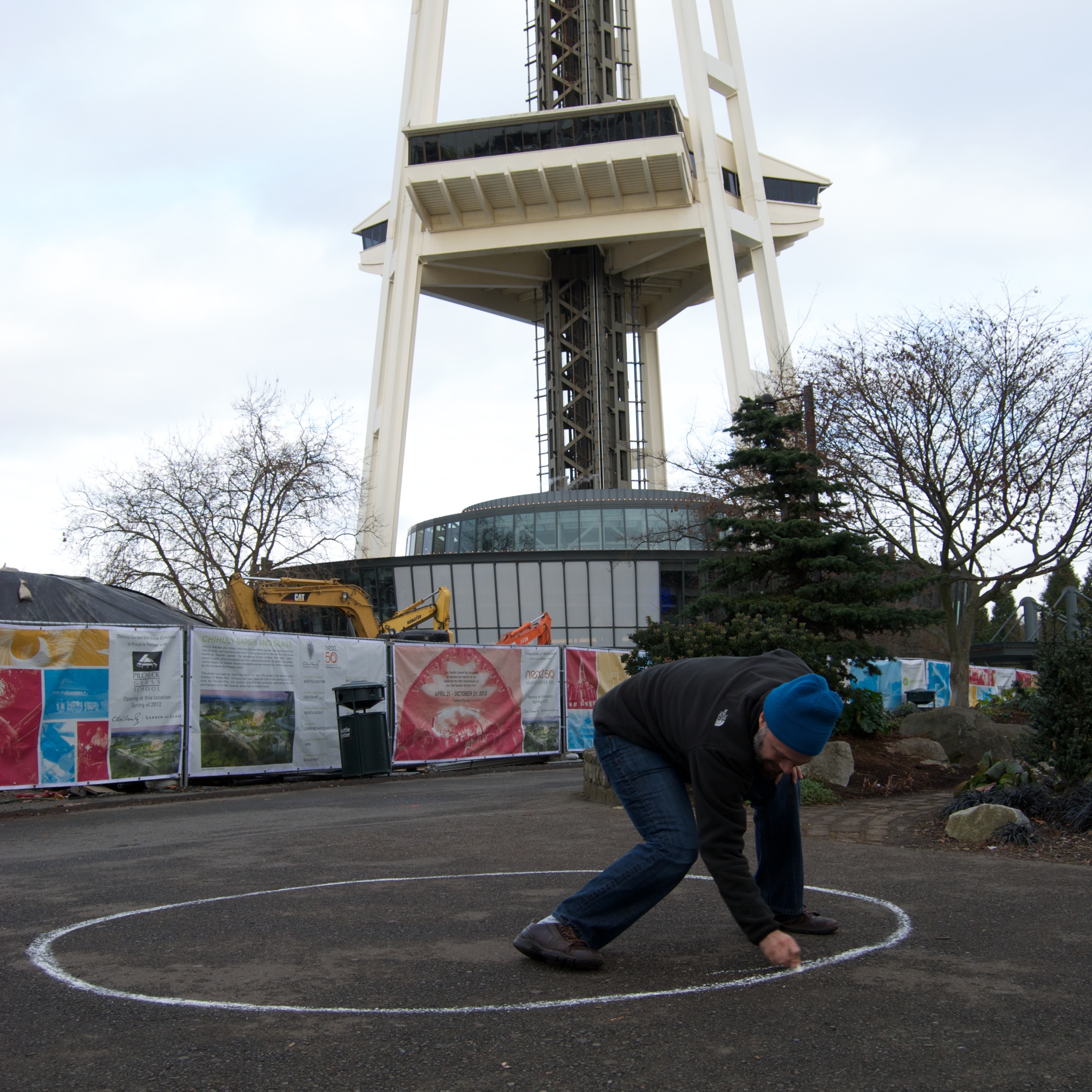
If this feels like the set up of a story problem, it should. The chalking I did at the foot of the Space Needle involves angular velocity. Angular velocity is used in calculations of the speed of an object rotating around a fixed point. We make this distinction “angular” velocity because funny things happen when circular motion is involved.
The Greek letter omega, ω, is used to represent angular velocity.

This notation comes from calculus, where ω can be treated as a derivative, an instantaneous rate of change. The letter d is used for change and is an evolution from using the Greek letter delta, Δ. The equation simply says ω is the rate of the instantaneous angular change, dΦ, with respect to the instantaneous change in time.
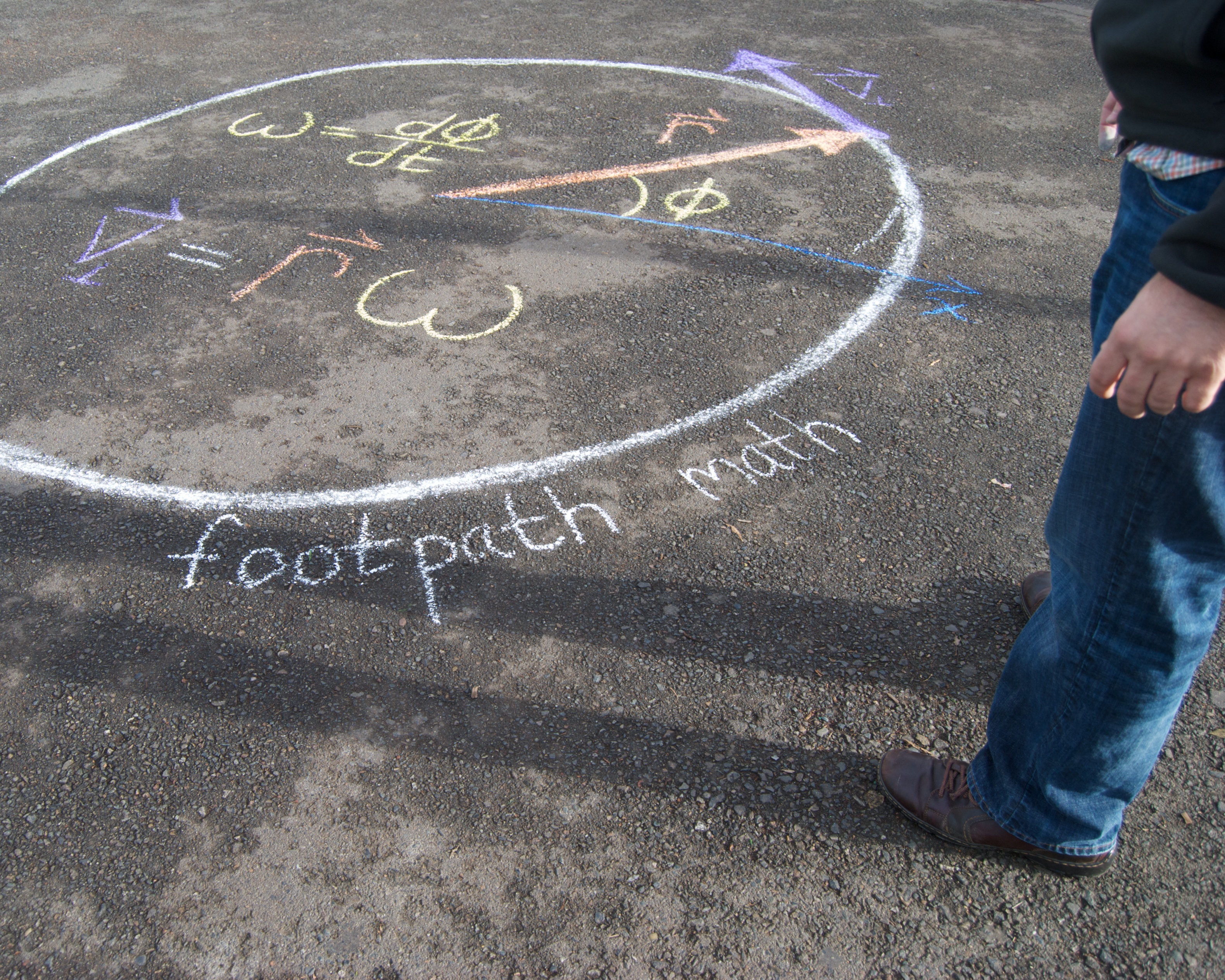 Working with angular velocity often involves working with vectors.2 Vectors are mathematical objects used in physics because they hold two important pieces of information: magnitude and direction. Graphically, an arrow is used to represent a vector. The length of the arrow is given by the vector’s magnitude, and the direction the arrow is pointing is given by, well, the vector’s direction. In the case of velocity, the magnitude, or length, of the vector represents speed.
Angular velocity is measured in radians per second. Radians are an alternative way to measure angles. Instead of being based on a seemingly arbitrary number (360)3, radians are based on what we know about circles. Radians are great! Here is a quick primer:
 We know the circumference of a circle, C, can be found with C = 2π r. A circle with a radius of 1 unit has a circumference of 2π. Then, 360° is equivalent, in a sense, to 2π. 180° translates into 1π. And, our dear friend 90° can be converted into π/2 radians. (Little quiz: What is the radian measure of a 45° angle ?)
Again, angular velocity is measured in radians per second. Using what we learned in the quick primer, one revolution is 2π radians. If we multiply the number revolutions per second an object is rotating by 2π, we get how fast the object is rotating, i.e. its angular velocity.
In the case of the band of floor rotating in the restaurant in the Space Needle, so far, we know it takes 47 minutes to complete one revolution. Let’s convert that rate to radians per second. Since there are 60 seconds in a minute, one revolution is completed every 47 × 60 = 2820 seconds. Then, 1/2820 of a revolution is completed each second. Multiplying by 2π will yield the angular velocity.

The section of floor in the Space Needle has an angular velocity of ω = π/1410 rad/s ≈ 0.002 rad/s. But, that isn’t the whole story.
Most of us have had the experience of rotating around a fixed point. I assume 95% of readers have played on the classic piece of playground equipment known as a merry-go-around. As you will recall, your sense of how fast you were moving depended on how close or how far away you were from the center of the merry-go-round. This was not just your sense. As you move away from the center, your body is moving a greater distance in the same amount of time. How do you cover a greater distance in the same amount of time? You go faster.
As mathematicians and scientists, we would like to account for this phenomenon. To do so, we are interested in the motion perpendicular to the radius from the center of rotation. That is the direction you would fly if you let go of the merry-go-round, despite the feeling of being flung outward. The instantaneous linear velocity we want is the product of the distance from the axis of rotation, r, and the angular velocity.

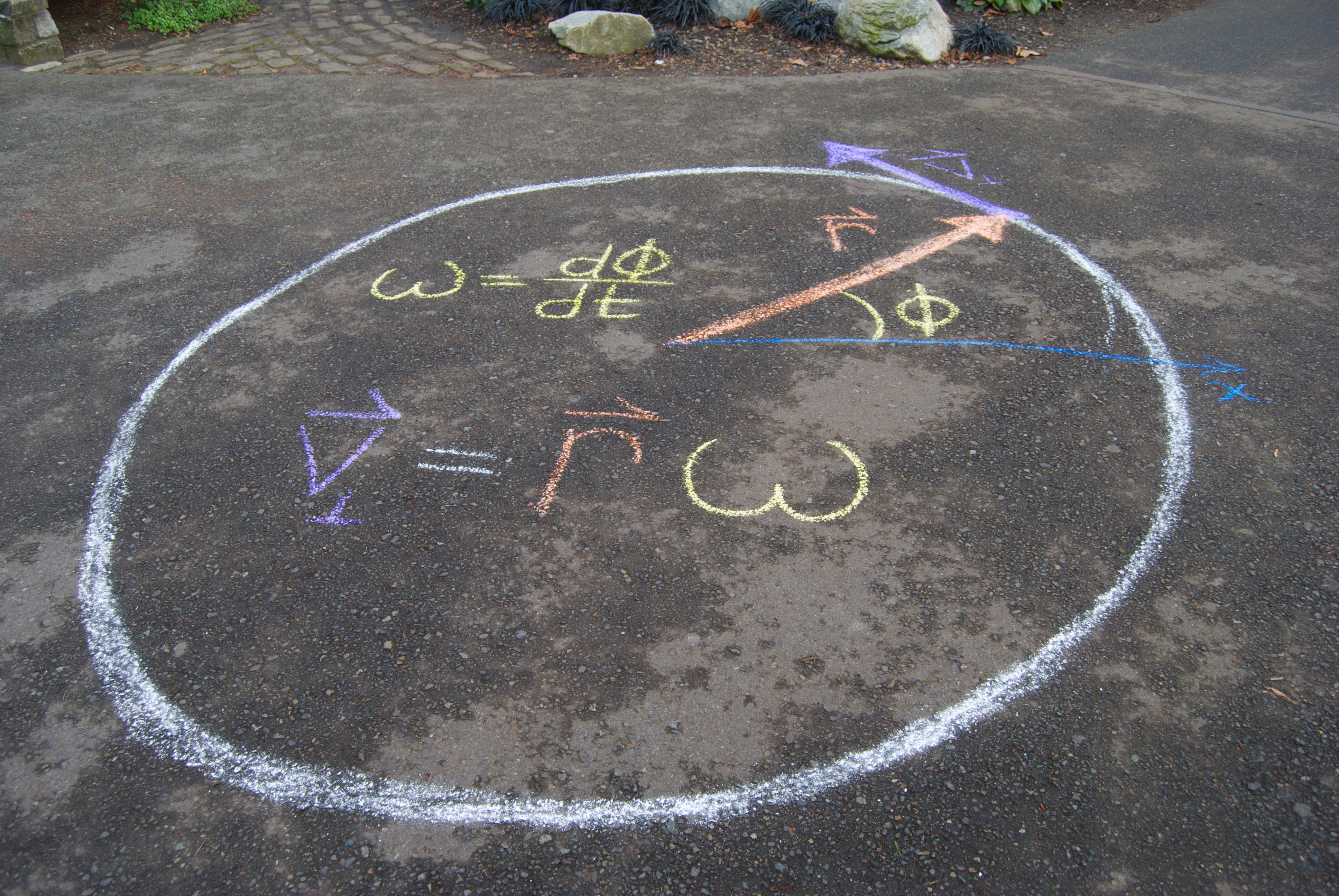 Since the radius of restaurant is 94.5 / 2 = 47.25 feet, the instantaneous linear velocity of someone standing (very) near the windows of the restaurant is about 0.105 ft/s.
 Converting to miles per hour, the instantaneous linear velocity is 0.072 mi/h. To give this some context, on the surface of the Earth, we are revolving 1 revolution or 2π radians / day. One day is 86,400 seconds.

For a person standing on the Equator, their linear velocity due to the rotation of the earth is between one quarter and one third mile per second.

This is about 1037.511 mi/h. Compared to the rotation of the Earth, the restaurant floor is moving very slowly. Yes, you notice the rotation of the restaurant floor because you are turning and stuff around you isn’t. Whereas, on the surface of the earth, it is all spinning, right along with you.
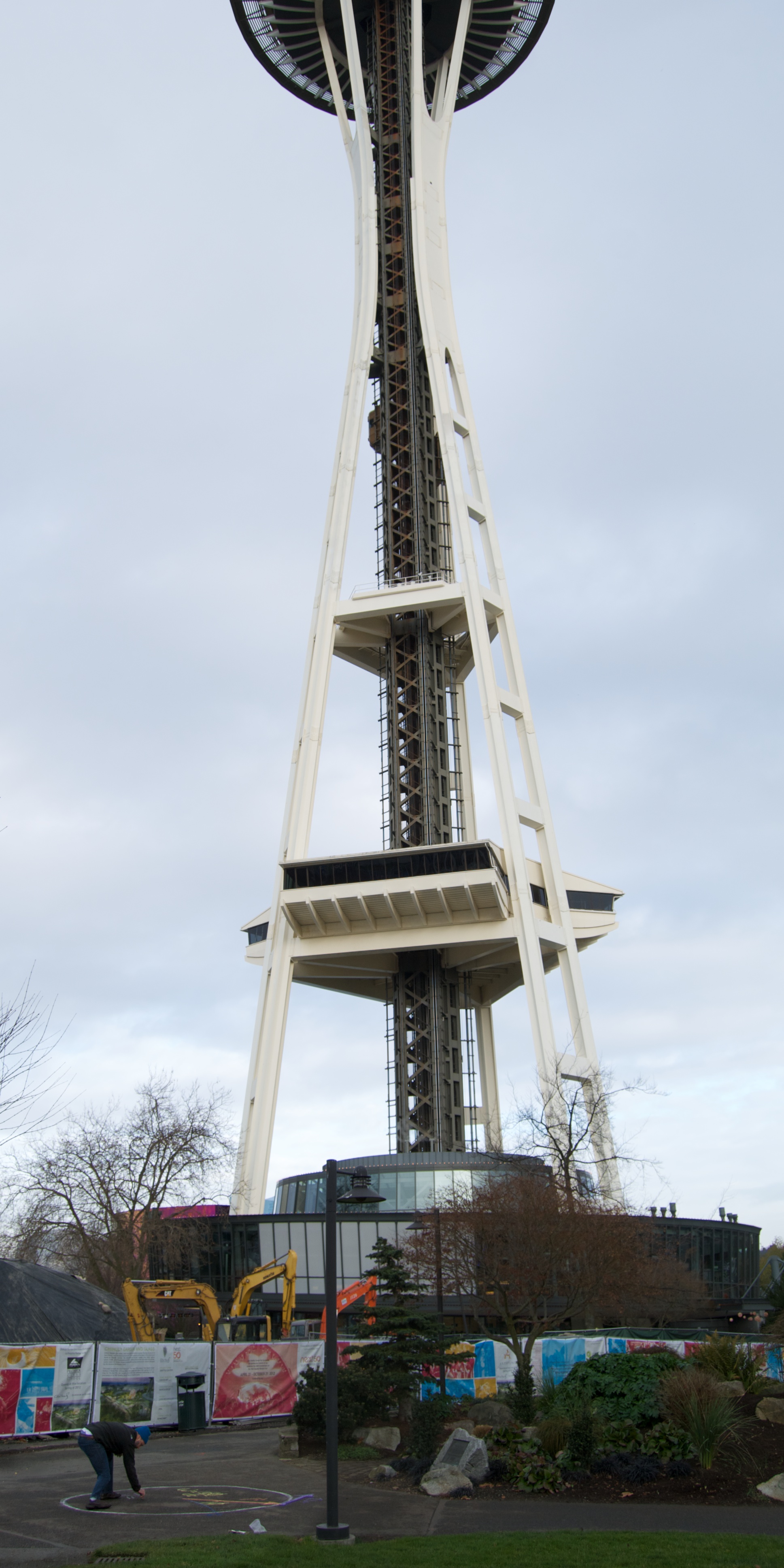
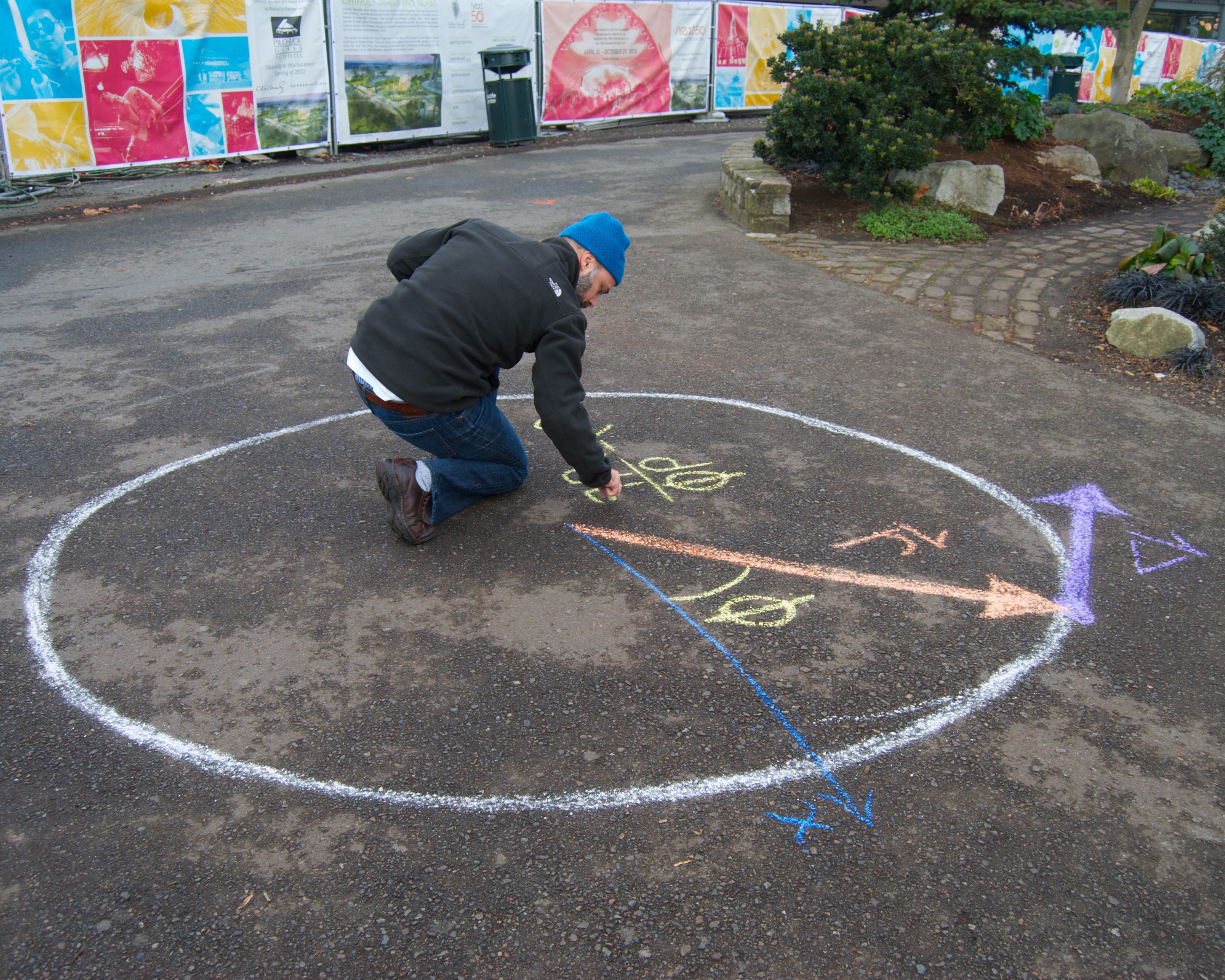
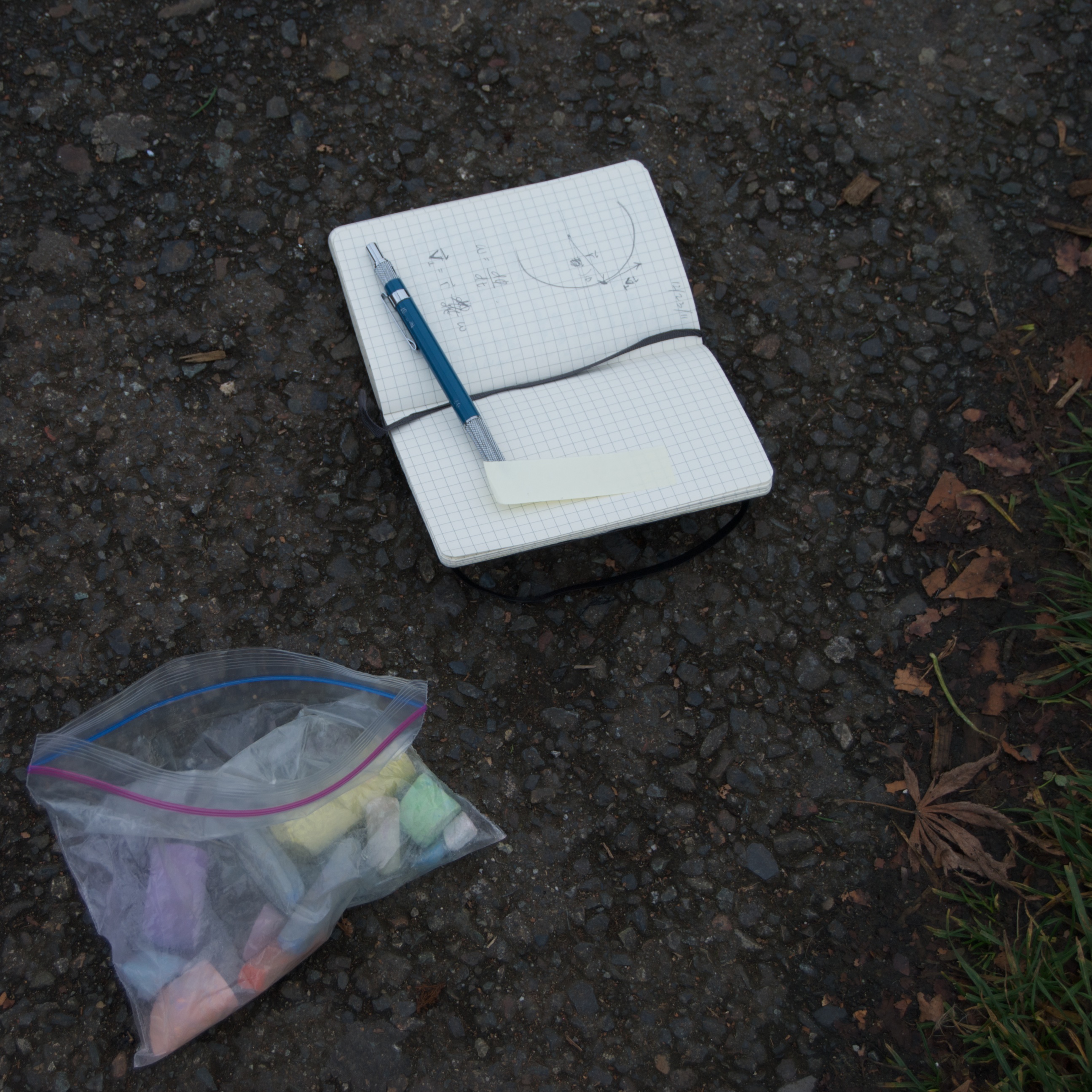
Photographs taken by Karen Ussery http://karenussery.com/.
1. For more on the Space Needle, check out http://en.wikipedia.org/wiki/Space_Needle and http://www.spaceneedle.com/discover/funfacts.html.
2. There are great resources for math and physics online. I referenced the following sites in sorting out the details of angular velocity:
http://en.wikipedia.org/wiki/Angular_velocity
http://hyperphysics.phy-astr.gsu.edu/hbase/rotq.html
http://www.sparknotes.com/testprep/books/sat2/physics/chapter10section3.rhtml
Yes, that is right. I didn’t have all of this sorted out before I decided to chalk out angular velocity in Seattle. My friend Karen, the photographer for this outing, encouraged me to chalk something site specific here in Seattle, and the Space Needle just kept standing there trying to act innocent.
3. Given that we all grew up with 360, it probably doesn’t seem arbitrary, and it isn’t really. Whether it was the approximate number of days in the year or the Babylonian sexagesimal number system (base 60), dividing a circle into 360 parts does make a certain sense.
 Footpath Math: Chalk it up to a math geek
It all looks so much friendlier on the sidewalk!
The setting and scale seem to invoke some playfulness. I like that aspect. Plus, math on the sidewalk is definitely a situation where you may pay attention or not. You won’t get in trouble either way, and there won’t be a test.