
 It all started with a square.
Just a simple square.
Over two thousand years ago, in a small Greek colony in southern Italy, someone noticed something was not quite right about the distance along the diagonal. Life for that someone, and their friends, was never quite the same.
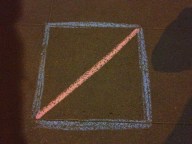 That someone was a member of a religious order with a firm belief in ALL arising from NUMBER: nice numbers, well-behaved numbers, numbers that had the good sense to be rational. Numbers like 1, 2, 1.5, even 7/8. The length of our simple square’s diagonal was not such a nice number, and its irrational nature threatened to shake the foundation of the order. It was a closely held secret; ALL wasn’t as rational as they had hoped. According to legend, someone dared to leak this secret and was drowned.1
Before making that discovery, those fine folk had sorted out a rule for the relationship between the three sides of a right triangle. We know it as the Pythagorean theorem. (I wonder if they just called it THE theorem.) You may know it as:

The theorem says, “The sum of the squares of the lengths of the sides of a right triangle equals the square of the hypotenuse.” Let’s use the Pythagorean theorem to find out just how far it is in between diagonally opposed corners of our simple square. The diagonal is our hypotenuse.
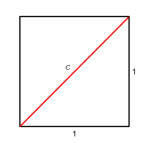 Our a and b are equal to the length of a side of the square, i.e. 1. We just need to figure c.

Since 1 squared is 1 and 1 plus 1 is 2, the last equation simplifies to

and, thus

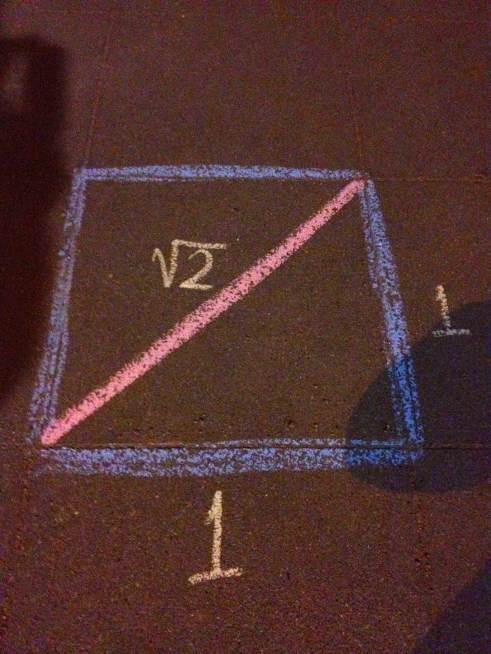
What was all the hubbub in ancient Italy? For the Pythagoreans, the problem was that 1 and square root 2 are not commensurable. That is, you cannot make a ruler with units that divide both 1 and square root 2 evenly. Said another way, the square root of 2 is not a rational number.2 It cannot be written as a ratio of two integers (the counting numbers, their negatives, and zero). Try as you might, you cannot do it. I promise.3 This incommensurability, this irrationality, was a serious problem for the order’s beliefs about the order of the universe.
Thanks to the work of many mathematicians, irrational numbers like square root 2, have sloughed off their bad reputation. In fact, much of the application of mathematics in engineering would not be possible if we did not include irrational numbers. What are circles without π? Signal processing and the digital age of music would be lost. Population growth and decay wouldn’t be the same without e, another irrational. Plus, it turns out there are far more irrational numbers than rational numbers.4
Even an irrational has friends. If we double or triple the size of the square, we do the same to the length of the diagonal.


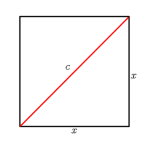 Before we leave, let’s just take a moment to see how long the diagonal of any square is. You may have divined the answer from the geometry. We can also find out using algebra. To do this, say the length of the side of the square is x.
Plug that into the good ol’ theorem, and we get

I know you have deep programming to find x, but we are after the value of c, in terms of x.

Take some square roots, and voila!

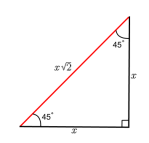 Let’s commute that root 2 and x.

Now, you have a simple formula for the length of the diagonal of any square.
Plus, cut off half the square and you are left with a special triangle, the famous 45-45-90 triangle.5 If you know a side, you know the hypotenuse.


1. There are MANY great resources on the Pythagoreans. A Google search for Pythagoras returns almost 6.5 million results. Janna Levin, in her superb book, How the Universe Got Its Spots (Princeton University Press, 2002), mentions this drowning anecdote in the opening pages. A book by Eli Maor, The Pythagorean Theorem (Princeton University Press, 2007), tells the tale of the theorem we have come to know as the Pythagorean theorem including its origin before Pythagoras strutted his stuff.
2. Unlike rational numbers, the decimal form of an irrational number never terminates and never repeats. (It would be more accurate to say, “never establishes a global pattern” instead of “repeats”.) You might know someone who can recite π to a ridiculous number of digits. π is irrational, too. Someone at NASA thought it would be good to provide a source for the first million digits of root 2. Nice of them.
3. In fact, a good way to prove the irrationality of root 2 is to assume it is rational and see what happens. What happens is you will find yourself in an unavoidable contradiction; thereby proving your original assumption was incorrect. You could start with something like

where c and d are integers with no common factors. This is a reasonable assumption. Every rational number can be written in this reduced form.
Maor, in appendix D of The Pythagorean Theorem, shares all the details of this proof.
4. One of my favorite examples of this is the following thought experiment: Imagine a number line from zero to one. Now, with an infinitely fine eraser, erase every point corresponding to a rational number. (Go ahead, now. Erase 1/2, 1/4, 1/8, … and 2/3, 1/3, 1/6, …) What will you see? The same number line. Though there are infinitely many holes, they make no difference in your perception. Now, repeat the experiment, except, this time erase every irrational number. What will you see? Nothing. Even though there are infinitely many points of the rational numbers still there, you won’t be able to perceive them. Those rationals are too spread out. The vast majority of the points on the number line correspond to irrational numbers.
5. The other famous special triangle, 30-60-90, was featured in the post on Hexagons.
 Footpath Math: Chalk it up to a math geek
Eric, you are a trip…………………………..I really did understand a lot of this, but it really has been tooooooo long since I last studied any of this. Hope you have a great holiday in New Orleans!!
Love you