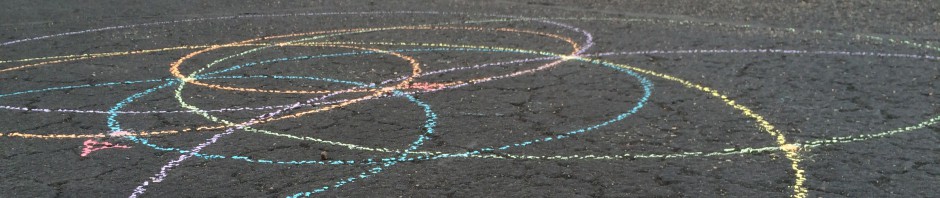
 Traveling around the world tends to shift my perspective. If for only a moment, I remember our planet is round, not flat. I know it is round, sure, but I often live as if the world is flat. For example, I tend to think of streets as parallel and perpendicular lines. (Surprising, since I live in Austin, where all roads seem to merge into one.)
There is nothing wrong per se with operating as though the world is flat. Mental constructs help us filter out extraneous information. I don’t need to consider the roundness of the Earth while I am walking down the street. In fact, I tend to run into things while I am simultaneously thinking about terrestrial geometry and walking. But, if I am on an international flight, having the roundness of the world loaded into memory can be useful.
The Earth is not a sphere. All the mountains and valleys muck it up, not to mention tidal forces from our moon stretching the globe like a kickball kicked a bit off kilter. Still, a sphere is not a bad construct for this planet of ours.
On a sphere, a great circle is the closest analog of a straight line. Akin to a line in Euclidean space, the shortest path between any two points on a sphere is along a great circle.
 If the seemingly parallel streets of ours follow great circles, then they are not parallel at all. Think beach ball. The streets would meet. Twice. On opposite ends of the earth. Not necessarily at the north and south poles, but the two intersections would be diametrically opposed, in a geometric sense, not philosophical.
So, here comes the kicker.
Two great circles form the boundary of a two-sided shape. We call it a lune: the two-sided polygon of spherical geometry. Some refer to it as a digon. I would let it be a bigon.


Questions
- How might you find the surface area of a spherical lune?
- How might you determine whether two lunes are congruent?
- How many tennis balls end up in Shoal Creek each year?

 Footpath Math: Chalk it up to a math geek
Hi Eric, I love your posts! They inspire me to think about things I never thought of before. I am still chewing on “power” from your last post, as I am working in the yard and imagine my husband could do the same amount of work as I do in less time. This must be what Adam Smith referred to when he suggested division of labor. Thanks for posting! (and very curious how your life is at this moment!)
Thank you, Elly! I think efficiency and power are definitely connected. I will say with jobs like raking leaves, I like to take my time. It’s nice to putter around the yard! Still, I get your point. Life is exciting. The little boy will here any day now!
I think I’ve got a handle on the lune problems, as long as we are careful to say they’re made from the intersection of great circles. The area of the lune then would be the angle of intersection divided by the angle of a whole circle (2 pi radians, if we’re working with those) times the area of the surface of the sphere. The lunes ought to be congruent if they’re on spheres the same size and have great circles making the same angles of intersection.
As for the tennis balls ending up in Shoal Creek, well, tennis balls float. Nearly all of them would end up on the creek, not in it.