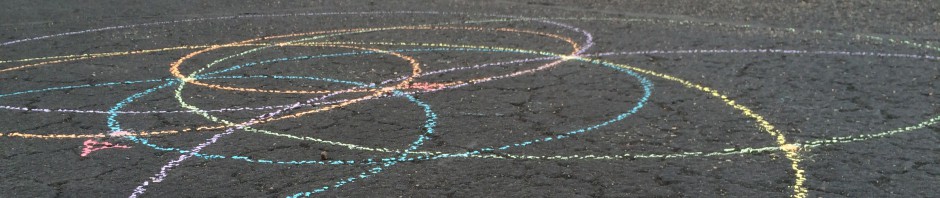
W 4th St Station, NYC
5/29/2011
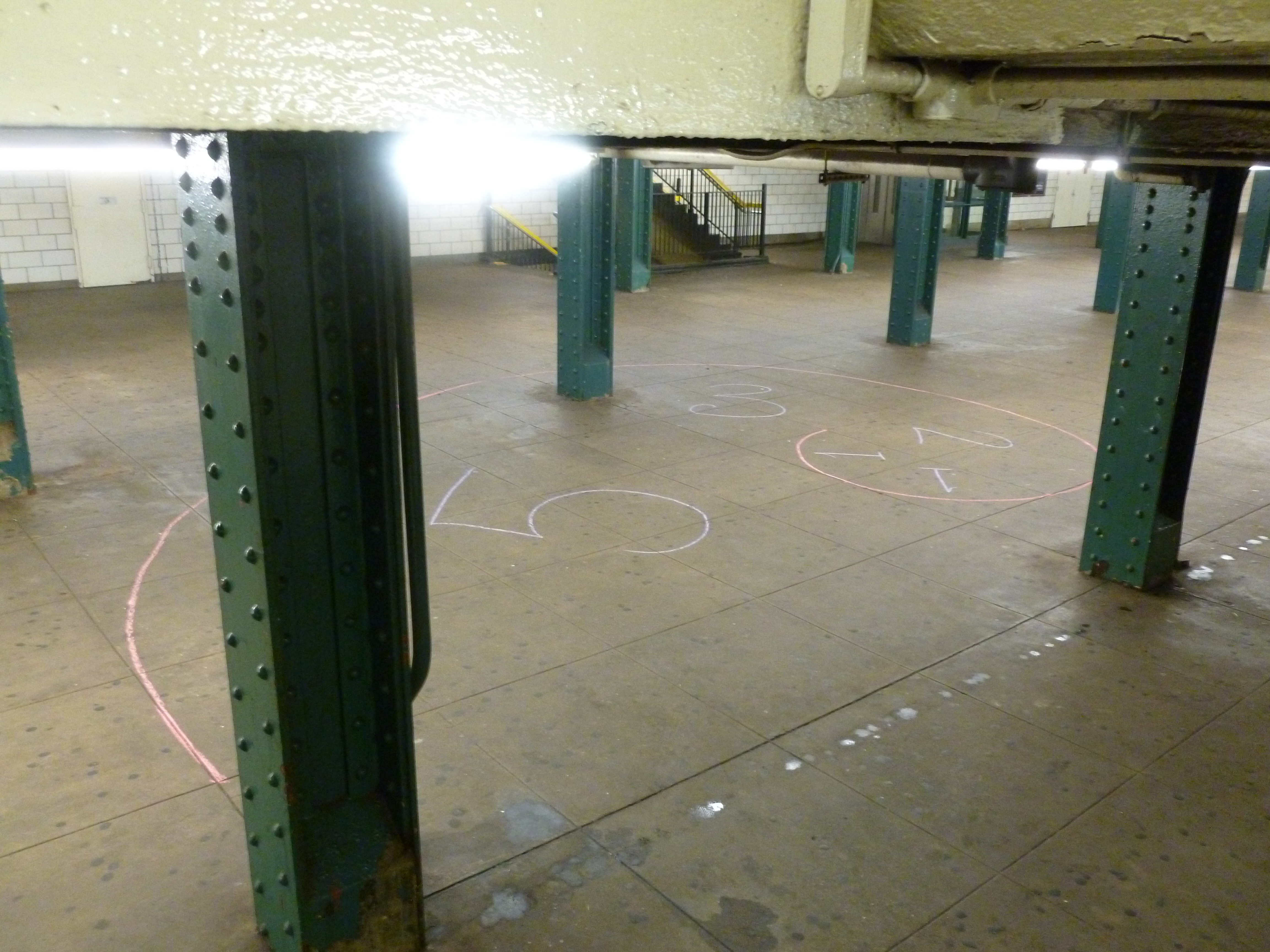
I had a lovely day with dear friends Marlowe, Yasmina, and their little ones, Elia and Aviva. Marlowe encouraged Laurie and me to go to Babbo for dinner. I had the mushroom sformato, squab, and panna cotta. It was delightfully delicious. The spirits of New York and Europe were alive and well in us as we left the restaurant. We were heading to Times Square to have a brief encounter with bright lights, big city, tourists, and to leave a little math. We made our way to the W 4th Street subway station.
Heading down to the F train, I entered a cavernous hall with a floor of 2 x 2 foot concrete squares. I couldn’t resist. With panna cotta in my belly and the F train in my future, Fibonacci was looking to be conjured.
Once upon a time there was a man named Leonardo of Pisa who was born in the late 12th century in what is now Italy. This Leonardo, though Italian, was not a painter.1 He was a traveler and a mathematician. Most people know him as Fibonacci. You may have heard of the Fibonacci numbers and the connections to the golden ratio, golden rectangle, and golden spiral.
If you haven’t, you will soon. Just keep reading. There is a lot to say about Fibonacci, his namesake sequence of numbers, the goldens, and his gifts to “western” mathematics.2
To get those nice little Fibonacci numbers, start by adding 0 and 1 to get the next number, 1, add 1 and 1 to get the next number, 2, add 1 and 2 to get the next number, 3, add 2 and 3 to get 5, add 3 and 5 to get 8, and so on.
0, 1, 1, 2, 3, 5, 8, 13, …
As the Fibonacci numbers grow, the ratio of one of them to its smaller next-door neighbor heads towards a number known as the golden ratio, Φ ≈ 1.618.
1/1 = 1, 2/1 = 2, 3/2 = 1.5, 5/3 ≈ 1.666, 8/5 = 1.6, 13/8 = 1.625, … , 144/89 ≈ 1.618, …
Just as the ratios approach the golden ratio, the golden rectangle begins to take shape when squares with sides of Fibonacci number length are put together just so. Start with two 1×1 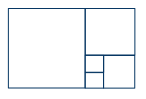 squares, lay a 2×2 square next to the pair, put a 3×3 square next to those, and keep going with subsequent squares. The more Fibonacci squares you include, the closer the outermost rectangle gets to the golden rectangle.
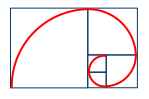 Now, what is really cool is to embed little quarter circles inside each of the Fibonacci squares. Guess what. As you include more and more arcs, the large spiral gets closer and closer to achieving golden status. (Forever failing to do so, but forever willing to approach.)
I love the look and feel of the Fibonacci spiral.
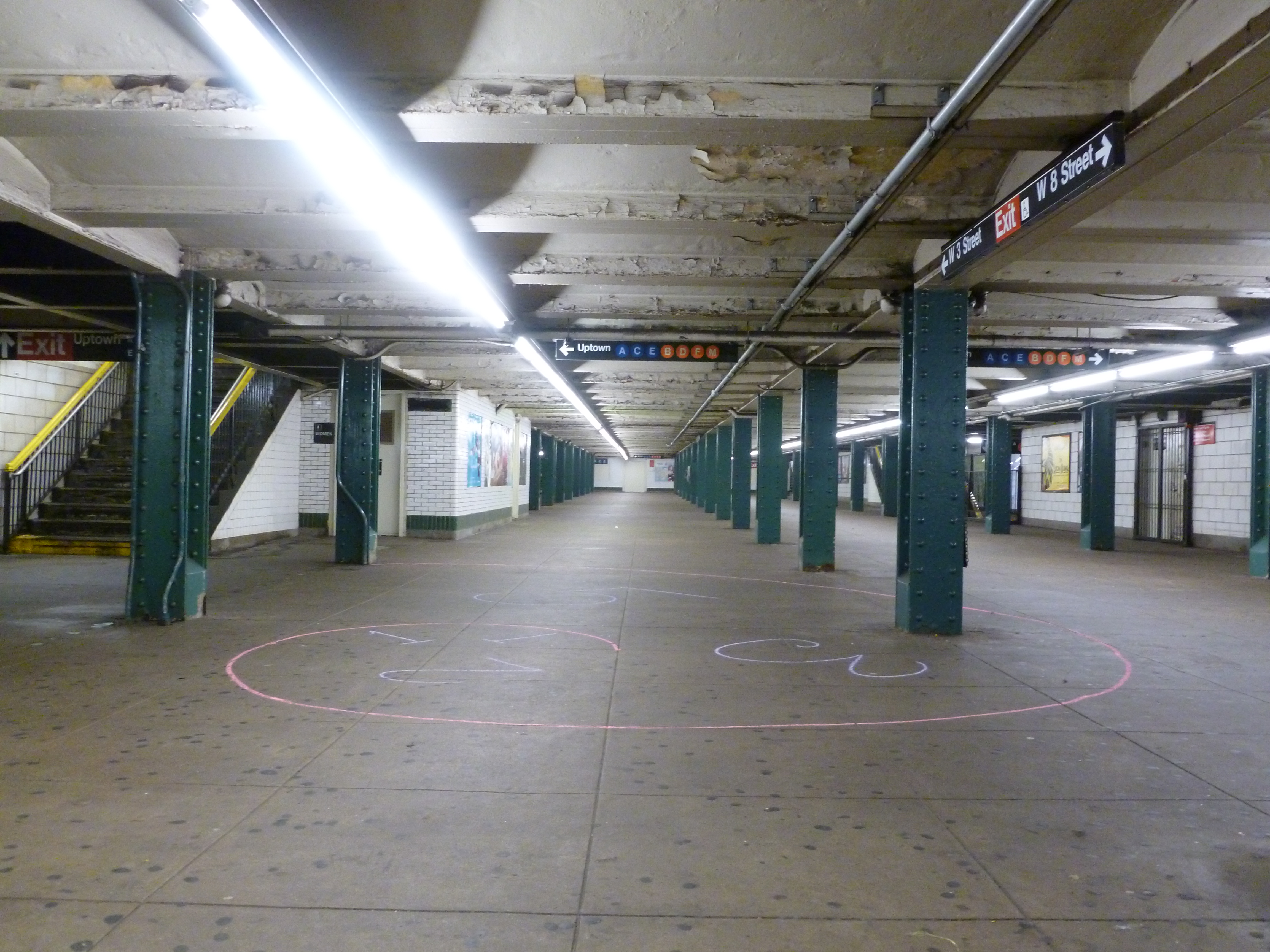
Fibonacci left zero out of his book, and I left it out of my spiral in the W 4th Street subway station in New York City. Poor zero.
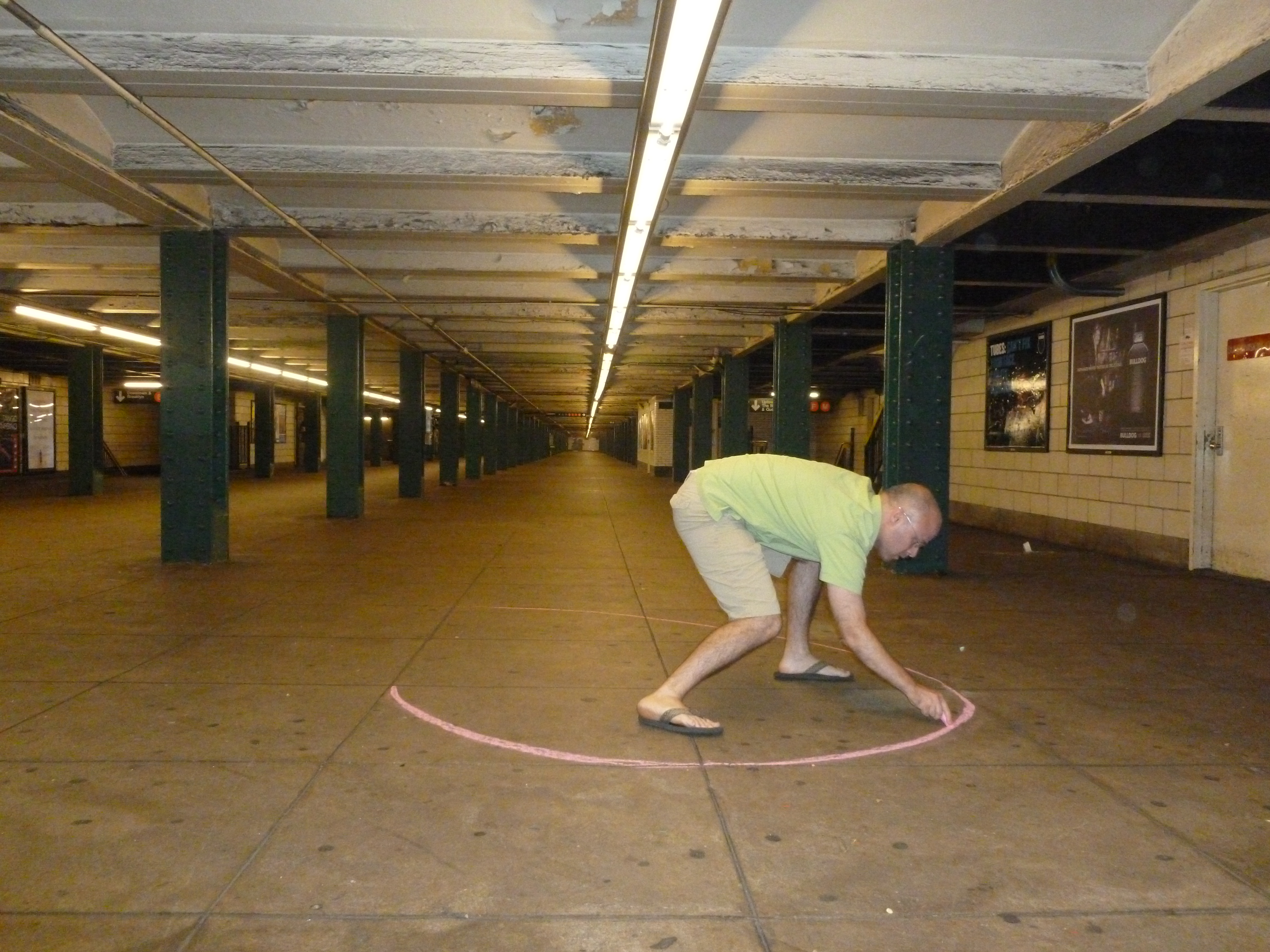
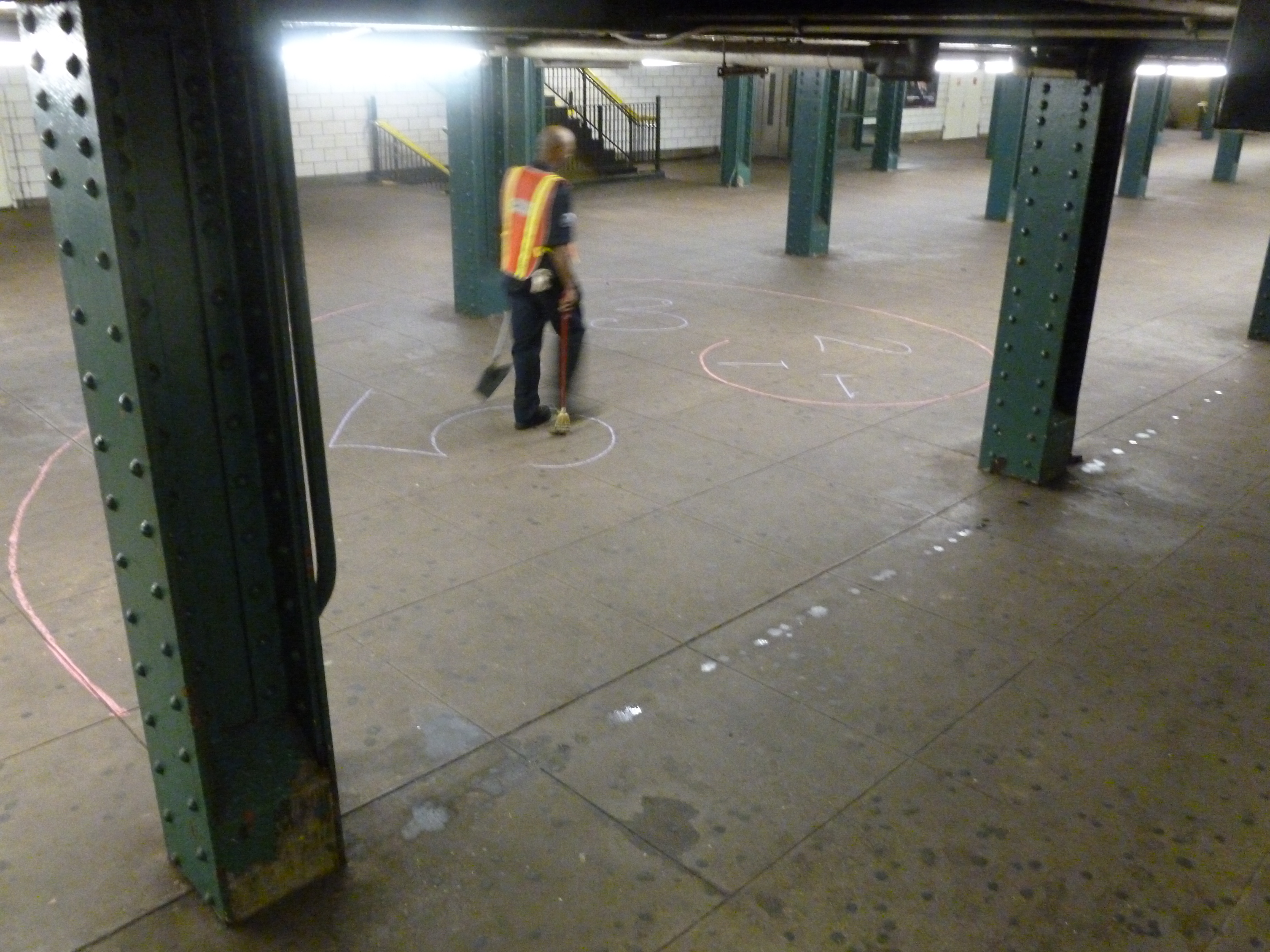 The photographer for this post is Laurie Zimmerman Mann. Check out her site: www.lzmstudio.com.
1 It is said another Italian, also named Leonardo, the one from Vinci, employed the Golden Ratio and the Golden Rectangle in an attempt to capture objective aesthetic beauty in his Vitruvian Man.
2 Fibonacci brought to “western” mathematics when his book Liber abaci was published in the early 1200s. Fibonacci returned from his travels in the east with remarkably powerful tools for mathematics including the Hindu-Arabic use of place value and the Arabic numerals themselves. Being able to write “94” where the “9” is interpreted as “9 tens” and the “4” is “4 ones” is a huge step forward from writing “94” like the Romans had done, XCIV. Where the “X” is in front of the “C” to note that 10 should be removed from one hundred to take us to 90 before we slap on 1 less than five (known to you and me as four.) “94” is way better, right? If you disagree, than check out 1998 in Roman numerals: MCMXVCVII, not to mention what algebra equations used to look like. (Check out MacTutor Math Archives for more.)
 Footpath Math: Chalk it up to a math geek
1. I love this site. I love non-commissioned public art, and I love that you’re doing it consciously (i.e., not permanently marking). I love that it’s about your math passion. Mathion?
B. (ha ha) Did you know I’ve shot many images in nature (esp. succulents and flowers) that have that Fibonacci action? Musing upon the subject, I think there’s something inherently soothing about it to our brains. Don’t quite have the distinctions to put it into words, so it’s more of a hunch, but if you’d like to read what I got so far: http://karenussery.com/ca.html
III. My best example of it: http://karenussery.com/suswre.html
Thank you! I wanted to push at my own bounds and share my joy for math with honor and respect for people. I want the images to occur as an opportunity, rather than a requirement. The chalk will be gone with the next rain or by the end of the next rush hour. The blog gives a different life to the work. I am working on a graceful way to point people who are chalkside to this blog.
I love that you are referencing the Fibonacci sequence. Your photos are beautiful. The succulent swirl remix image is profound. I think you are spot on about some sort of innate response to the golden rectangle and spiral. Maybe it is genetic information passed down from some important lesson we learned ages ago.
– e
I was going to suggest that you get people to your blog via the chalk! Perhaps a simple signature of “footpath math”? And on the other hand, there’s also something kind of magical when you stumble upon something anonymous and beautiful and/or thought-provoking…
That is the debate I have been having with myself. I love to think of the wonder some folks might experienced when finding math imagery on the ground. Given that I am keeping a blog, my project isn’t secret. For the folks who find it on the street, though, anonymity is preserved. The work on the street is not an advertisement for the online work, and the two are connected (one-way at least). I think if I use small white chalk and plant a note, the connection could be created without undermining the wonder.
Exceptional!!!
Art and math intersect. I want more. Venn diagrams art: math? Thanks for having such a passion for math!
I was thinking a lot about Venn diagrams when I replied to Karen’s comment. I was thinking about the people who have seen the blog (one circle) and the people who have seen the chalk on the street (another circle). To my knowledge, Laurie and I are the only ones in the intersection, the overlap of the two circles. That will be changing soon.
I have also been reading a book about infinity by Brian Clegg. He has done a great job articulating the difference between the way the ancient Greeks did math (think Geometry; arguments were visual) and the way math transformed with the advent of algebra (arguments live in the abstraction of symbolism). Our brains have both capacities: (1) the world of sight, spatial relations, and aesthetics; and (2) the world of symbols. I believe the great mathematicians and artists are strong in both realms. Math is not merely concerned with abstract symbolism. The symbolism is merely a tool for noting complex relationships, relationships that may be beyond our capacity to visualize. Mathematicians are creative in how they see and represent the world. As a math teacher, my #1 job is to foster the development of creative and analytical thought. Not just one at a time, I am interested in making room for the sort of magic occurring when these two circles of thinking overlap.
“Our brains have both capacities: (1) the world of sight, spatial relations, and aesthetics; and (2) the world of symbols.”
I hope you don’t mean to exclude aesthetics from the world of symbols. I often encounter symbols which are quite beautiful! ; )
Yes, symbols can be beautiful! I love a good 3! Lower case zeta can be downright sexy. By “world of symbols,” I was thinking of symbols as pointers to concepts as opposed to the symbol as an object in and of itself. The numeral 2 can be lovely, and it is also a pointer to the concept: thing and another thing. Parts of our brains have developed to consider the numeral as an object of language, abstracting a concept. This is what I was distinguishing from the world of aesthetics.
Very cool, Eric. I can’t help wondering, though, what would have happened if a New York policeman had arrived on the scene. New equation altogether!