Austin, TX
7/7/2011
For millennia, humans have loved to operate with mathematical objects. We started with shapes. We moved them around, flipped them over, and even “added” them, laying them side-to-side. Then, we went to town on numbers, and the town grew to a metropolis of operation neighborhoods: addition, subtraction, multiplication, division, and exponentiation. From numbers, a strange sense of manifest destiny took hold, and we expanded our operational influence to conceptual “things” like polynomials, matrices, and even functions themselves.
Polynomials are an abstractional hurdle for young math students. Polynomials are mathematical expressions involving addition (or subtraction) and multiplication. Check out these examples.
You can tell how many terms they have, as the terms are separated by addition.1 The above examples have 3, 4, and 2 terms respectively.
Many high school algebra students learn to “FOIL” when they are learning how to multiply binomials.2 A binomial is a two-term polynomial. For example, , , and are all binomials. But, FOIL is dangerous.
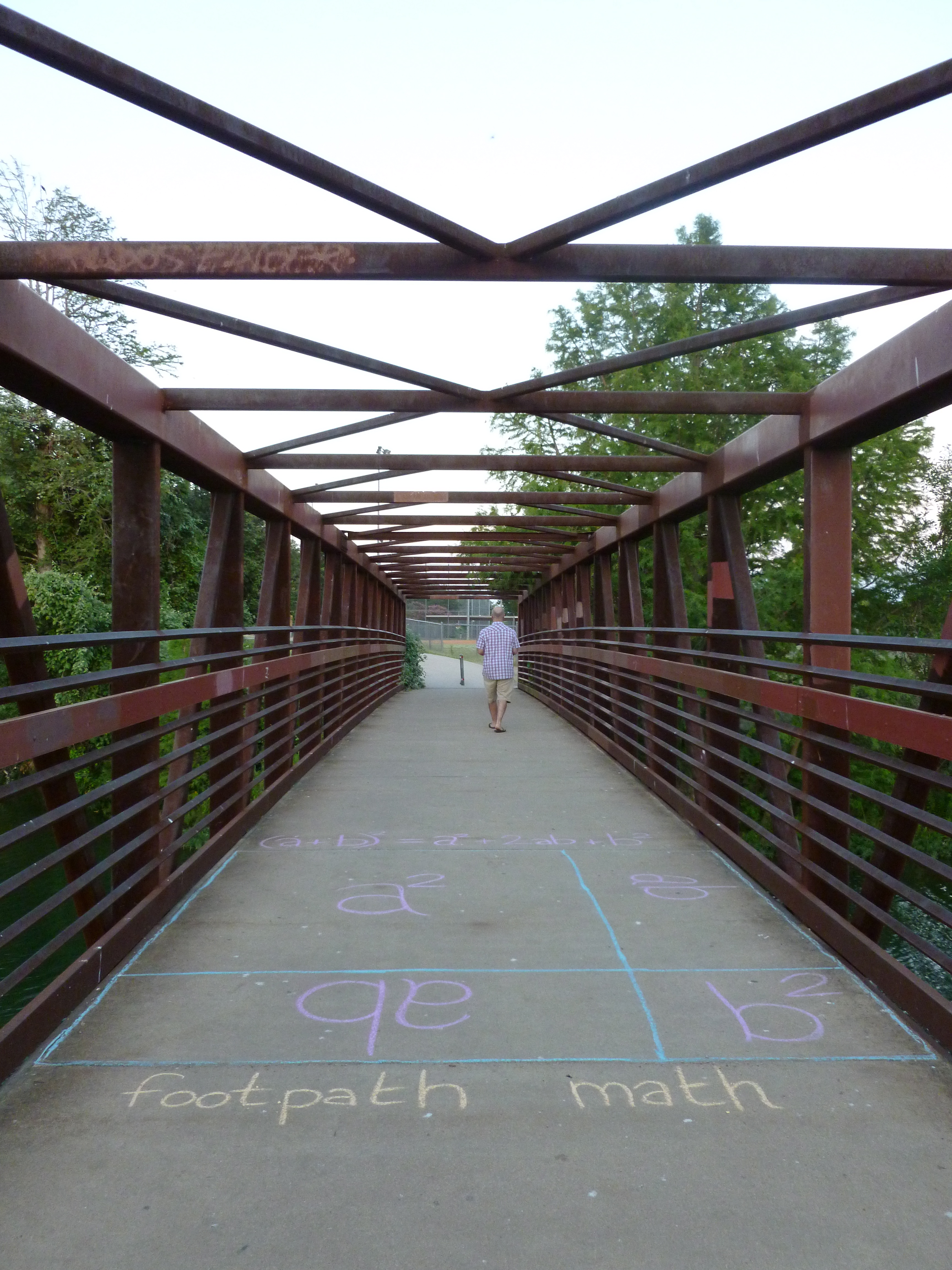
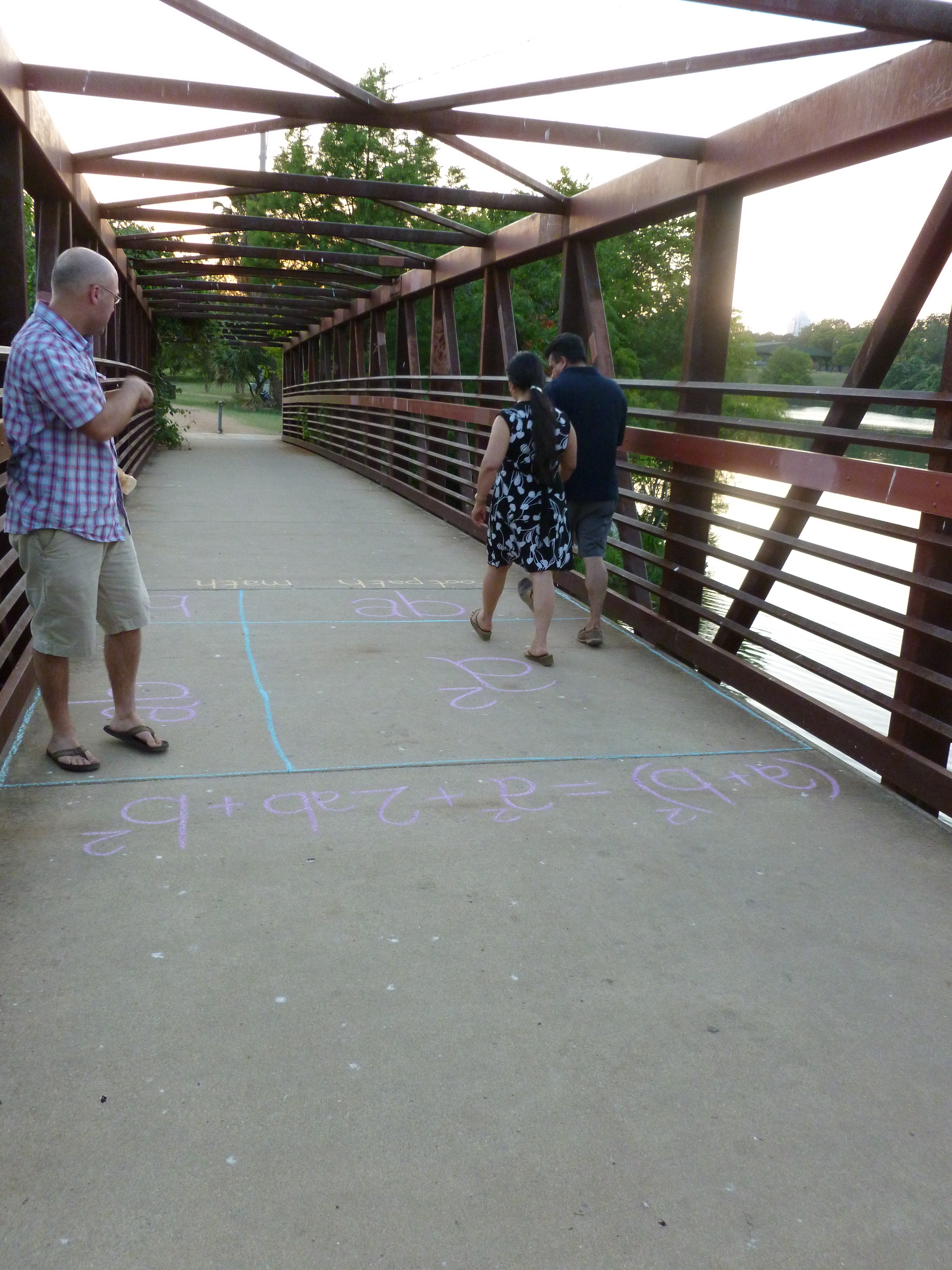
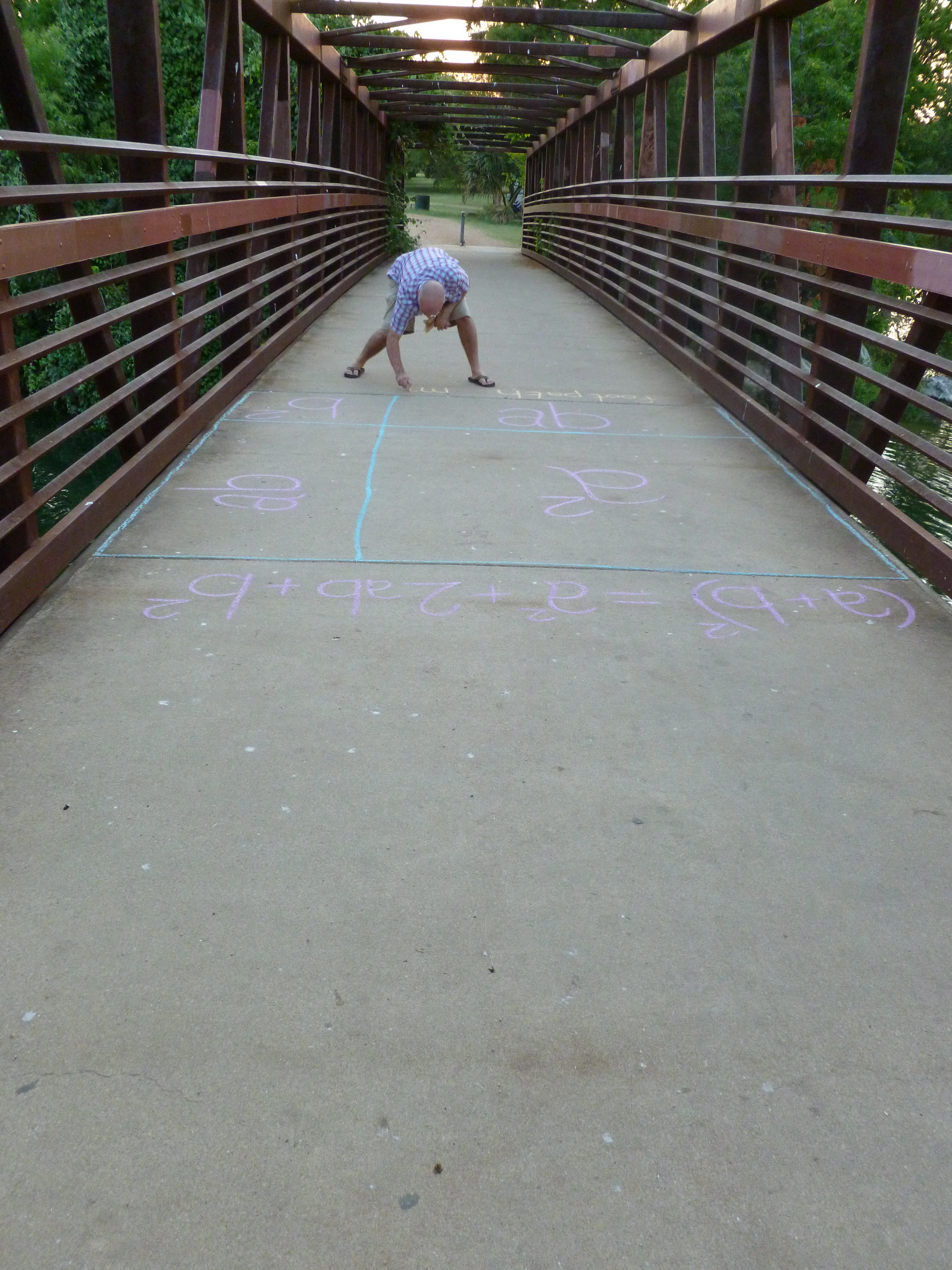
What is depicted in chalk is another way to think about the multiplication of binomials. Geometry helps to illuminate what is happening. Remember how the area of a rectangle is calculated? Simply multiply the length by the width, i.e., . So, multiplication yields the area of a rectangle.
“Squaring” a number, like 3, is how one finds the area of a square with sides with that number as their length. . If you had a square with sides 3 units length, the area of that square would be 9 units2. Squaring a binomial, as with numbers, is simply a matter of multiplying the binomial by itself.
Let’s consider a square with sides of length . You can see, in the following photo, how the square is made of an upper and lower rectangle. The upper rectangle is in turn made up of a square (area ) and a rectangle (area ). The lower rectangle has another rectangle (area ) and the square (area ). (I know the “ab” is “upside down” in the photo. It looked better on the bridge.)
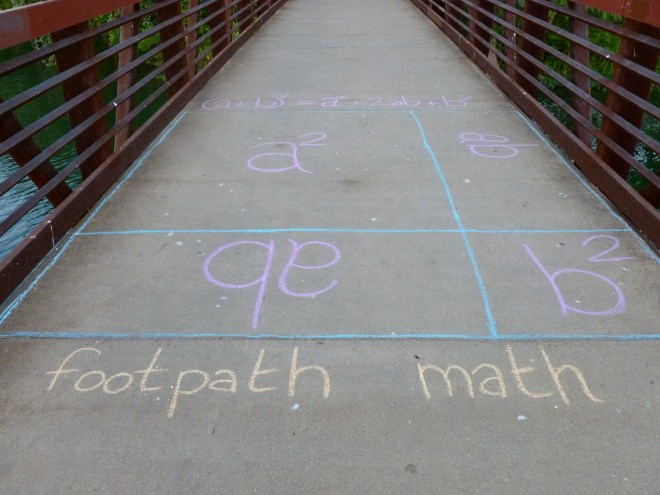
Hopefully, the idea is becoming clear. If not, well, let’s try one last time. Multiplying by itself results in the area of two squares, and , AND two rectangles, technically and . Of course, , so those two rectangles have a combined area of .3 In which case, when you multiply by itself, you get a sum of the squares and two rectangles.

- Subtraction can be considered addition of a negative. This makes sense if you think of negatives as though they represent being in debt. Having 3 dollars and spending 2 means you have 1 dollar. If you have three dollars and you owe someone 2, you really only have 1 dollar.
↩︎ - FOIL is easy and dangerous. It is a mnemonic device, and it ONLY works for multiplying two binomials. Plus, FOIL doesn’t shed any light on why we multiply the way we do. It simply gives instructions a machine could follow. Since you are neither, we shouldn’t end the story with FOIL. Algebraically, what is happening is an application of the distributive property. Each term of one of the binomials is being distributed to the terms of the other binomial. This post features a geometric interpretation of that distribution. ↩︎
- Multiplication of numbers is commutative. 3 times 5 is fifteen, and so is 5 times 3. If you think about multiplication of numbers as calculation of rectangular area, it makes sense. So, . Thus, . ↩︎
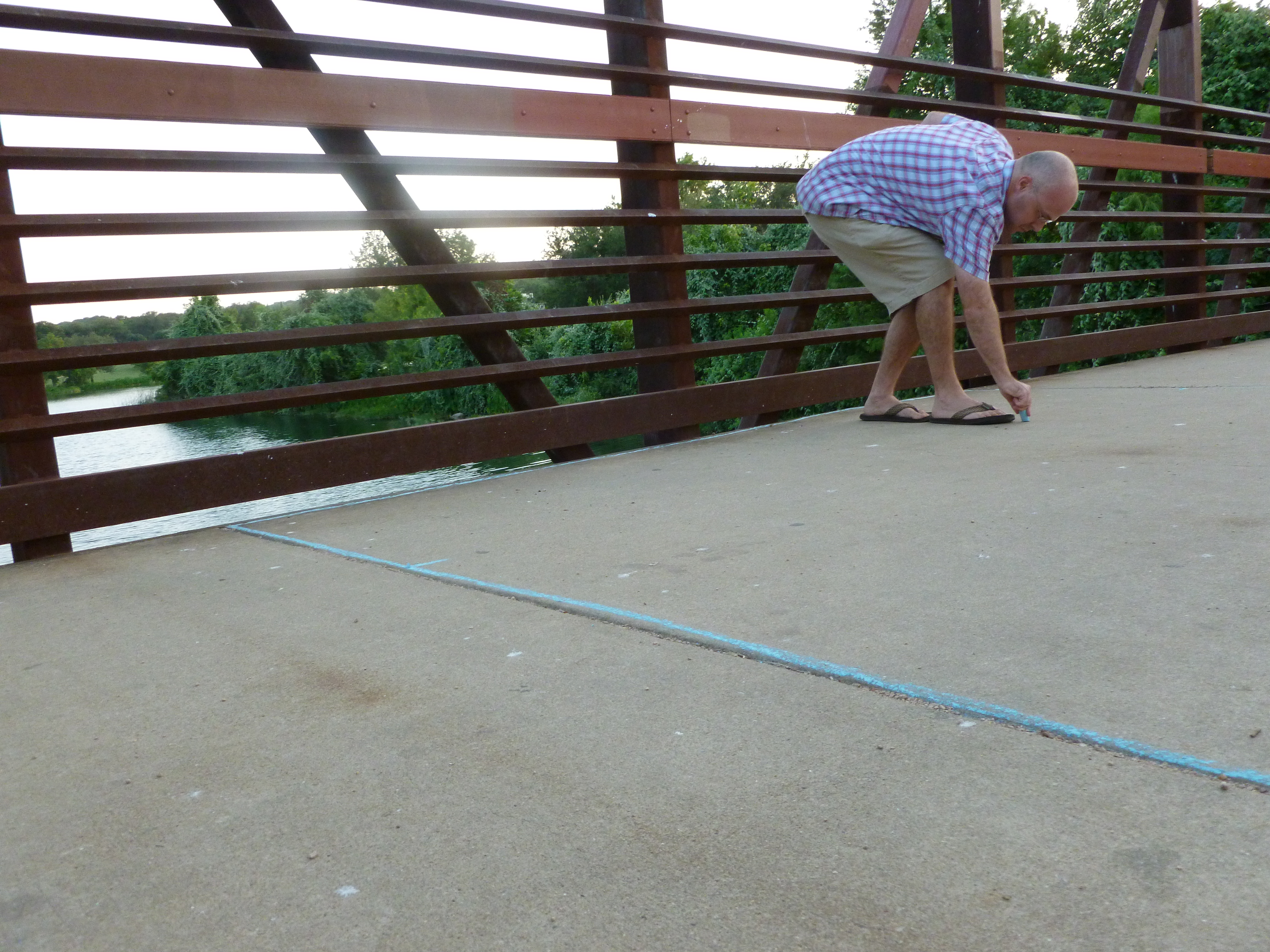

The photographer for this post was Laurie Zimmerman Mann. Check out her site: www.lzmstudio.com.
 Footpath Math: Chalk it up to a math geek
I LOVE seeing this concept presented geometrically. My brain nods yes, yes!
I wonder if the shadows of the upper bridge supports could add another dimension to the illustrations on the ground? What about constructing a combination solar calendar and geometric illustration? Sounds like a fun project week.
Whoa…..